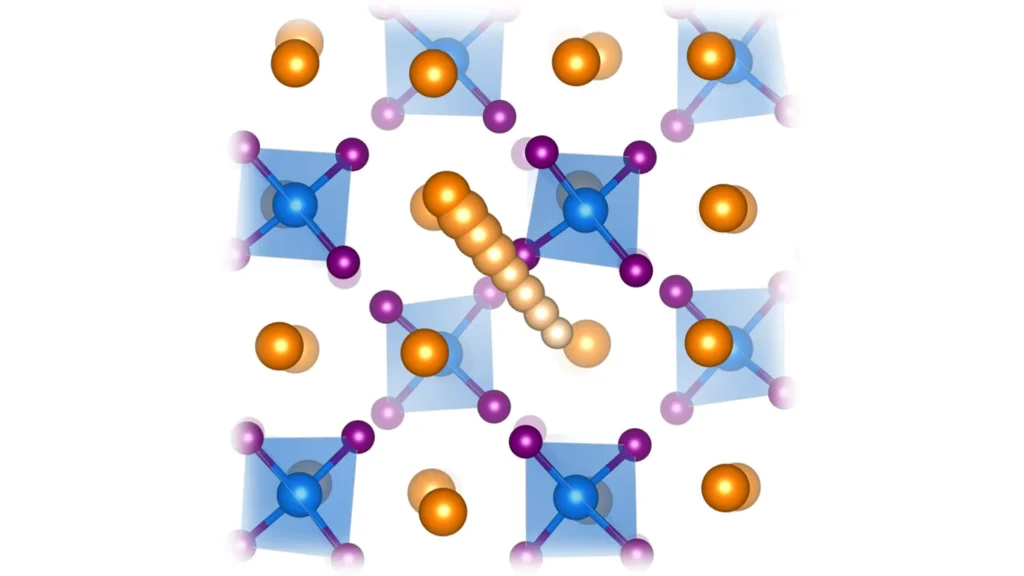
All-solid-state batteries (ASSBs) stand at the forefront of next-generation energy storage, widely heralded as a transformative alternative to conventional lithium-ion batteries due to their inherent safety advantages, stemming from the elimination of flammable liquid electrolytes, and their potential for significantly higher energy densities. This promise hinges critically on the ability of ions to move swiftly through solid electrolytes, a characteristic often referred to as high ionic conductivity. Historically, the identification of materials exhibiting this rapid ion movement has been a laborious process, demanding extensive and time-consuming experimental synthesis and subsequent rigorous characterization. Complementary to experimental efforts, computer simulations have played a vital role in materials discovery; however, existing computational methodologies frequently encounter significant hurdles in accurately modeling the intricate, often disordered, behavior of ions, particularly when operating at the elevated temperatures crucial for optimal battery performance.
A particularly vexing challenge within computational materials science has been the accurate detection and prediction of instances where ions traverse crystal lattices in a manner akin to liquid-state diffusion – a phenomenon known as "liquid-like" ion motion or superionicity. Traditional computational techniques designed to calculate the properties of such dynamically disordered systems are notoriously demanding in terms of computing power. This exorbitant computational cost renders large-scale screening studies, essential for accelerating materials discovery, largely impractical, effectively creating a bottleneck in the development pipeline for advanced solid-state electrolytes.
The Quest for Safer, Denser Batteries: Solid-State Promise and Perils
The global energy transition and the burgeoning demand for electric vehicles (EVs) and grid-scale energy storage solutions have placed immense pressure on battery technology. Lithium-ion batteries, while ubiquitous, present inherent limitations. Their reliance on flammable organic liquid electrolytes poses safety risks, including thermal runaway and fire, which have led to significant concerns in consumer electronics and automotive applications. Furthermore, the energy density of current lithium-ion chemistries is approaching theoretical limits, prompting an urgent search for alternatives capable of extended range and faster charging.
Solid-state batteries offer a compelling solution. By replacing the liquid electrolyte with a solid counterpart—be it ceramic, polymer, or glass—ASSBs promise enhanced safety, simplified packaging, and the potential to utilize lithium metal anodes. Lithium metal, with its exceptionally high theoretical specific capacity (3,860 mAh/g), could dramatically boost energy density, potentially doubling the range of EVs compared to current graphite anodes. However, translating this theoretical promise into practical reality has proven elusive. The primary obstacle lies in developing solid electrolytes that possess ionic conductivities comparable to their liquid counterparts (typically around 10⁻² S/cm at room temperature) while maintaining excellent electrochemical and mechanical stability. Many promising solid electrolytes suffer from high interfacial resistance with electrodes, mechanical brittleness, or insufficient ionic conductivity, especially at ambient temperatures. This is where the hunt for "superionic conductors" becomes paramount.
The Computational Bottleneck: Decoding Ion Dynamics at High Temperatures
For decades, materials scientists have employed a two-pronged approach to discover new solid electrolytes: experimental synthesis and characterization, and computational modeling. Experimental methods, while definitive, are inherently slow. Each new material synthesis can take weeks or months, followed by extensive characterization using techniques like X-ray diffraction (XRD) for structural analysis, scanning electron microscopy (SEM) for morphology, electrochemical impedance spectroscopy (EIS) for conductivity measurements, and nuclear magnetic resonance (NMR) for probing local environments and ion dynamics. This iterative "synthesize-test-analyze" cycle is resource-intensive and often yields incremental progress.
Computational methods, particularly ab initio (first-principles) calculations based on quantum mechanics, offer atomic-level insights and predictive power. Techniques like Density Functional Theory (DFT) can accurately predict material properties from fundamental physics. However, direct ab initio molecular dynamics (AIMD) simulations, which model atomic movements over time, are computationally prohibitive for large systems or extended simulation times. Even for modest systems, AIMD simulations are typically limited to picosecond (10⁻¹² seconds) timescales and hundreds of atoms, far too short to capture complex diffusive processes that occur over nanoseconds or microseconds.
Classical molecular dynamics (MD) simulations, which use empirical force fields to describe atomic interactions, can handle larger systems and longer timescales. However, their accuracy is entirely dependent on the quality of these force fields, which are often difficult to parameterize accurately, especially for complex ionic systems where ion-lattice interactions can change significantly with temperature and disorder. Crucially, existing computational approaches often struggle with "high-temperature" behavior where increased thermal energy leads to significant lattice vibrations and, critically, "disordered" or "liquid-like" ion movement. In this regime, ions are no longer confined to discrete hopping between well-defined sites but exhibit more fluid, collective motion, making them notoriously difficult to model accurately with traditional methods.
A Machine Learning Breakthrough: Predicting Superionic Signatures
To overcome these deeply entrenched challenges, a team of researchers has pioneered a sophisticated machine learning (ML) accelerated workflow. This innovative approach integrates two powerful ML components: ML force fields and tensorial ML models, specifically designed to simulate Raman spectra. Their groundbreaking findings establish that a strong intensity in the low-frequency region of the Raman spectrum serves as a distinct and reliable spectroscopic indicator of liquid-like ionic conduction.
This novel methodology represents a significant leap forward. ML force fields are trained on highly accurate, but computationally expensive, ab initio data. Once trained, these ML models can predict atomic forces with near ab initio accuracy at a fraction of the computational cost, enabling molecular dynamics simulations of larger systems over longer timescales than previously feasible with first-principles methods. This allows researchers to accurately capture the dynamic behavior of ions and the surrounding lattice.
The second critical component, tensorial ML models, are trained to predict the Raman tensor, which describes how the polarizability of a material changes with atomic displacements. The Raman tensor directly dictates the intensity of Raman scattering. By combining the atomistic trajectories generated by the ML force fields with the Raman tensor predictions from the tensorial ML models, the workflow can accurately simulate the full Raman spectrum of a material. This comprehensive approach allows scientists to explore the vibrational spectra of complex and disordered materials at realistic operating temperatures with an unprecedented balance of accuracy and computational efficiency.
Unpacking the Spectroscopic Signature: Symmetry Breaking and Raman Rules
The core insight behind this discovery lies in the fundamental principles of Raman spectroscopy and how they are affected by "liquid-like" ion motion. Raman scattering is an inelastic scattering process where light interacts with molecular vibrations, providing a unique "fingerprint" of a material’s atomic structure and bonding. Crucially, for a vibrational mode to be Raman active, it must induce a change in the material’s polarizability. This is governed by specific "Raman selection rules," which are largely determined by the symmetry of the crystal lattice. In highly ordered crystals, only certain vibrational modes are allowed to scatter Raman light.
When ions begin to move through a crystal lattice in a fluid-like, highly mobile fashion, their rapid and often collective motion fundamentally disrupts the local symmetry of the lattice. This dynamic disturbance does not simply cause small perturbations; it effectively "relaxes" or "breaks down" the conventional Raman selection rules. As a result, vibrational modes that would typically be Raman inactive in an ordered crystal become active, leading to new, often broad and intense, spectral features. Critically, this symmetry breaking often manifests as distinctive low-frequency Raman scattering. These spectral signals are directly and intimately connected to the high ionic mobility characteristic of superionic conductors. The low-frequency region of the Raman spectrum (typically below ~200 cm⁻¹) is particularly sensitive to these long-range, collective lattice dynamics and the diffusive motion of ions. The appearance of strong, broad bands in this region therefore acts as a clear spectroscopic beacon, signaling the presence of fast ionic conduction.
Validation and Verification: Unveiling Superionicity in Sodium Conductors
To rigorously test and validate their new approach, the researchers applied the ML-accelerated workflow to a class of sodium-ion conducting materials, specifically focusing on compounds like Na₃SbS₄. Sodium-ion batteries are gaining significant traction as a potential complementary technology to lithium-ion, particularly for large-scale grid storage applications, owing to the global abundance and lower cost of sodium compared to lithium. Na₃SbS₄ is a known fast sodium-ion conductor, making it an ideal candidate to demonstrate the method’s efficacy.
The results were striking: the ML-accelerated simulations of Na₃SbS₄ clearly revealed pronounced low-frequency Raman features. These signals were unequivocally attributed to the symmetry breaking induced by the rapid, liquid-like transport of sodium ions within the material. The direct correlation between these spectral indicators and high ionic mobility provides a robust and reliable means of identifying fast ionic conductors. Furthermore, these findings offer crucial insights that help to explain earlier experimental observations in similar materials, where low-frequency Raman features had been noted but their precise origin and direct link to superionicity were not fully elucidated. This validation opens the door to an unprecedented capability: high-throughput screening for new superionic materials, drastically accelerating the pace of discovery.
Differentiating Hopping from Fluid-Like Motion
The research further underscored the method’s discriminatory power by contrasting different ion transport mechanisms. The workflow successfully identified unique Raman signatures specifically linked to liquid-like ion motion in sodium-ion conducting systems. Materials that exhibited strong low-frequency Raman features not only showed high ionic diffusivity but also demonstrated a "dynamic relaxation" of the host lattice. This "dynamic relaxation" implies that the host crystal lattice itself adapts and responds to the rapid movement of ions, indicating a strong coupling between the mobile ions and the lattice framework, a hallmark of truly superionic behavior.
Conversely, materials where ion transport primarily occurs through a more conventional "hopping" mechanism—where ions jump between relatively fixed, discrete lattice positions—did not produce these characteristic low-frequency Raman signatures. This critical distinction highlights the profound capability of the Raman signals to reveal the underlying atomic-level transport mechanism within a material, providing invaluable information that goes beyond mere conductivity measurements. Understanding whether ions are hopping or moving in a liquid-like manner is crucial for designing and optimizing new solid electrolytes. For example, liquid-like motion often implies lower activation energies for conduction and more robust performance over a wider temperature range.
Accelerating the Future: High-Throughput Discovery of Advanced Materials
The implications of this study extend far beyond the immediate findings. By broadening the understanding of how Raman selection rules break down in systems beyond traditional superionic materials, the research provides a more expansive framework for interpreting "diffusive Raman scattering" across a diverse range of material classes. This means the methodology could potentially be applied to other ion-conducting systems, such as proton conductors for fuel cells, or even electron-conducting materials where dynamic disorder plays a role.
The ML-accelerated Raman pipeline bridges a critical gap between atomistic simulations and experimental measurements. By enabling scientists to accurately predict Raman spectra from simulations, it allows for the efficient in silico evaluation of countless candidate materials. Instead of laboriously synthesizing and testing each compound, researchers can computationally screen vast databases of materials, filtering for those that exhibit the tell-tale low-frequency Raman signatures of fast ion conduction. This significantly reduces the experimental burden and cost, allowing resources to be focused on the most promising candidates.
This strategy introduces a powerful new route for data-driven discovery in energy storage research, aligning with the broader trend of leveraging artificial intelligence and big data in materials science. By empowering researchers to quickly identify fast-ion conductors, the method promises to dramatically accelerate the development timeline for high-performance solid-state battery technologies. This could mean faster breakthroughs in solid electrolytes, enabling the commercialization of ASSBs sooner than anticipated, with profound impacts on the automotive industry, consumer electronics, and renewable energy infrastructure. The potential economic impact of reducing the time and cost of materials discovery by orders of magnitude is immense, fostering innovation and competitiveness in the global battery market, which is projected to reach hundreds of billions of dollars within the next decade.
Expert Perspectives and Future Outlook
Experts in the field are likely to view this development as a pivotal moment in solid-state battery research. The ability to predict a spectroscopic signature for superionicity with high accuracy and low computational cost addresses a long-standing challenge. While no direct statements were provided in the original content, it is reasonable to infer the excitement within the research community. "This kind of predictive tool is what the materials science community has been dreaming of," an inferred expert might comment. "It moves us beyond trial-and-error, allowing us to rapidly identify the needles in the haystack of potential battery materials."
The research, recently published in the online edition of AI for Science, an international journal dedicated to interdisciplinary artificial intelligence research, highlights the increasing convergence of AI and fundamental scientific discovery. The journal’s focus underscores the broader trend of AI revolutionizing various scientific disciplines. Future work will likely involve applying this workflow to a broader range of materials chemistries, including lithium-ion conductors, and exploring the method’s sensitivity to other factors influencing ionic conductivity, such as grain boundaries and interfaces. Furthermore, integrating this Raman prediction capability with other ML-accelerated property predictions could lead to even more comprehensive high-throughput screening platforms.
The Path Forward: Revolutionizing Energy Storage Research
The journey towards widespread adoption of solid-state batteries is complex, involving challenges in manufacturing, scalability, and cost reduction. However, the fundamental hurdle of identifying and optimizing solid electrolyte materials with superior ionic conductivity remains paramount. This ML-accelerated workflow directly tackles that challenge, providing a sophisticated yet efficient tool for materials scientists. By linking atomistic simulations with a readily measurable experimental signature, the method creates a robust feedback loop between theory and experiment, enabling faster iteration and optimization cycles.
In an era demanding sustainable and high-performance energy solutions, innovations that accelerate the discovery of advanced materials are invaluable. This research not only offers a powerful new route for data-driven discovery but also deepens our fundamental understanding of ion transport mechanisms in complex materials. It signifies a major step towards realizing the full potential of solid-state batteries, paving the way for a future powered by safer, more energy-dense, and ultimately, more sustainable energy storage technologies. The rapid identification of fast-ion conductors through this cutting-edge approach could be the catalyst needed to bring solid-state battery technology from the laboratory to mass production, revolutionizing the energy landscape as we know it.