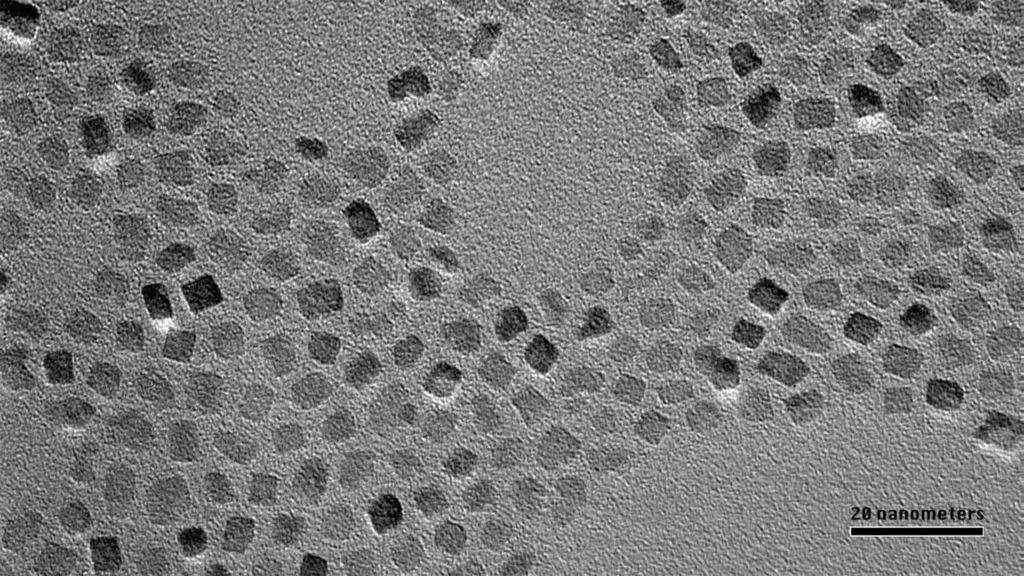
The landscape of modern materials science has been fundamentally altered by a significant discovery emerging from the collaborative efforts of researchers at the University of Chicago and Argonne National Laboratory. By developing a pioneering method to synthesize nanocrystals from metal nitrides—a class of materials previously deemed nearly impossible to manipulate at the nanoscale—the team has unlocked a new realm of possibilities for the future of electronics, medical technology, and industrial manufacturing. The study, recently published in the prestigious journal Nature, marks a pivotal moment in nanotechnology, overcoming a long-standing "bond-strength" barrier that has restricted the field for decades.
Nanocrystals, often referred to as "artificial atoms" due to their unique, size-dependent properties, have already begun to revolutionize technology. The 2023 Nobel Prize in Chemistry, awarded for the discovery and synthesis of quantum dots, highlighted the immense impact these microscopic structures have on everything from television displays to biological imaging. However, despite the success of semiconductor nanocrystals like cadmium selenide, many of the world’s most robust and technologically vital materials, particularly metal nitrides, remained out of reach for traditional colloidal synthesis. This recent breakthrough changes that reality, offering a blueprint for creating nearly a dozen new nanomaterials that were once thought to be chemically inaccessible in crystal form.
The Evolution of Nanotechnology: From Quantum Dots to Metal Nitrides
To understand the magnitude of this discovery, one must look at the trajectory of materials science over the last forty years. The field of nanotechnology was largely built on the ability to control the size and shape of crystals at the billionth-of-a-meter scale. When materials are reduced to this size, they exhibit quantum mechanical effects; for instance, changing the size of a nanocrystal can change the color of light it emits or its ability to conduct electricity.
Until now, the "library" of available nanocrystals was largely limited to metal chalcogenides (compounds involving sulfur, selenium, or tellurium) and certain oxides. Metal nitrides, however, represent a far more durable and versatile family of compounds. Known for their extreme hardness, high melting points, and exceptional chemical stability, nitrides are the backbone of the modern semiconductor industry. Gallium nitride (GaN), for example, is the primary material used in blue and white LEDs, power electronics for electric vehicles, and 5G telecommunications hardware.
The challenge for scientists has been that the same properties that make nitrides so useful—their incredible strength and stability—also make them incredibly difficult to grow into perfect, tiny crystals. In traditional nanocrystal synthesis, chemicals are mixed in a liquid solvent, where they react and assemble into crystals. For nitrides, the bonds between the metal and nitrogen atoms are so strong that once they form, they refuse to break or rearrange. This "kinetic trapping" often results in "amorphous" or defective clumps rather than the highly ordered, crystalline structures required for high-tech applications.
Breaking the Bond: A New Chemical "Sweet Spot"
The research team, led by Ruiming Lin, a graduate student at the University of Chicago, and Dmitri Talapin, the Ernest DeWitt Burton Distinguished Service Professor of Chemistry and Molecular Engineering, had to rethink the fundamental physics of crystal growth. Professor Talapin, who also holds a joint appointment at Argonne National Laboratory, described the traditional synthesis process as a "square dance" where partners (ions) must be able to change places and move freely before settling into a final formation. In the case of metal nitrides, the "dancers" were effectively frozen in place by the strength of their chemical bonds.
"If bonds cannot break during this process, that’s a death sentence for nanocrystals," Talapin explained. "Once you make an incorrect bond, everything goes south."
The solution involved two primary innovations. First, the team moved away from traditional organic solvents, which boil away at high temperatures. Instead, they utilized molten salts as the liquid medium. Molten salts can withstand the intense heat required to provide the energy needed for nitride formation while simultaneously stabilizing the growing nanocrystals. This approach built upon earlier foundational work in the Talapin lab regarding "molten salt synthesis."
The second, and perhaps most crucial, innovation was the discovery of a specific "sweet spot" involving high ammonia pressure and temperature. By introducing ammonia at high pressures, the researchers created a chemical environment where metal-nitrogen bonds could break and reform dynamically. This "reversibility" allowed the atoms to correct errors during the growth process, eventually settling into a perfect crystalline lattice. This counter-intuitive approach—using high pressure and heat to create delicate structures—flew in the face of established common sense in the field of colloidal chemistry.
A Catalog of New Materials: From Superconductors to Implants
The versatility of this new method was proven when the researchers successfully synthesized nearly a dozen different nitride materials. Each of these has profound implications for various industrial sectors:
- Gallium Nitride (GaN): Already the gold standard for LEDs and power transistors, GaN in nanocrystal form could lead to flexible, "printable" lighting and ultra-efficient displays that can be integrated into fabrics or curved surfaces.
- Titanium Nitride (TiN): Known for its extreme hardness and biocompatibility, TiN is frequently used as a coating for medical implants and drill bits. Nanocrystalline TiN could lead to new types of plasmonic devices or more durable bio-sensors.
- Niobium Nitride (NbN): A critical material for the development of superconductors. In the form of nanocrystals, NbN could be used to create inks for printing superconducting circuits, potentially lowering the cost of manufacturing quantum computers and high-sensitivity sensors.
- Molybdenum Nitride (MoN): Widely used as a catalyst in industrial chemical reactions. The high surface-area-to-volume ratio of molybdenum nitride nanocrystals could significantly improve the efficiency of hydrogen production and other green energy processes.
The ability to produce these materials at the nanoscale means they can now be processed using "solution-phase" techniques. Instead of requiring expensive, high-vacuum equipment to grow rigid films of these materials on silicon wafers, manufacturers could potentially use inkjet printing or spin-coating to apply these advanced materials to plastics, glass, or even paper.
Chronology of Discovery and Institutional Support
The path to this discovery was a multi-year journey that combined theoretical modeling with rigorous experimental testing.
- 2020-2021: The Talapin lab began investigating molten salts as a medium for nanocrystal growth, focusing on overcoming the limitations of organic solvents.
- 2022: Researchers identified that metal nitrides remained the "missing link" in their nanocrystal library and began experimenting with ammonia-rich environments.
- 2023: Ruiming Lin and the team identified the specific thermodynamic conditions—the "sweet spot"—that allowed for the reversible formation of metal-nitrogen bonds.
- Late 2023 – Early 2024: The team successfully expanded the synthesis to include a wide array of nitrides, including superconductors and catalysts, confirming the universality of the method.
- 2024: The findings were peer-reviewed and published in Nature, receiving immediate attention from both the academic and industrial communities.
The research was made possible through the extensive infrastructure provided by the University of Chicago and Argonne National Laboratory. The scientists utilized the National Science Foundation (NSF) Materials Research Science and Engineering Center (MRSEC) at UChicago, as well as the Soft Matter Characterization Facility. High-resolution imaging, critical for verifying the crystalline structure of the particles, was conducted at Argonne’s Center for Nanoscale Materials, a Department of Energy (DOE) Office of Science user facility.
Funding for the project was provided by a diverse group of stakeholders, including the U.S. Department of Energy, the Samsung QD Cluster Collaboration, the National Science Foundation, and the Air Force Office of Scientific Research. This mix of government and corporate interest underscores the perceived economic and strategic importance of the discovery.
Analysis of Global Implications and Future Trends
The implications of being able to mass-produce metal nitride nanocrystals are far-reaching. From a manufacturing perspective, this transition from "vacuum-based" to "solution-based" processing could drastically reduce the carbon footprint and energy costs of semiconductor fabrication. Currently, the production of high-quality GaN films requires Metal-Organic Chemical Vapor Deposition (MOCVD), a process that is both expensive and energy-intensive. Transitioning to nanocrystal-based "inks" could democratize access to high-performance electronic materials.
In the medical field, the use of titanium nitride nanocrystals offers a path toward more integrated prosthetics. By incorporating these biocompatible nanocrystals into 3D-printable polymers, engineers could create implants that not only match the mechanical properties of bone but also possess integrated electronic sensors to monitor healing or detect infection.
Furthermore, the discovery arrives at a time when the global race for quantum computing supremacy is accelerating. The successful synthesis of niobium nitride nanocrystals provides a new building block for superconducting qubits. If these nanocrystals can be organized into precise arrays, they may offer a more scalable architecture for the quantum processors of the future.
Industry analysts suggest that the market for nanocrystals—currently dominated by quantum dots for high-end televisions—could see a compound annual growth rate (CAGR) of over 15% as these new nitride materials enter the fray. The transition from "discovery" to "commercial product" will likely take several years, as researchers work to scale up production and refine the purity of the nanocrystals.
Conclusion
The work of Ruiming Lin, Dmitri Talapin, and their colleagues has effectively broken a "glass ceiling" in materials chemistry. By proving that even the most stubborn chemical bonds can be tamed through precise control of the reaction environment, they have provided the scientific community with a powerful new toolkit. As these nearly a dozen new materials move from the laboratory to the factory floor, the next generation of electronics, medical devices, and energy technologies will likely be built on the foundation of metal nitride nanocrystals. For the researchers involved, the sight of these crystals under an electron microscope was not just a scientific victory, but a glimpse into a more flexible and efficient technological future.