In a landmark shift for nuclear physics, new experimental findings from the Solenoidal Tracker at RHIC (STAR) detector have provided compelling evidence that challenges a half-century of assumptions regarding the fundamental structure of matter. For decades, the scientific consensus held that the "baryon number"—a strictly conserved quantum property that defines protons and neutrons—was carried by the three valence quarks that reside within these particles. However, data emerging from the Relativistic Heavy Ion Collider (RHIC) at Brookhaven National Laboratory suggests that this property may instead be anchored to a "gluon junction," a Y-shaped configuration of the force-carrying particles that bind quarks together.
The study, recently published in the journal Science, represents the culmination of years of data collection and theoretical refinement. By smashing gold ions and other nuclei together at nearly the speed of light, researchers have been able to probe the subatomic landscape with unprecedented precision. If these results are confirmed through further experimentation, they will necessitate a rewrite of standard physics textbooks, shifting the focus from quarks to the complex web of gluons that facilitate the strong nuclear force.
The Evolution of Baryon Theory: From Quarks to Junctions
To understand the weight of this discovery, one must look back to the 1960s and 70s, when the quark model was first established. In the "naive" quark model, a proton is composed of two "up" quarks and one "down" quark, while a neutron consists of two "down" quarks and one "up" quark. Because a proton or neutron is a "baryon," and each is assigned a baryon number of plus one, it was logically assumed that each of the three valence quarks carried exactly one-third of that number.
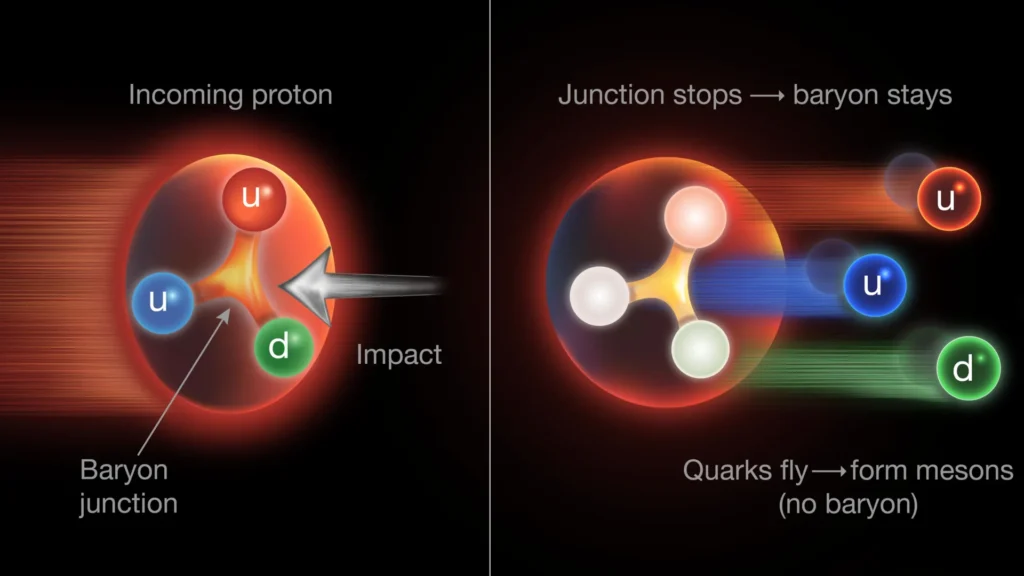
However, even in the 1970s, theoretical physicists realized that the reality of the strong force—governed by Quantum Chromodynamics (QCD)—was likely more complex. Gluons, the massless particles that mediate the strong force, do not just sit between quarks; they interact with one another. This led to the hypothesis of the "gluon junction," a topological arrangement where three gluon fields meet at a central point, forming a Y-shape that connects the three valence quarks.
In 1996, Dmitri Kharzeev, a theoretical physicist now at Stony Brook University and Brookhaven Lab, took this idea a step further. He proposed that it was this central junction, rather than the quarks themselves, that might be the true carrier of the baryon number. For nearly thirty years, this remained a provocative but unproven theory, as the extreme conditions required to isolate the behavior of the junction were difficult to achieve and even harder to measure.
Experimental Methodology: The STAR Detector at RHIC
The Relativistic Heavy Ion Collider, a Department of Energy Office of Science user facility, provided the perfect laboratory for testing Kharzeev’s hypothesis. By accelerating heavy ions to ultra-relativistic speeds and colliding them, RHIC creates a "quark-gluon plasma"—a state of matter that mimics the conditions of the universe microseconds after the Big Bang.
The STAR detector, a massive instrument designed to track thousands of particles flying out from these collisions, allowed physicists to observe the "transport" of baryon number. In high-energy collisions, most of the energy is converted into new particles. If the baryon number were tied strictly to the valence quarks, then the "stopping" of baryon number—seeing an excess of baryons in the center of the detector rather than flying down the beampipe—would require the quarks themselves to lose significant momentum.
"Traditionally, scientists have assumed that each of the three main ‘valence’ quarks inside a proton or neutron carries one-third of the baryon number," explained Zhangbu Xu, a professor at Kent State University with a joint appointment at Brookhaven Lab. "Our results suggest that the baryon number is not simply carried by individual quarks, but is more favorably carried and transported by gluons arranged in this special junction configuration."
The Electric Charge Mismatch: A Smoking Gun
The most definitive evidence for the gluon junction came from a clever comparative analysis involving electric charge. Unlike baryon number, electric charge is undeniably carried by quarks. Up quarks have a charge of +2/3, and down quarks have a charge of -1/3. By measuring how much electric charge was "stopped" or redirected in a collision, researchers could effectively track the movement of the valence quarks.
The STAR collaboration compared the net baryon number (the difference between baryons and antibaryons) with the net electric charge in the same collisions. If quarks carried the baryon number, the two measurements should have scaled together. Instead, the researchers found a striking discrepancy.
"Measuring the electric charge coming out perpendicular to the collision gives you a definitive way of measuring how many quarks are stopped," said Zebo Tang, a professor at the University of Science and Technology of China. The team observed that the amount of baryon number stopped at "midrapidity"—the area perpendicular to the beam—was roughly twice as high as what would be expected if it were tied to the quarks’ electric charge.
This 2:1 ratio suggests that the baryon number is able to be "stripped" from the quarks. As the protons collide, the valence quarks, which carry most of the momentum, continue moving forward at high speeds. However, the gluon junction—which becomes increasingly "dense" and slower-moving as the proton is accelerated—gets caught in the collision zone. This junction then fragments and "seeds" the creation of new baryons that emerge at midrapidity.
Broader Scientific Implications and Universe Stability
The implications of this discovery extend far beyond the subatomic scale, touching upon the very existence of the universe. One of the greatest mysteries in modern cosmology is the matter-antimatter asymmetry. The Big Bang should have produced equal amounts of matter and antimatter, which would have annihilated each other, leaving a universe of pure energy. Yet, we live in a matter-dominated universe.
Baryon number conservation is a key piece of this puzzle. "Since the Big Bang, the number of protons and neutrons all together never changes as a function of time," noted Nicole Lewis, a STAR physicist at Rice University. "The reasons for this conservation are not well understood. It’s one of the mysteries of the universe, related to why we have more matter than antimatter."
Furthermore, the stability of the proton—and thus the stability of all atoms—is predicated on the conservation of baryon number. If a proton could easily decay into lighter particles (like mesons or leptons), atoms would disintegrate, and life as we know it would be impossible. Current estimates suggest the proton’s lifetime is longer than the current age of the universe. Understanding that the baryon number is held by a topological gluon junction provides a new framework for understanding why this conservation is so robust.
Technical Analysis of Particle Production
The complexity of the proton is often understated in introductory physics. Tommy Tsang, a researcher at Argonne National Laboratory, emphasized that the "naive" model of three quarks is a simplification. "If we look at details inside, there are not only three quarks but also a lot of gluons interacting… and there are also quarks and antiquarks that pop up from the vacuum," Tsang said.
In the high-energy environment of RHIC, the "gluon multiplication" effect becomes dominant. As a proton reaches higher energies, the number of gluons inside it increases exponentially, a state sometimes referred to as the Color Glass Condensate. In this state, the momentum of the proton is shared among a vast sea of gluons. The STAR findings suggest that in this chaotic environment, the Y-shaped junction acts as a singular, cohesive unit.
When the junction is "held behind" in a collision while the quarks fly on, it must satisfy the laws of QCD, which forbid quarks and gluons from existing in isolation (confinement). To resolve this, the junction pulls three new quarks from the vacuum to form a new baryon. This process explains why the STAR detector consistently sees an excess of baryons over antibaryons at angles perpendicular to the beamline.
Future Research and the Electron-Ion Collider
While the results from RHIC are statistically significant and supported by multiple collision types (including gold-gold and isobar collisions), the physics community views this as the beginning of a new chapter rather than the final word. The upcoming Electron-Ion Collider (EIC), currently under construction at Brookhaven Lab, will be the ultimate tool for verifying these findings.
The EIC will use high-energy electrons to "scan" the internal structure of protons and nuclei, much like a subatomic MRI. By precision-mapping the distribution of gluons, the EIC will be able to directly observe the topological structure of the gluon junction and confirm its role as the primary carrier of the baryon number.
Rongrong Ma, a physicist at Brookhaven Lab, summarized the impact of the current findings: "Our research challenges the long-held idea that baryon number is simply divided among and carried by the three quarks. This new understanding reshapes how we think about the structure of matter and deepens our knowledge of the most fundamental element that is responsible for the universe in its current form."
As nuclear physicists continue to analyze the data from the final runs of RHIC, which operated until early 2026, the scientific community anticipates further refinements to our understanding of the strong force. The transition from a quark-centric model to a gluon-junction model represents a significant evolution in our quest to understand the building blocks of reality.