Cambridge, MA – Engineers at the Massachusetts Institute of Technology (MIT) have unveiled a groundbreaking flexible, shape-sensing sheet capable of digitally reconstructing its own form as it undergoes bending and twisting motions. This innovative development, detailed in a study published in the journal Advanced Intelligent Systems, marks a significant leap forward in the field of wearable technology and human-machine interfaces, offering unprecedented flexibility, resilience, and accuracy compared to existing solutions.
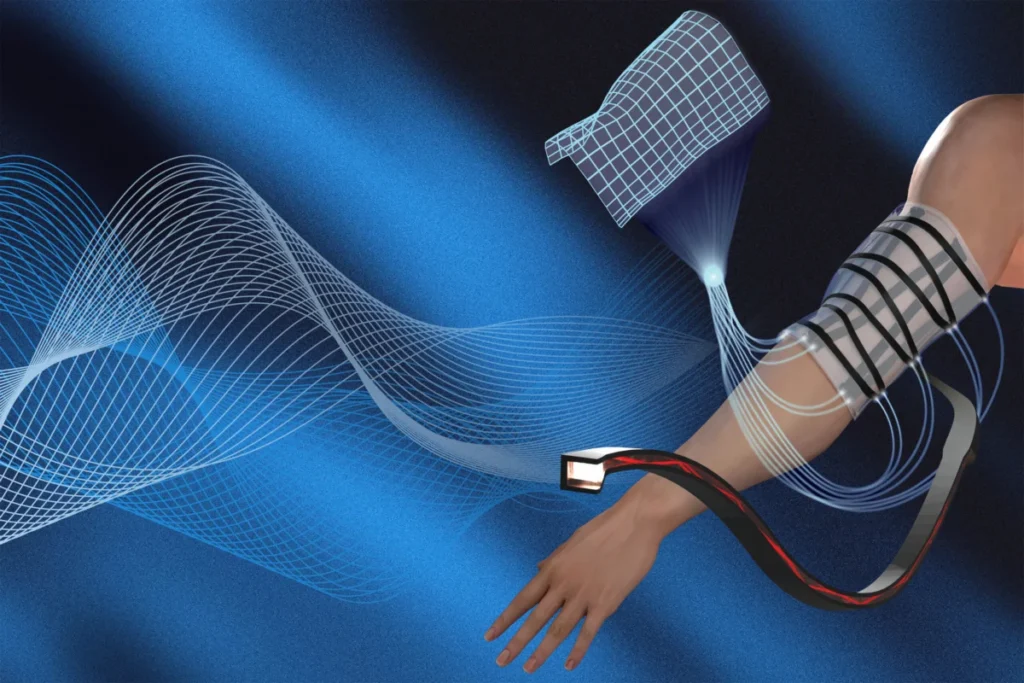
The core of this new technology lies in its departure from the rigid sensor arrays typically found in motion-capture garments. Unlike conventional systems that rely on strategically placed, inflexible sensors stitched into a suit to track physical movements, the MIT team’s design integrates multiple soft optical fibers that zig-zag throughout a pliant, stretchable sheet. When this sheet flexes or contorts, the embedded fibers mirror these movements, altering the patterns of light transmitted through them. An advanced algorithm, developed by the researchers, then interprets these dynamic light patterns in real-time, generating a precise digital representation that mimics the sheet’s physical deformation.
A key advantage highlighted by the research team is the system’s inherent resistance to damage. Even if a number of fibers are severed or disconnected, the remaining intact fibers can still accurately reconstruct the overall shape of the sheet. This robustness significantly enhances the practical utility and longevity of the technology in demanding environments.
"Our setup is targeting fully soft and stretchable sensing surfaces so it’s potentially safer for interacting with a human or a soft environment," states Qifan Yu, a mechanical engineering graduate student at MIT and a lead researcher on the project. This emphasis on softness and safety positions the technology for a wide array of applications where human comfort and interaction are paramount.
The Evolution of Shape Sensing: From Rigid to Resilient
The journey towards sophisticated shape sensing has seen various technological iterations, primarily driven by the demands of industries such as entertainment, sports science, and robotics. Early motion-capture systems, emerging in the 1980s, often employed optical markers tracked by external cameras, requiring specialized environments and often line-of-sight. Subsequent advancements introduced inertial measurement units (IMUs) – small, rigid sensors containing accelerometers, gyroscopes, and magnetometers – that could be attached directly to a subject’s body. These IMU-based systems offered greater freedom of movement and portability, but still presented limitations.
Traditional motion-capture suits, which track a person’s physical movements to mimic them in a virtual avatar or analyze biomechanics, typically utilize these rigid IMU sensors. While effective for capturing gross movements, their inherent rigidity can restrict natural motion, create discomfort for the wearer, and present challenges when integrating with truly soft, deformable surfaces. Furthermore, the discrete placement of these sensors means that shape information between sensor points must often be interpolated, potentially leading to less accurate reconstructions of complex, continuous deformations.
The MIT team’s innovation directly addresses these limitations by offering a continuous sensing surface that is inherently soft and stretchable. This shift from discrete, rigid points to a distributed, flexible network of sensors represents a fundamental paradigm change in how shape and movement can be captured. The inspiration for this technology stems from the basic principles of optical fibers, which have long been used to guide light efficiently. However, the MIT team’s approach cleverly modifies these principles to transform light transmission into a highly sensitive indicator of complex, multi-directional bending.
The Intricate Dance of Light: How the Technology Works
At its heart, the MIT shape-sensing sheet leverages a sophisticated understanding of how light behaves within specially designed optical fibers. A standard optical fiber, or waveguide, consists of a transparent core (often glass) surrounded by an opaque cladding. This cladding traps light within the core, allowing it to travel long distances with minimal loss, a principle that underpins high-speed fiber optic telecommunications.
Scientists have previously experimented with optical fibers as rudimentary shape sensors. When a fiber bends, it can cause a small amount of light to escape the core, reducing the intensity of light exiting the other end. The degree of light reduction can then be correlated with the degree of bending, enabling the sensing of simple curvatures, often applied to monitor the shape of linear structures like robotic arms.
The MIT team, however, sought to extend this capability to reconstruct the 3D shape of an entire surface. Their innovative "fiber tweaks" involved fabricating their own optical fibers from a clear, flexible rubber core encased in a black-dyed rubber cladding. Crucially, they intentionally roughened one side of the fiber’s core. This asymmetrical roughness introduces a directional sensitivity: when the fiber bends towards its rough side, light scatters differently than when it bends towards its smooth side, even at the same bending angle. This novel design transforms each fiber into a bidirectional shape sensor, capable of distinguishing between different directions of curvature.
To optimize the arrangement of these bidirectional fibers within a soft silicone sheet, the researchers conducted extensive simulations. They tested various embedding patterns, from checkerboards to criss-crossed and zig-zag configurations, subjecting the simulated sheets to different bending and twisting scenarios. By analyzing the light output from each fiber configuration and comparing the reconstructed 3D shapes to the original simulated deformations, they identified an optimal zig-zag pattern that most accurately recreated the sheet’s complex movements.
Following these simulations, the team fabricated a physical prototype, embedding the optimized zig-zag pattern of optical fibers into a silicone sheet. Each fiber was equipped with an LED at one end to inject light and a light sensor at the other to measure its output, all connected to an external circuit board for data collection and amplification. Complementing the hardware, a custom-developed algorithm was designed to automatically convert the real-time light measurements from the fibers into a seamless, virtual 3D reconstruction of the sheet’s dynamic shape.
Experimental validation demonstrated the system’s remarkable performance. As researchers twisted and folded the physical sheet into various complex forms—such as folding it diagonally and then in the opposite direction—its virtual twin mirrored these changes almost instantaneously. The team further quantified the accuracy by placing the sheet over precisely 3D-printed molds, allowing for a direct comparison between the digitally reconstructed surface and the known physical shape. Their findings showed an impressive error margin of less than 0.4 centimeters, significantly outperforming existing rigid-sensor designs, which typically exhibit errors ranging from 1 to 2 centimeters. "We use a metric that describes the distance between the actual surface and the reconstructed surface, and from that, we found our error was less than 0.4 centimeters," Yu confirms. "Existing designs, which are based on rigid sensors, have errors of around 1 to 2 centimeters. So that’s respectable, and at least on par with existing technologies."
Transformative Applications: Reshaping Industries
The implications of this flexible, accurate, and damage-resistant shape-sensing sheet are far-reaching, promising to revolutionize several key sectors.
Healthcare and Rehabilitation: One of the most immediate and impactful applications lies in physical therapy and medical rehabilitation. The sheet can be comfortably wrapped around a patient’s limb, such as an arm or leg, to meticulously track and record their mobility and range of motion during therapeutic exercises. This provides objective, quantifiable data that can significantly enhance patient care.
"In physical therapy, you often need to gather patient data on how they are moving and stretching their arm during rehabilitation, for example," Yu explains. "Surface shape sensing could be very useful in that way." Assistant Professor Kaitlyn Becker further elaborates on the clinical potential: "We hope to build tools that augment what a physical therapist can do and help them track and quantify their patients’ progress over time. These sensing sheets could help a physical therapist to recall and compare more precisely how an evaluation went today versus two months and hundreds of appointments ago.”
The global market for rehabilitation equipment and assistive technologies is projected to reach tens of billions of dollars in the coming years, driven by aging populations and increasing demand for personalized care. This MIT innovation could provide therapists with unprecedented precision in monitoring patient recovery, customizing treatment plans, and demonstrating progress to patients and insurance providers. It could also facilitate remote monitoring, enabling patients to perform exercises at home while their progress is accurately tracked and transmitted to clinicians.
Robotics and Teleoperation: The ability to sense the shape of a soft surface opens new avenues for robotics, particularly in the realm of soft robotics and human-robot collaboration. A flexible sheet could be integrated into robotic grippers to enhance tactile sensing, allowing robots to manipulate delicate or irregularly shaped objects with greater dexterity. In teleoperation, where human operators control robots remotely, the shape-sensing sheet could form part of an intuitive interface. A user could wear a garment fashioned from this material, and their body movements would be precisely translated to control a tele-operated robot, potentially in hazardous environments like bomb disposal, deep-sea exploration, or surgical procedures. The market for collaborative robots (cobots) alone is expanding rapidly, with projections indicating a multi-billion dollar valuation, as industries seek safer and more intuitive human-robot interaction.
Gaming and Virtual Reality: The entertainment industry, particularly virtual reality (VR) and augmented reality (AR) gaming, stands to benefit immensely. Current VR systems often rely on handheld controllers or external trackers for interaction. A full-body garment made from this shape-sensing material could allow players to physically control in-game avatars with unprecedented fidelity and immersion. Imagine performing a complex martial arts move and seeing your virtual character perfectly mimic every nuance of your body’s contortion. This could usher in a new era of highly immersive, physically engaging gaming experiences, potentially expanding the VR/AR gaming market, which is already valued in the billions, by offering more naturalistic interaction.
Other Potential Applications: Beyond these primary areas, the technology holds promise for smart textiles, industrial inspection (allowing sensors to conform to complex machinery surfaces), and advanced human-computer interaction where gestures and body language could be interpreted with greater accuracy.
The Road Ahead: Optimization and Commercialization
The researchers are not resting on their laurels; plans for further optimization are already underway. The immediate goal is to significantly reduce the thickness of the optical fibers. Currently, the fibers are 1 millimeter thick. With advanced fabrication processes, this could be shaved down to mere tens of micrometers, thinner than a human hair. This reduction in thickness would allow for the embedding of many more fibers into a garment, enabling the detection of even finer, more detailed changes in shape and form, crucial for highly precise applications like advanced physical therapy or nuanced robotic control.
Scaling up manufacturing, integrating power sources, and developing robust wireless communication protocols will be critical steps in moving this technology from the lab to widespread commercial application. The research, supported in part by MathWorks, highlights the collaborative effort between academic innovation and industry support.
As the team, including graduate student Nina Cao and Assistant Professor Kaitlyn Becker, continues its work, the flexible shape-sensing sheet stands poised to redefine how humans interact with digital environments and robotic systems, offering a glimpse into a future where technology seamlessly integrates with the natural fluidity of the human body. This breakthrough from MIT is not just an incremental improvement; it represents a foundational advancement that could unlock entirely new possibilities for wearable electronics, healthcare diagnostics, and immersive digital experiences.