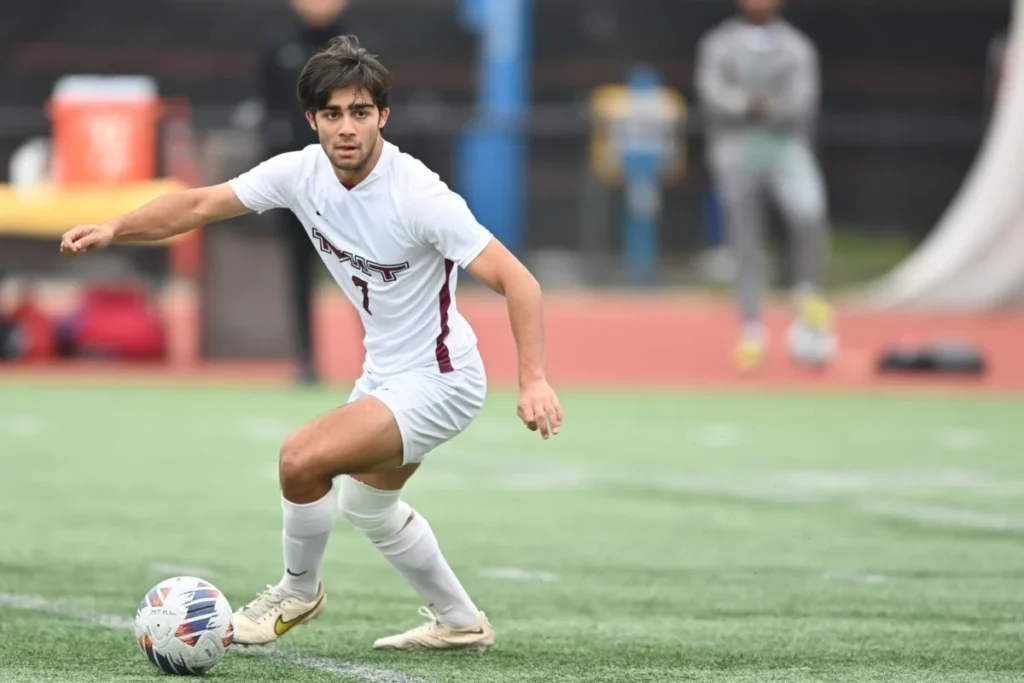
The intersection of high-level competitive athletics and rigorous academic inquiry defines the modern student-athlete experience at the Massachusetts Institute of Technology (MIT), a reality exemplified by the journey of Dilin Meloni. A rising senior double-majoring in Nuclear Science and Engineering (Course 22) and Physics (Course 8), Meloni has managed to balance the demands of being an attacking midfielder for the MIT Engineers soccer team with the complexities of fusion energy research. His trajectory from a standout high school athlete in Needham, Massachusetts, to a leader in student governance and a researcher at Commonwealth Fusion Systems (CFS) provides a window into the unique culture of MIT, where the pursuit of excellence in the laboratory is often mirrored by a relentless drive on the playing field.
A Foundation of Excellence: From Needham to Cambridge
Meloni’s journey to MIT was paved with accolades that would have allowed him to pursue soccer at numerous elite programs across the country. As a student at Needham High School, he was recognized as the Massachusetts Boys Soccer Player of the Year and earned the prestigious title of All-American. However, for Meloni, the choice of college was driven by a specific intellectual spark that ignited during his junior year of high school. After reading a research paper from the MIT Plasma Science and Fusion Center (PSFC), he realized that his future lay in the pursuit of sustainable energy solutions through nuclear physics.
This clarity of purpose brought him to Cambridge, where he sought to embody the "Engineer" moniker in two distinct ways: as a tactical playmaker on the soccer pitch and as a literal engineer in the classroom. Upon arriving at MIT, Meloni found that the transition was facilitated by the very athletic community he had joined. The fall preseason, which begins two weeks before the general student body arrives, serves as an intensive orientation. For Meloni and his peers, these early weeks are foundational, creating a social support network of individuals who share a common background of high-level athletic dedication and academic ambition.
The Integrated Ecosystem of the MIT Student-Athlete
The social fabric of MIT is often perceived by outsiders as purely academic, yet Meloni highlights a vibrant community driven by its 33 varsity sports. Within this ecosystem, the traditional boundaries between social, athletic, and residential life often blur. Meloni’s own fraternity is a testament to this integration, consisting primarily of members from the soccer team, as well as athletes from football, swimming, and track.
Despite this close-knit athletic circle, Meloni emphasizes that the MIT experience is far from "siloed." While his athletic life provides a core social group, his academic life in Course 22 and Course 8 exposes him to a diverse array of perspectives. Nuclear science and physics are historically underrepresented in the varsity athlete population—a trend Meloni is actively working to reverse by mentoring incoming players. He notes that the "MIT ecosystem" allows him to move between a high-stakes lab environment, where he collaborates with non-athletes from various global backgrounds, and the soccer field, where he finds common ground with his teammates. This duality, he argues, is a privilege that prevents the narrow specialization often found in elite academic or athletic circles.
Leadership and Advocacy through the Student-Athlete Advisory Committee
As Meloni progressed through his undergraduate years, his focus expanded from personal excellence to systemic advocacy. This shift led him to a leadership role in the Student-Athlete Advisory Committee (SAAC). Representing the needs of 33 varsity teams—one of the largest athletic programs in NCAA Division III—requires a sophisticated approach to communication and negotiation.
Under Meloni’s leadership, SAAC has undertaken a proactive strategy to identify and address "pain points" within the student-athlete experience. This process began with an extensive outreach campaign to coaches and players across all disciplines. By facilitating small-group discussions, Meloni and the SAAC co-presidents were able to distill a wide range of concerns into a focused agenda for change. The issues identified ranged from broad institutional concerns, such as the quality of dining services and the allocation of time in the new Sports Performance Facility, to sport-specific logistical challenges.
One of the primary difficulties in this role is managing the competing interests of different teams. With seven teams vying for time on major turf fields and various aquatic sports sharing pool space, the allocation of facilities is a zero-sum game. Meloni describes the challenge of communicating realistic expectations to his peers. While student-athletes naturally desire priority access and continuous training windows, the administrative reality involves significant costs and complex logistical constraints. Meloni’s role often involves acting as a mediator, explaining the internal mechanics of the university to students while ensuring that the administration remains responsive to the unique pressures of the student-athlete lifestyle.
Bridging the Gap: CFS Internship and the Future of Fusion
Meloni’s summer internship at Commonwealth Fusion Systems (CFS) serves as a bridge between his academic training and the professional world of high-tech engineering. CFS, a spin-off from the MIT Plasma Science and Fusion Center, is at the forefront of the global race to develop commercial fusion energy. For a student double-majoring in nuclear science and physics, the opportunity to work at CFS is the culmination of the interest that first led him to MIT.
Fusion energy, often described as the "holy grail" of clean power, involves replicating the processes that power the sun. The work is inherently multidisciplinary, requiring expertise in plasma physics, superconducting magnets, and advanced materials—fields that Meloni navigates daily. His ability to apply the discipline and teamwork learned on the soccer field to the collaborative environment of a fusion startup illustrates the "engineer" mindset he sought to cultivate.
Data and Context: The Scale of MIT Athletics
To understand the impact of Meloni’s work with SAAC, it is necessary to look at the scale of athletics at MIT. The institute sponsors 33 varsity programs, making it one of the most diverse athletic departments in the country. Approximately 20% to 25% of the undergraduate population participates in varsity sports, a figure that contradicts the stereotype of the purely bookish MIT student.
The Department of Athletics, Physical Education, and Recreation (DAPER) manages a vast infrastructure of fields, rinks, pools, and courts. The introduction of the new Sports Performance Facility was a major milestone for the department, but as Meloni points out, the "allocation and access" to such facilities remain a point of contention. The role of SAAC is vital in ensuring that the $70 million+ investments in athletic infrastructure are utilized in a way that maximizes student well-being and performance.
Furthermore, MIT competes in the New England Women’s and Men’s Athletic Conference (NEWMAC), where it consistently ranks as a top performer. The "Engineer" teams are not merely participants; they are frequent contenders for conference championships and NCAA tournament berths. This level of competition, maintained alongside MIT’s rigorous academic standards, creates a high-pressure environment where student governance organizations like SAAC are essential for preventing burnout and ensuring student voices are heard.
Implications and Broader Impact
The story of Dilin Meloni is indicative of a broader trend in higher education where the "myth of the dumb jock" is being systematically dismantled by elite institutions. At MIT, the student-athlete is not an anomaly but a core component of the institutional identity. Meloni’s assertion that the 2023-2024 academic year was a "tipping point" for SAAC suggests a shift in how the university views student-athlete advocacy.
The willingness of DAPER and the Office of Student Life to overhaul their communication channels and seek input from student leaders like Meloni reflects a growing recognition of the value of the student-athlete perspective. When students feel heard and supported, their overall engagement with the institution increases, leading to better outcomes both in the classroom and on the field.
As Meloni enters his senior year, his focus remains on the "small changes that lead to big changes." Whether it is negotiating better field access for the soccer team or contributing to the next breakthrough in fusion energy, his approach is defined by a commitment to the process. For Meloni, the transition from the soccer pitch to the nuclear lab is not a leap between two different worlds, but a continuous application of the same principles: dedication, strategic thinking, and a willingness to lead.
The legacy of student-athletes like Meloni at MIT will likely be measured not just in wins and losses, or in published papers, but in the strengthened communication channels and improved facilities that will benefit future generations of "Engineers." His journey underscores the fact that at the highest levels of achievement, the skills required to excel in sports and science are remarkably similar. As the search for sustainable energy continues and the competitive landscape of collegiate athletics evolves, the dual-role model exemplified by Meloni remains a vital part of the MIT narrative.