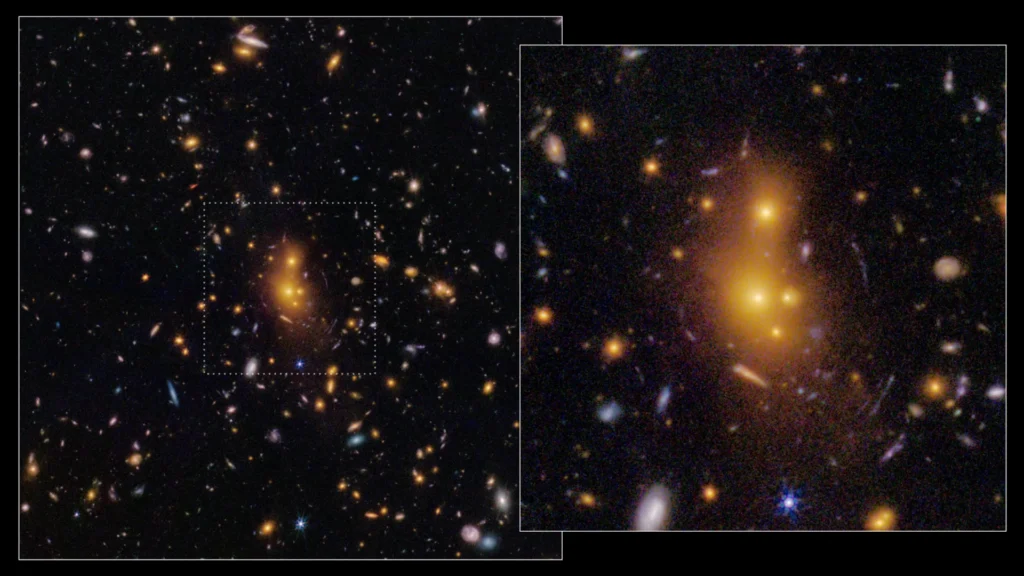
The discovery of a massive, highly structured galaxy cluster dating back to the early universe is forcing astronomers to reconsider the timelines and mechanisms behind the formation of the largest structures in the cosmos. Observations from NASA’s James Webb Space Telescope (JWST) have provided an unprecedented look at XLSSC 122, a galaxy cluster located approximately 10.4 billion light-years from Earth. The data suggests that this ancient assembly of galaxies reached a state of maturity and density far earlier than current cosmological simulations predict, raising fundamental questions about the distribution of dark matter and the rate of structural growth following the Big Bang.
The findings, which were detailed in three comprehensive studies led by researchers at IPAC, Caltech’s science and data center for astrophysics and planetary science, were presented on June 17, 2026, during the 248th meeting of the American Astronomical Society. The research establishes XLSSC 122 as the most distant galaxy cluster ever observed to exhibit strong gravitational lensing, a rare phenomenon that serves as a natural "magnifying glass" for the distant universe.
A Discovery Decades in the Making
The identification of XLSSC 122 did not happen overnight. Its discovery is the result of a multi-generational effort using the world’s most advanced space-based observatories. The cluster was first detected in 2014 during an X-ray survey conducted by the European Space Agency’s (ESA) XMM-Newton spacecraft. X-ray telescopes are particularly effective at finding galaxy clusters because the space between galaxies in these clusters is filled with extremely hot gas—millions of degrees in temperature—that glows brightly in X-ray wavelengths.
Following its initial detection, the Hubble Space Telescope was used to provide optical and infrared follow-up. Hubble’s observations were critical in determining the cluster’s distance, confirming that it existed during "cosmic noon," a period roughly 10 billion years ago when the universe was at its peak of star formation. However, while Hubble confirmed the cluster was unusually developed for its age, it lacked the sensitivity and wavelength coverage to detect the subtle signatures of strong gravitational lensing.
The deployment of the James Webb Space Telescope changed the landscape of this research. With its massive primary mirror and advanced infrared sensors, Webb was able to see through cosmic dust and capture the faint, distorted light of galaxies located billions of light-years behind XLSSC 122. When the first images arrived, the research team, led by IPAC staff scientist Kyle Finner, immediately noticed distinctive curved arcs of light—the hallmark of strong gravitational lensing.
The Mechanics of Gravitational Lensing
Gravitational lensing is a phenomenon predicted by Albert Einstein’s General Theory of Relativity. It occurs when a massive object, such as a galaxy cluster, exerts a gravitational pull so strong that it warps the very fabric of spacetime around it. As light from even more distant background galaxies travels toward Earth, it follows the curves of this warped space, resulting in magnified, stretched, and often multiple images of the same background object.
In the case of XLSSC 122, the cluster acts as a cosmic lens. Because the degree of distortion depends entirely on the amount of mass present in the lens, astronomers can use these "lensed" images to calculate the total mass of the cluster with extreme precision. Crucially, this includes not just the visible stars and gas, but also the invisible dark matter that constitutes the vast majority of the cluster’s mass.
"XLSSC 122 has now set the record for the most distant galaxy cluster displaying strong lensing," said Finner. "This isn’t just a record for the sake of a record; it is a vital tool that allows us to probe the distribution of dark matter at a time when the universe was still in its formative stages."
Challenging the Standard Cosmological Model
The most striking revelation from the JWST data is the concentration of mass within XLSSC 122. According to the Lambda Cold Dark Matter (ΛCDM) model—the current "standard model" of cosmology—large structures like galaxy clusters grow hierarchically. This means that small clumps of matter should gradually merge over billions of years to form larger systems.
Under this model, a cluster existing 10.4 billion years ago should still be in a relatively "loose" state of assembly. However, the JWST observations show that XLSSC 122 is remarkably dense and organized, with a massive amount of matter packed into its central core. This suggests that the processes driving the collapse of matter into clusters may have occurred more rapidly or more efficiently in the early universe than previously thought.
The discrepancy between the observed density of XLSSC 122 and the predictions of cosmological simulations is significant. If such concentrated clusters are common in the early universe, it could imply that our understanding of dark matter’s behavior or the initial conditions of the Big Bang requires refinement.
Insights from Cosmic Noon
The era in which XLSSC 122 is situated, known as "cosmic noon," is a pivotal epoch in galactic history. During this time, the universe was approximately 3.4 billion years old. Galaxies were churning out stars at rates nearly 100 times faster than what is observed in the Milky Way today.
By studying XLSSC 122, researchers are gaining a better understanding of how environment influences galaxy evolution. In the high-density environment of a cluster, galaxies frequently interact, collide, and merge. The JWST data provided a "three-dimensional" view of this process by combining strong lensing data with weak lensing analysis and X-ray observations.
While strong lensing focuses on the dense center, weak lensing examines the subtle distortions of thousands of background galaxies across a wider field of view. This allowed the team to map the mass distribution in the cluster’s outskirts. The conclusion was clear: XLSSC 122 is currently undergoing a massive merger, as surrounding groups of galaxies are being pulled into its gravitational well.
The Discovery of Intracluster Light
A third major component of the research, led by Zachary Scofield and Hyungjin Joo of Yonsei University, focused on "intracluster light" (ICL). This is a very faint, diffuse glow that permeates the space between galaxies within a cluster. It is produced by "orphan stars" that have been stripped away from their parent galaxies due to gravitational tidal forces during galactic mergers.
The JWST observations of XLSSC 122 represent the earliest detection of intracluster light in the history of astronomy. The presence of this light confirms that the cluster is a site of violent gravitational interactions. More importantly, the researchers discovered that the spatial distribution of the intracluster light almost perfectly matches the distribution of dark matter mapped through gravitational lensing.
"In this cluster, the intracluster light essentially traces the dark matter," Finner noted. This discovery is a breakthrough for observational astronomy. If ICL consistently follows dark matter, it provides a visible proxy for mapping the "skeleton" of the universe in regions where gravitational lensing might not be strong enough to provide a clear picture.
Future Research and the Sunyaev-Zel’dovich Effect
The anomalies found in XLSSC 122 have prompted a call for a much larger survey of the early universe. To determine if this cluster is a "cosmic outlier" or a representative of a hidden population of early, dense structures, astronomers need to find dozens, if not hundreds, of similar objects.
Searching for these clusters requires a multi-wavelength approach. One of the most promising methods involves the Sunyaev-Zel’dovich (SZ) effect. This occurs when the high-energy electrons in the hot gas of a galaxy cluster interact with photons from the Cosmic Microwave Background (CMB)—the leftover radiation from the Big Bang. This interaction shifts the energy of the photons, creating a "shadow" or a hole in the CMB at specific frequencies.
By using ground-based radio telescopes and space-based X-ray observatories to identify these SZ signatures, astronomers can pinpoint the locations of distant clusters. Once identified, the JWST can then be pointed at these targets to perform the high-resolution infrared imaging and spectroscopy necessary to measure mass and lensing.
Broader Implications for Science
The study of XLSSC 122 is more than an exercise in mapping distant stars; it is a stress test for the laws of physics as we understand them. If the universe was able to produce such massive and concentrated structures so shortly after its birth, it may suggest that dark matter has properties we have yet to discover, or that the "cosmic web" formed much earlier than the first billion years.
As the JWST continues its mission, it will likely uncover more clusters that challenge our preconceptions. The data from XLSSC 122 serves as a benchmark for future studies, providing a high-precision look at the state of the universe during its most active period.
"It’s still early in the JWST era," Finner concluded. "If we can start to get data on tens or hundreds of these types of objects at this stage in the universe, then we can really start putting our cosmological models to the test. We are at the threshold of a new understanding of how the cosmos came to be."