Researchers at Rice University, in collaboration with an international team of scientists, have achieved a significant breakthrough in the field of condensed matter physics by demonstrating that the inherent, microscopic wrinkles in graphene can fundamentally alter the material’s electrical properties. This discovery provides the first definitive experimental evidence for flexoelectricity in graphene—a phenomenon where non-uniform strain or bending in a crystal lattice induces a spontaneous electrical polarization. The study, recently published in the prestigious journal Advanced Materials, suggests a paradigm shift in how engineers might design next-generation electronics, moving away from traditional chemical alterations toward a method defined by structural and geometric manipulation.
The Science of Flexoelectricity at the Nanoscale
To understand the implications of the Rice University study, one must first examine the nature of graphene itself. Since its isolation in 2004, graphene—a single layer of carbon atoms arranged in a hexagonal honeycomb lattice—has been hailed as a "wonder material" due to its exceptional strength, thermal conductivity, and electrical mobility. However, graphene in its pristine, flat state is a semi-metal with no inherent electrical dipoles.
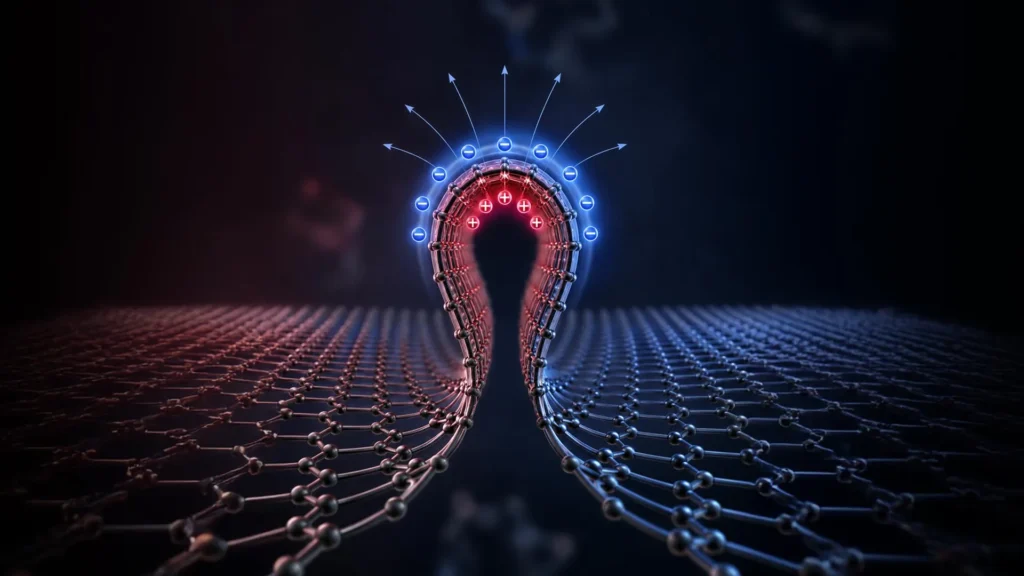
Flexoelectricity changes this dynamic. Unlike piezoelectricity, which requires a specific type of crystal symmetry to generate electricity from uniform pressure, flexoelectricity can occur in almost any dielectric material when it is bent unevenly. In the case of graphene, when the material is subjected to extreme curvature, the symmetry of the carbon-to-carbon bonds is broken. At the site of a sharp wrinkle, the electron cloud surrounding the carbon atoms is forced to shift. This displacement creates a separation of charges, effectively turning a localized section of the graphene into a tiny, atomic-scale battery with distinct positive and negative poles.
The Rice University team focused on wrinkles that occur naturally during the growth or transfer process of graphene. While these wrinkles were previously viewed as defects or imperfections that hindered performance, this research reclassifies them as functional features. Some of these bends were found to be squeezed into regions smaller than a billionth of a meter, creating a level of curvature that is impossible to achieve in bulk materials without causing structural failure.
A Sixteen-Year Chronology: From Theoretical Prediction to Experimental Proof
The journey toward this discovery began in 2008, a period when graphene research was still in its nascent stages following the 2010 Nobel Prize-winning work of Andre Geim and Konstantin Novoselov. At that time, theoretical physicist Vincent Meunier, now the P. B. Breneman Chair and head of the Department of Engineering Science and Mechanics at Pennsylvania State University, utilized computational models to predict a startling effect. He hypothesized that if graphene could be bent sharply enough, the resulting strain gradient would rearrange its electronic structure, producing a measurable electrical response.
However, in 2008, the technology required to measure electrical signals across a wrinkle only a few atoms wide simply did not exist. The scientific community lacked the precision probes and the stabilization techniques necessary to isolate the effects of curvature from the noise of the surrounding environment. For over a decade, Meunier’s prediction remained a compelling but unverified theory.
The turning point occurred when Sathvik Ajay Iyengar, then a doctoral student at Rice University and lead author of the current study, began reviewing data he had collected alongside Manoj Tripathi. Tripathi, a co-corresponding author now at South Dakota Mines and formerly with the University of Sussex, had assisted in gathering high-resolution electrical maps of graphene surfaces. Iyengar noticed that at the sharpest points of naturally occurring wrinkles, the electrical signals were not just different—they were anomalous.
Upon sharing these findings with Meunier, who had co-advised his doctoral work, the team realized they were looking at the experimental "smoking gun" for the 2008 prediction. By combining Meunier’s original atomic-scale calculations with modern experimental techniques, the researchers were finally able to bridge the gap between theory and reality.
Methodology: Mapping the Atomic Landscape
To validate the presence of flexoelectricity, the research team employed a multi-modal approach that combined physical measurement with optical analysis and computational validation.
- Scanning Probe Microscopy: The researchers utilized specialized microscope probes to traverse the topography of the graphene. These probes acted like the needle of a record player, but at a scale where they could detect the minute height variations of wrinkles and simultaneously measure local electrical energy and current flow. This allowed the team to create a "heat map" of electrical activity that corresponded exactly to the physical curvature of the material.
- Raman Spectroscopy: To confirm that the atoms were indeed being strained, the team used Raman spectroscopy. By shining lasers onto the graphene, they could observe the vibrational modes of the carbon atoms. When graphene is stretched or compressed, the frequency of these vibrations shifts. The Raman data provided clear evidence that the carbon bonds at the tips of the wrinkles were under intense mechanical stress, correlating with the electrical anomalies.
- Comparative Analysis: A critical component of the study was the comparison between highly curved wrinkles and adjacent areas of flat graphene. By using the flat sections as a control group, the researchers could rule out external factors such as substrate interference or chemical contamination. This isolation proved that the electricity was a direct product of the geometry (the "flexo" effect) rather than the material composition.
- Computer Simulations: The experimental results were fed into density functional theory (DFT) simulations. These models confirmed that the observed current and polarization matched the predicted movement of electrons within a curved hexagonal lattice.
Quantitative Findings: The "Speed Bump" Effect
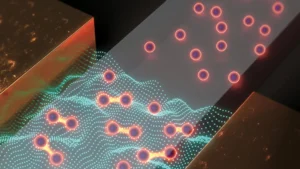
The data revealed that graphene wrinkles function as "electrical speed bumps." Under normal conditions, electrons move through graphene with almost zero resistance. However, when they encounter a sharp wrinkle, the local electrical energy landscape changes.
The team found that the strength of the electrical response was not dependent on the height or length of the wrinkle, but rather its "sharpness"—the radius of the curvature. The sharper the bend, the more intense the electron shift. Quantitatively, the researchers estimated that the resulting electrical polarization was between 100,000 and 10 million times stronger than the polarization typically observed in traditional, macro-scale flexoelectric systems (such as bulk ceramics).
Furthermore, the researchers discovered a threshold effect: once approximately one volt of electricity was applied to the system, a consistent and measurable current was detected at the wrinkle tips. This predictability is essential for the eventual development of electronic components that rely on these features to function.
Official Responses and Expert Analysis
The implications of the study have drawn significant praise from the materials science community. Pulickel Ajayan, the Benjamin M. and Mary Greenwood Anderson Professor of Engineering at Rice and co-corresponding author, emphasized the shift in perspective regarding material defects.
"Our work shows that even an ordinary wrinkle can become an extraordinary electronic feature when viewed at the atomic scale," Ajayan stated. "By demonstrating that geometry alone can reshape electrical behavior in graphene, we open a new pathway for designing materials whose properties can be controlled through structure rather than chemistry."
Sathvik Ajay Iyengar noted the efficiency of using nature’s own designs. "Nature already creates these tiny wrinkles for us," he explained. "Imagine bending a flexible ruler, except the bend is squeezed into a space smaller than a billionth of a meter. At that scale, the electrons in graphene shift slightly toward one side, creating two opposite electrical sides like the ends of a tiny battery."
Vincent Meunier reflected on the long-term validation of his theoretical work. He noted that the synergy between experimentalists and theorists was the key to unlocking the secret of the wrinkles. "Bringing the experiments and atomic-scale calculations together allowed us to test that connection directly," Meunier said, highlighting the importance of interdisciplinary collaboration in modern science.
Broader Impact: The Future of "Straintronics"
The discovery of high-magnitude flexoelectricity in graphene paves the way for a new field often referred to as "straintronics." This field explores how mechanical strain can be used to engineer the electronic properties of 2D materials. The potential applications are vast and could revolutionize several sectors:
- Ultra-Sensitive Sensors: Because the electrical response in these wrinkles is so highly sensitive to the degree of bending, they could be used to create sensors capable of detecting minute mechanical vibrations or pressure changes at the molecular level. This could lead to breakthroughs in medical diagnostics and environmental monitoring.
- Nano-Scale Power Sources: The "tiny battery" effect of the wrinkles suggests that arrays of graphene wrinkles could potentially harvest energy from ambient mechanical vibrations, providing a self-sustaining power source for micro-robotics or wearable technology.
- Advanced Semiconductors: Traditional semiconductors rely on "doping"—the addition of chemical impurities—to control the flow of electricity. Geometric control via wrinkles offers a cleaner, more stable alternative that does not degrade the material’s structural integrity.
- Flexible and Foldable Electronics: As the tech industry moves toward foldable phones and integrated "smart" fabrics, understanding how curvature affects electricity is paramount. This research provides the blueprint for ensuring that devices remain functional even when bent or twisted.
Conclusion and Acknowledgments
The study represents a collaborative effort involving researchers from Rice University, Pennsylvania State University, the University of Sussex, the University of Manchester, the University of Brighton, and the South Dakota School of Mines and Technology. The diverse expertise of the team—spanning engineering, physics, and chemistry—was instrumental in documenting a phenomenon that occurs at the very limits of physical measurement.
The research was supported by a variety of prestigious grants and fellowships, including the Quad Fellowship, the Sussex Strategy Development Fund, the University of Manchester Dame Kathleen Ollerenshaw Fellowship, and the National Science Foundation (NSF).
As scientists continue to explore the "geometry of electricity," the humble wrinkle, once considered a flaw in the perfect sheet of graphene, may very well become the cornerstone of the next electronic revolution. By mastering the art of the atomic bend, researchers are moving closer to a future where the shape of a device is just as important as the material from which it is made.