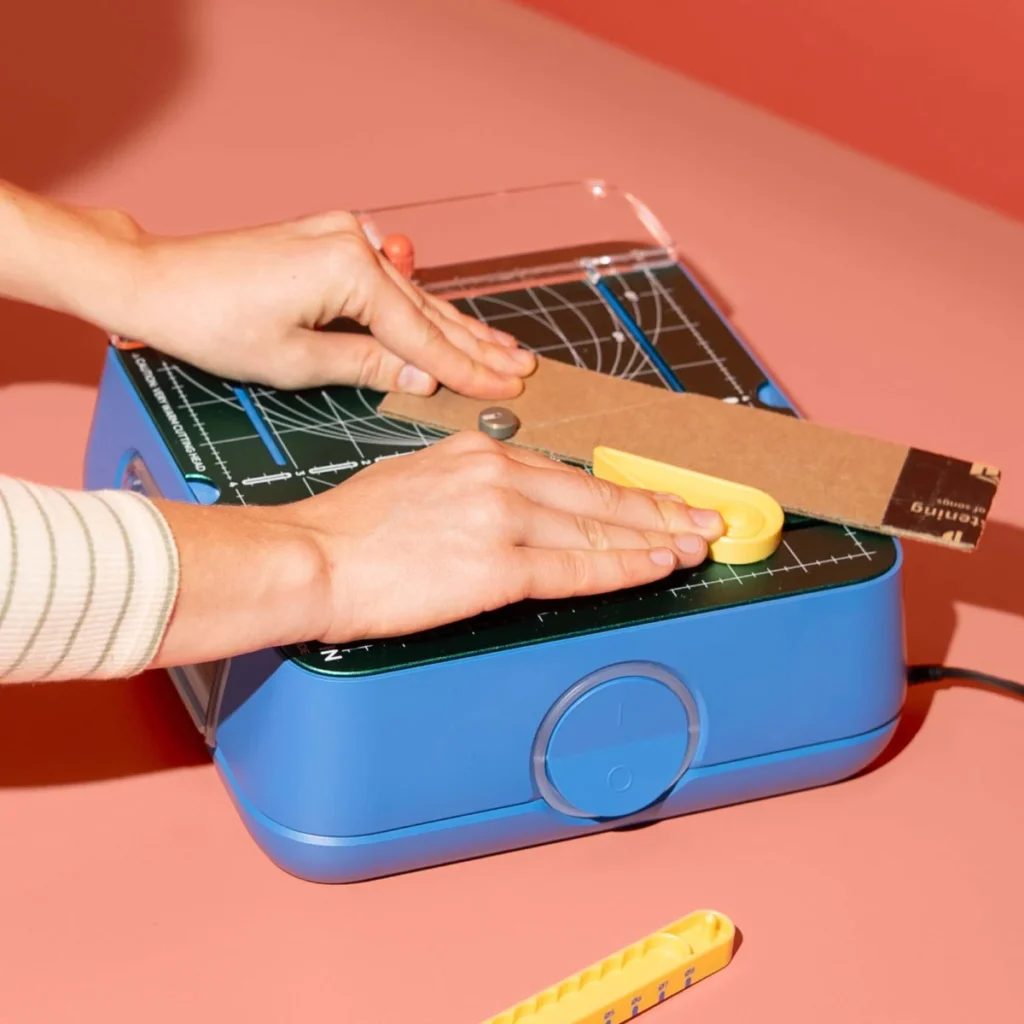
The ChompSaw, a specialized desktop power tool designed by Chompshop, is emerging as a significant innovation in the field of educational technology and childhood "maker" culture. Designed specifically to bridge the gap between manual crafting and industrial fabrication, this device offers a safety-certified method for children as young as three to manipulate cardboard with the precision of a professional power tool. At a price point ranging from $249 for the base unit to $299 for the comprehensive Maker Bundle, the ChompSaw represents a serious investment in a child’s creative development, moving away from the disposable nature of many toys toward a durable piece of educational equipment.
The Engineering of Safety and Precision
The core appeal of the ChompSaw lies in its unique mechanical operation. Unlike traditional saws that utilize a rotating blade or a reciprocating serrated edge—both of which pose significant laceration risks—the ChompSaw operates on a "nibbling" principle. This mechanism functions as a high-speed precision hole puncher, removing minute fragments of material in rapid succession. This design choice is the primary reason the device has achieved safety certification for children aged three and older. Because the cutting head is enclosed and the aperture for material entry is strictly limited, human fingers cannot physically reach the moving parts that perform the cutting.
The physical build of the machine emphasizes stability and tactile feedback. The base is constructed from high-impact plastic, designed not only to house the internal motor and electronics but also to provide integrated storage for the power cord. A slide-out dust collection drawer is situated at the bottom, capturing the "chomped" cardboard debris that results from the cutting process. The top of the device features a heavy metal lid, which serves as a steady work surface. This lid is reversible or flippable, featuring embossed measurements in both inches and centimeters to assist with precision layouts. For ease of operation, the unit utilizes a large, chunky toggle switch, specifically chosen to accommodate the developing fine motor skills of younger users.
Origins and the Design Thinking Philosophy
The ChompSaw was not originally conceived as a commercial product but began as a Master’s program project by Kausi Raman. The project’s goal was to identify barriers that prevent young children from engaging in complex "design thinking"—a problem-solving methodology that involves empathizing, defining, ideating, prototyping, and testing. Raman recognized that while cardboard is an abundant and versatile material for prototyping, the tools available to children are often inadequate. Manual scissors are difficult for small hands to use on thick corrugated cardboard, and utility knives are far too dangerous for unsupervised or early-childhood use.
By automating the cutting process in a safe environment, the ChompSaw allows children to focus on the "thinking" and "designing" phases of a project rather than struggling with the physical limitations of manual tools. This transition from labor-intensive cutting to automated precision is intended to foster a "flow state"—a psychological condition where a creator is fully immersed in their work. Observers of the tool in use, including library staff and educators, have noted that even preschoolers can enter a meditative state while steadily feeding material into the machine, indicating a high level of engagement and focus.

Field Performance and Material Versatility
In practical applications, the ChompSaw has demonstrated a surprising range of capabilities. During field testing at public libraries and educational centers, the tool was subjected to various use cases by different age groups. Preschoolers were able to master straight cuts almost immediately, quickly progressing to more complex curved designs. The tool’s ability to handle curves is a significant advantage over many manual cardboard saws, which often struggle with non-linear paths.
The versatility of the device extends beyond standard corrugated cardboard. Testing by secondary school students revealed that the ChompSaw is capable of processing other materials, such as plastic folders and heavy cardstock, without jamming or losing precision. This flexibility makes it a viable tool for a wide range of projects, from simple arts and crafts to the construction of functional prototypes for science and engineering competitions.
The Maker Bundle and Educational Ecosystem
To maximize the utility of the hardware, Chompshop offers the "Maker Bundle," which includes several supplemental tools designed to work in tandem with the saw. These accessories include hand tools for punching uniform holes and scoring lines for clean folds, which are essential for creating structural integrity in cardboard builds. The bundle also features an alternate metal lid designed to assist in cutting perfect circles and maintaining specific angles, further expanding the geometric possibilities for young builders.
Beyond the hardware, the ChompSaw is supported by a robust educational infrastructure. The included Inventor’s Workbook serves as a curriculum guide, utilizing real-world examples and relatable personalities to walk children through the design process. The workbook is carefully crafted with clear illustrations and accessible definitions for technical vocabulary. Furthermore, the company maintains an online repository of resources, including:
- Instructional Videos: Visual guides for tool maintenance and advanced cutting techniques.
- Printable Templates: Ready-to-use designs for various projects.
- K-8 Lesson Plans: Structured curricula for educators to integrate the ChompSaw into classroom environments.
- Subscription Kits: Monthly add-ons that provide themed paper templates and supplementary supplies like marbles, rubber bands, and fasteners.
Market Context and the Value of Cardboard
The emergence of the ChompSaw coincides with a broader resurgence in cardboard-based construction, often referred to as "cardboard engineering." This movement has been bolstered by products like Nintendo Labo and various "Makedo" kits, which encourage children to view waste material as a valuable resource. In an era dominated by digital screens, these tactile, physical activities are increasingly valued by parents and educators for their ability to develop spatial reasoning and fine motor skills.
However, the ChompSaw occupies a premium niche in this market. While manual cardboard saws can be purchased for under $20, the $249-$299 price point of the ChompSaw places it in competition with other high-end educational tools like entry-level 3D printers or digital die-cutting machines like the Cricut. The primary differentiator is the ChompSaw’s accessibility for very young children and its focus on a ubiquitous, free material (cardboard) rather than expensive filaments or proprietary cardstocks.

Technical Considerations and Maintenance
While the ChompSaw is designed for durability and ease of use, it is not without maintenance requirements. The "nibbling" action generates a significant amount of fine cardboard dust. While the integrated drawer catches much of this, dust can accumulate around the cutting head, requiring regular cleaning to prevent mechanical slowdowns. Users have also noted that when cutting particularly thick or heavy-duty cardboard, the machine may shift on smooth surfaces. The manufacturer provides guidance on stabilizing the unit, but this is a factor for users to consider when setting up a dedicated workspace.
The machine’s reliance on a standard power outlet (via its stored cord) limits its portability compared to manual tools, but it ensures a consistent power supply for long crafting sessions. The inclusion of both imperial and metric measurements reflects a global design perspective, making it suitable for international educational standards.
Broader Implications for STEAM Education
The ChompSaw represents a shift in how STEAM (Science, Technology, Engineering, Arts, and Mathematics) education is approached in early childhood. By providing a "gateway power tool," educators can introduce concepts of industrial safety and mechanical advantage long before a child is ready for a traditional woodshop. It democratizes the "maker" experience, allowing children who might be intimidated by the physical strength required for manual sawing to participate equally in construction projects.
The focus on cardboard also carries an environmental message. By transforming shipping boxes into sophisticated machines or works of art, children learn about upcycling and the potential for innovation within their immediate environment. This aligns with modern educational goals of sustainability and resourcefulness.
Conclusion: A New Standard for Young Makers
The ChompSaw stands as a testament to the power of thoughtful, user-centric design. By identifying a specific bottleneck in the creative process of children—the difficulty of cutting cardboard safely and accurately—Kausi Raman and Chompshop have created a tool that is both a functional piece of machinery and an educational catalyst. While the initial cost may be a barrier for some individual households, its value in a classroom, library, or makerspace setting is substantial. It provides a safe, engaging, and highly effective way for the next generation of designers and engineers to bring their ideas to life, one "chomp" at a time. As the maker movement continues to grow, tools like the ChompSaw will likely become staple components of the modern educational landscape, proving that even the simplest materials can be the foundation for complex innovation when the right tools are at hand.