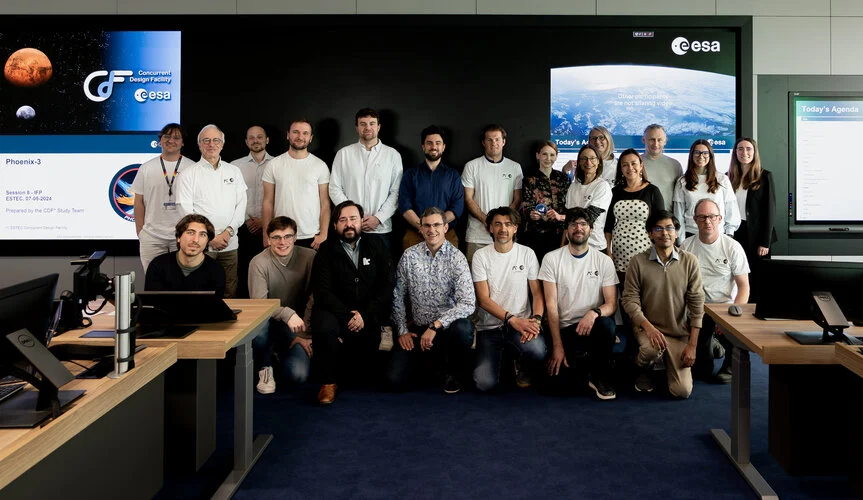
European Space Agency engineers and industry partners have successfully concluded an intensive concept study for Phoenix 3, a novel reusable spacecraft designed to ferry scientific and commercial experiments into microgravity and return them safely to Earth. This milestone marks a significant step forward for the proposed orbital return vehicle, a project spearheaded by the European startup ATMOS Space Cargo. The comprehensive evaluation, conducted within ESA’s state-of-the-art Concurrent Design Facility (CDF), has validated the fundamental feasibility of the ambitious endeavor, laying a robust foundation for subsequent development phases.
Genesis of Phoenix 3 and the CDF’s Role
The journey of Phoenix 3 began with a vision from ATMOS Space Cargo to create a European-centric solution for the growing demand for in-orbit experimentation and manufacturing. Recognizing the need for a rigorous, multidisciplinary assessment, ATMOS proposed their concept to the European Space Agency. In response, ESA’s Concurrent Design Facility (CDF), located at their technical center in Noordwijk, the Netherlands, transformed into a dynamic think-tank. This facility is specifically engineered to accelerate complex design evaluations by bringing together experts from a wide array of engineering disciplines. Utilizing a network of interconnected computers, advanced multimedia devices, and sophisticated software tools, the CDF allows teams to collaboratively assess intricate designs in a matter of weeks, a process that would typically span many months through conventional sequential engineering methods.
The CDF’s methodology for assessing a proposed concept involves detailed reviews against established templates and guidelines. For the Phoenix 3 study, the expert panel focused on a primary reference scenario: launching the spacecraft into a low Earth orbit at an altitude of approximately 350 kilometers. This orbital altitude is a common target for scientific missions, offering a stable microgravity environment suitable for a wide range of experiments.

Mission Profile and Payload Capabilities
Within this low Earth orbit, Phoenix 3 is envisioned to serve a multifaceted role. It is slated to support burgeoning fields such as commercial microgravity manufacturing, advanced scientific research, and the crucial in-orbit demonstration and validation of novel technologies. The spacecraft is designed for extended missions, with orbital durations anticipated to range from several months to a full year. Upon completion of its mission, Phoenix 3 is programmed to execute a controlled deorbit maneuver, followed by a guided atmospheric entry. The ultimate goal is to ensure a safe recovery of the spacecraft and its valuable payload, enabling refurbishment and preparation for subsequent launches, thereby embodying the principles of reusability.
The configuration evaluated during the CDF study incorporated a sophisticated service module, responsible for providing essential power and propulsion capabilities to the spacecraft. Central to the design is a pressurized cabin area, meticulously engineered to replicate Earth-like atmospheric conditions. This cabin is intended to accommodate scientific and commercial payloads weighing upwards of 1,000 kilograms. While this configuration served as a critical reference point for the study, it is important to note that it is not a definitive blueprint. Key design trade-offs remain open for further investigation during Phase A of the mission lifecycle, the next crucial step in translating a concept into a tangible mission.
Innovative Reentry Technology
A cornerstone of ATMOS’s approach to reusable spacecraft, and a key element for Phoenix 3, is the development and integration of an inflatable decelerator. This proprietary technology, which ATMOS has been actively maturing and flight-testing across its Phoenix family of vehicles, plays a pivotal role in the spacecraft’s return to Earth.
Jeffrey Hendrikse, Chief Technology Officer and Co-Founder of ATMOS Space Cargo, elaborated on the significance of this technology. "During reentry, the spacecraft uses its Inflatable Atmospheric Decelerator to slow down through the atmosphere ahead of a safe recovery," Hendrikse explained. "What pleases me most is that the study confirmed we can maintain the modularity of the microgravity platform, serving our customers from late access before launch to early access after return, as well as the communication bandwidth they need in orbit." This highlights the dual focus on mission flexibility and customer service, critical for commercial viability.

Identified Trade-offs and Future Directions
The CDF study was instrumental in identifying not only the strengths of the Phoenix 3 concept but also the critical trade-offs and potential risks that require further attention. Daniela Lomanto from ESA’s Concurrent Engineering and Future Missions section emphasized the value of this output. "The CDF study also identified key trade-offs and risks to be addressed next, providing a solid starting point for Phase A, in which ATMOS will focus on the optimisation of aerodynamics, stability and thermal design, and on improving entry modelling and guidance to increase landing accuracy," Lomanto stated. This targeted approach ensures that future development efforts are focused on the most critical aspects of the spacecraft’s design and performance.
The successful conclusion of this concept study underscores ESA’s commitment to fostering and accelerating the competitiveness of European industry. By providing targeted technical support at crucial junctures, the agency empowers nascent space ventures. Ilaria Roma, Head of the CDF, commented on the broader implications of this collaboration. "ATMOS has created a win-win scenario for the future of European space exploration, so their vision and this specific mission assessment is supported by ESA’s Directorate of Human and Robotic Exploration." This endorsement from a key directorate within ESA signals strong institutional backing for the Phoenix 3 project.
Sustainability and Industrialization at the Forefront
A significant theme woven throughout the Phoenix 3 CDF study is the critical importance of sustainability in space operations. By defining a new, scalable class of reusable return vehicles, the project directly addresses the urgent need for circularity in orbit and a reduced environmental footprint. This aligns with a growing global imperative to minimize space debris and promote responsible space utilization.
"Central to this collaboration is the topic of sustainability," remarked a spokesperson from ESA’s Directorate of Human and Robotic Exploration. "By defining a new, scalable class of reusable return vehicles, the study addresses the urgent need for circularity in orbit and reduced environmental footprint in space operations. At the same time, ATMOS is developing concepts and solutions that will directly benefit industrialization capabilities and sovereign infrastructure within Europe." This dual focus on environmental responsibility and the strengthening of Europe’s indigenous space capabilities is a key strategic objective for the agency.

Marta Oliveira, Chief Operating Officer and Co-Founder of ATMOS Space Cargo, highlighted the unique advantages of the CDF process. "The value of the CDF is the ability to examine every major subsystem and interface at the same time," Oliveira explained. "Bringing specialists from across disciplines into one concurrent process helped us identify dependencies that would be difficult to resolve through sequential engineering work." This concurrent approach proved invaluable in fostering a holistic understanding of the spacecraft’s complex systems and their interdependencies.
The Third Party Activity Initiative: Enabling Collaboration
The collaborative nature of the Phoenix 3 CDF study is made possible through ESA’s Third Party Activity (TPA) initiative. This program serves as a vital mechanism for opening ESA’s extensive consultancy and testing infrastructure to the broader industrial ecosystem. From agile startups to established large-scale enterprises, the TPA initiative facilitates access to cutting-edge resources and expertise, fostering innovation and driving the development of new space technologies and services across Europe. The success of the Phoenix 3 study is a testament to the effectiveness of this initiative in nurturing the next generation of European space endeavors.
The successful completion of the Phoenix 3 concept study within the ESA CDF represents a pivotal moment, validating a promising European approach to reusable orbital return capabilities. With a clear roadmap for Phase A and strong institutional backing, the project is well-positioned to advance towards its goal of enhancing microgravity research, in-orbit manufacturing, and the overall sustainability of space operations. The collaboration between ATMOS Space Cargo and ESA exemplifies a forward-thinking strategy to bolster European industrial prowess and secure a leading role in the evolving global space economy.