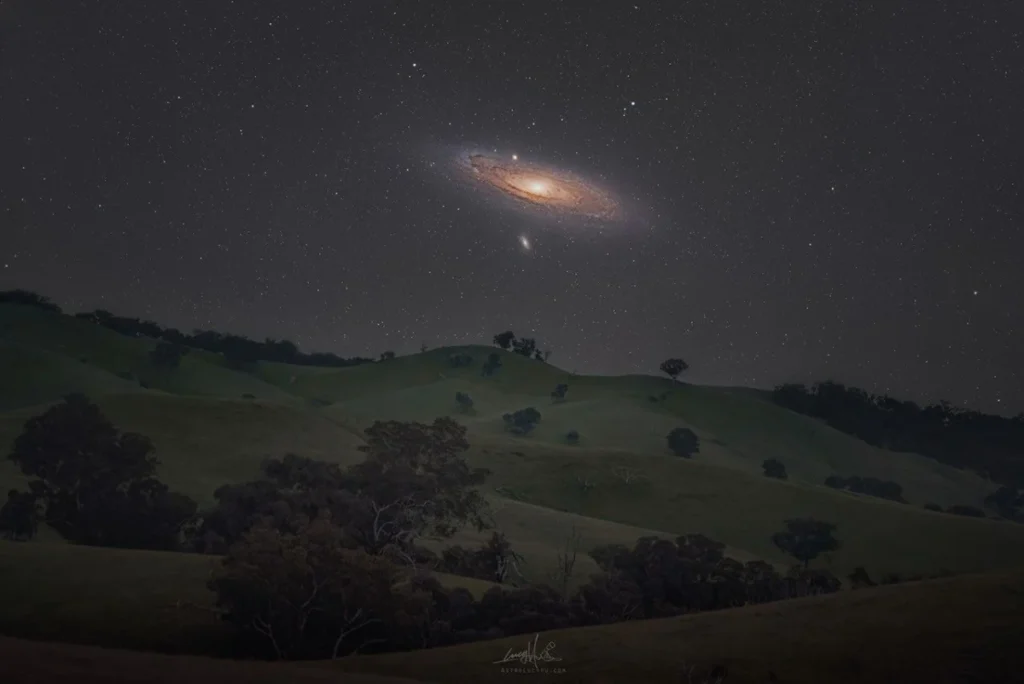
Looking toward the north from Mullion, New South Wales, Australia, the Andromeda Galaxy never gets more than a few degrees above the horizon. During the southern hemisphere spring, Andromeda is highest in the sky around midnight though. And in this telephoto scene from October 10/11, multiple exposures were used to reveal the spiral galaxy in tantalizing detail as it climbed above rolling Australian hills. Also known as M31, the Andromeda Galaxy is one of the brightest objects in the Messier catalog, but is only visible to the unaided eye as a small, faint, fuzzy patch. Digitally tracked and stacked frames were combined with a foreground shot in the deep astro-image composite to reveal the galaxy’s greater extent in planet Earth’s night. In the springtime night skyscape, the closest large spiral galaxy spans nearly 6 full moons. Tomorrow’s picture: pixels in space.
Unveiling the Andromeda Galaxy: A Southern Hemisphere Perspective
The recent astronomical image, captured from Mullion, New South Wales, offers a stunning perspective of the Andromeda Galaxy (M31) as observed from the Southern Hemisphere. The photograph, a composite of multiple exposures taken on October 10th and 11th, showcases the grandeur of our nearest large spiral galactic neighbor against the backdrop of Australia’s undulating hills. While the Andromeda Galaxy is a prominent celestial object, its visibility from Earth’s southern latitudes presents unique observational challenges and opportunities, as highlighted by this remarkable image.
The image emphasizes that the Andromeda Galaxy, even at its highest point in the night sky during the southern hemisphere’s spring, remains relatively low on the northern horizon. This characteristic is a direct consequence of Earth’s axial tilt and our position on the planet. For observers in the Northern Hemisphere, Andromeda appears higher and more prominently throughout much of the year. However, for astronomers and stargazers in Australia and other southern regions, the galaxy’s ascent is a specific, often anticipated, event, typically occurring around midnight.
The technical prowess behind this photograph is evident in its ability to resolve intricate details of the spiral galaxy. By employing a technique of digitally tracking and stacking multiple exposures, astronomers were able to overcome the limitations of atmospheric conditions and the inherent faintness of distant celestial objects. This sophisticated approach allowed for the precise alignment of individual frames, thereby accumulating light over time and significantly enhancing the signal-to-noise ratio. The result is an image that reveals the Andromeda Galaxy in "tantalizing detail," far beyond what the unaided eye can perceive.
Furthermore, the composite nature of the image is crucial. It expertly merges the deep-sky data of the Andromeda Galaxy with a separate foreground exposure of the Australian landscape. This technique not only grounds the celestial spectacle in a terrestrial context, making it more relatable, but also requires careful calibration and alignment to ensure a seamless and aesthetically pleasing final product. The "rolling Australian hills" serve as a terrestrial anchor, emphasizing the vast cosmic distances involved and the human endeavor to capture and understand them.
Andromeda Galaxy: A Celestial Landmark
The Andromeda Galaxy, officially designated Messier 31 (M31), is a barred spiral galaxy located approximately 2.537 million light-years away from Earth. It is the closest large galaxy to our own Milky Way and is part of the Local Group, a collection of galaxies that includes the Milky Way, the Triangulum Galaxy, and about 30 smaller galaxies. Andromeda is the largest member of the Local Group, boasting an estimated one trillion stars, a significant portion more than the Milky Way’s estimated 100-400 billion stars.
Historically, M31 has been a subject of fascination and scientific inquiry. Immanuel Kant, in the 18th century, speculated that some "nebulae" might be "island universes" – vast collections of stars similar to our own galaxy. While he didn’t specifically identify Andromeda, his theoretical framework laid the groundwork for understanding the true nature of galaxies. It wasn’t until the early 20th century, through the work of astronomers like Edwin Hubble, that it was definitively proven that Andromeda was an extragalactic object, a galaxy in its own right, and not a nebula within our own Milky Way. Hubble’s observations of Cepheid variable stars in Andromeda allowed him to calculate its distance, revolutionizing our understanding of the scale of the universe.
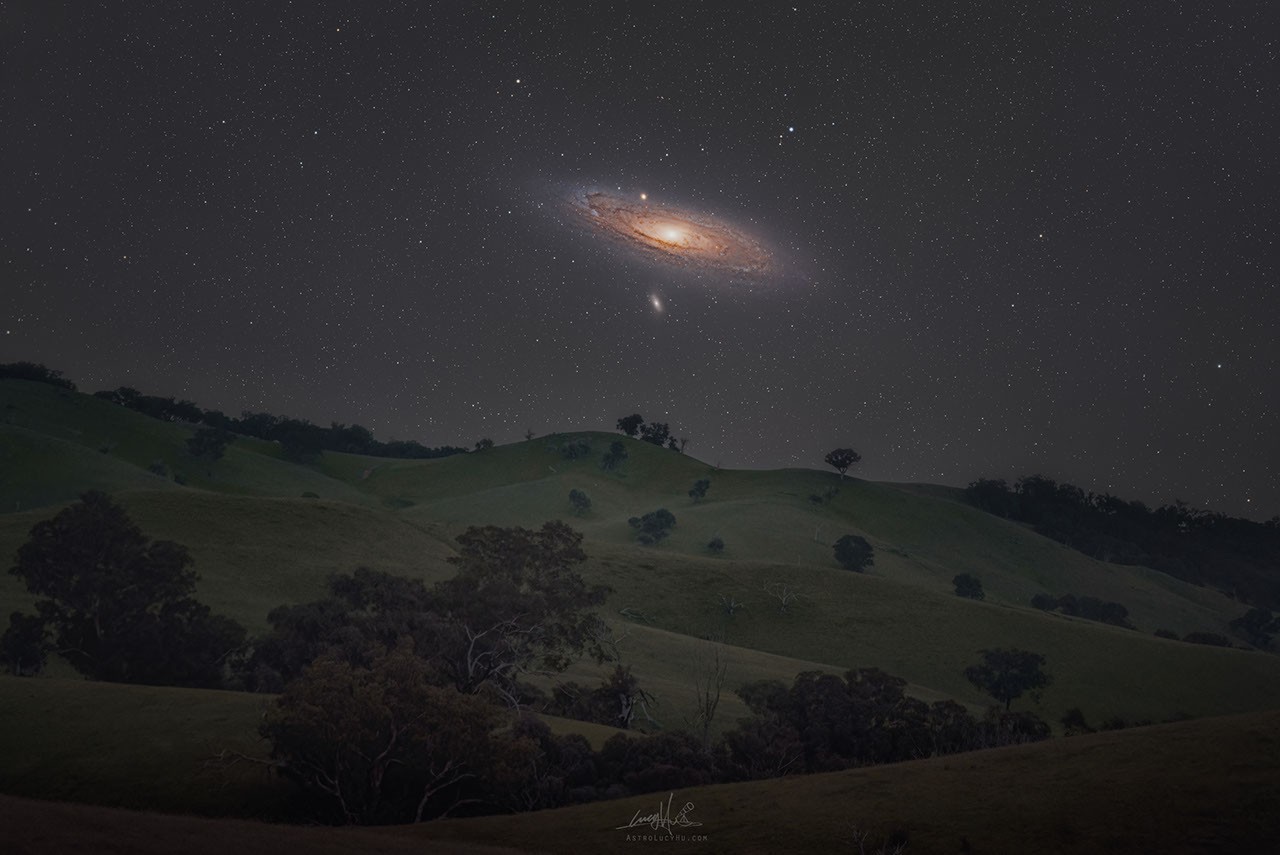
The apparent size of the Andromeda Galaxy in the night sky is approximately 3.167 degrees by 1 degree, which translates to roughly six times the angular diameter of the full Moon. This vast expanse, however, is largely diffuse and faint. To the naked eye, under ideal dark sky conditions, Andromeda appears as a small, elongated, fuzzy patch of light, often described as a faint smudge. This modest naked-eye appearance belies its immense structure, which encompasses a luminous central bulge, two major spiral arms, and a fainter halo of stars and globular clusters.
The Andromeda Galaxy is also a target for detailed study due to its projected collision course with the Milky Way. Current models predict that the two galaxies will collide and merge in approximately 4.5 billion years, forming a larger elliptical galaxy, often referred to as "Milkomeda" or "Milkdromeda." This future cosmic event is a significant area of research for astrophysicists, offering insights into galactic evolution and dynamics.
Technological Advancements in Astrophotography
The creation of the featured image is a testament to the advancements in astrophotography and image processing techniques. Capturing detailed images of faint celestial objects like galaxies requires overcoming several challenges:
- Light Pollution: Urban and suburban areas are plagued by artificial light that scatters in the atmosphere, washing out faint astronomical objects. The image’s location in Mullion, New South Wales, likely indicates a site with relatively low light pollution, crucial for capturing such detailed imagery.
- Atmospheric Turbulence (Seeing): Earth’s atmosphere is not static; it churns and distorts light from celestial objects, causing them to twinkle and appear blurred. Long exposures are susceptible to these effects.
- Faintness of the Object: Galaxies, even nearby ones like Andromeda, are incredibly distant, meaning the light reaching us is extremely weak.
To address these challenges, astrophotographers employ several techniques:
- Long Exposure Imaging: By taking multiple images with exposures ranging from seconds to minutes, astronomers can gather more light from the target.
- Stacking and Alignment: Sophisticated software is used to align and stack these multiple exposures. This process averages out random noise (like sensor noise and faint atmospheric variations) while accumulating the signal from the target. Precise alignment is critical to prevent the image from becoming blurry.
- Tracking Mounts: Telescopes are mounted on sophisticated equatorial mounts that track the apparent motion of celestial objects across the sky due to Earth’s rotation. This allows for very long exposures without the object drifting out of frame or appearing as streaks.
- Image Calibration: Calibration frames, such as dark frames (images taken with the lens cap on to capture sensor noise), bias frames (short exposures to capture read noise), and flat frames (images of a uniformly illuminated surface to correct for dust and vignetting), are essential for processing raw astronomical data.
- Post-Processing: After stacking, the data undergoes extensive post-processing, including stretching the dynamic range to reveal faint details, color balancing, and noise reduction.
The "telephoto scene" mentioned in the description suggests a powerful lens and a well-aligned camera system capable of capturing distant objects with significant magnification. The combination of these techniques has allowed for the creation of an image that not only reveals the structure of the Andromeda Galaxy but also places it within a captivating terrestrial landscape.
Significance and Future Outlook
This photograph serves as a powerful reminder of the vastness and beauty of the universe accessible to us. By highlighting the Andromeda Galaxy from a unique southern hemisphere vantage point, it underscores the universal nature of astronomical observation and the shared human curiosity about the cosmos.
The Astronomy Picture of the Day (APOD) initiative, from which this image originates, plays a crucial role in public outreach and education. By featuring a different astronomical image daily with an explanation written by a professional astronomer, APOD makes complex scientific concepts and breathtaking imagery accessible to a broad audience. This particular image, showcasing the Andromeda Galaxy, can inspire interest in:
- Galactic Astronomy: Encouraging people to learn more about the structure, formation, and evolution of galaxies, including our own Milky Way.
- Observational Astronomy: Promoting an understanding of the challenges and rewards of observing the night sky, from naked-eye observation to sophisticated telescopic imaging.
- Interdisciplinary Arts and Sciences: Demonstrating the synergy between scientific inquiry and artistic representation, as seen in the integration of the celestial object with the terrestrial landscape.
The mention of "pixels in space" for tomorrow’s picture hints at a potential focus on the digital nature of astronomical data or perhaps a distant astronomical phenomenon observed through digital instruments. Regardless, the consistent delivery of high-quality astronomical imagery and explanations through platforms like APOD continues to foster a deeper appreciation for our universe and humanity’s place within it. The enduring allure of objects like the Andromeda Galaxy, captured from diverse locations on Earth, ensures that the pursuit of astronomical knowledge will continue to inspire and captivate generations to come.