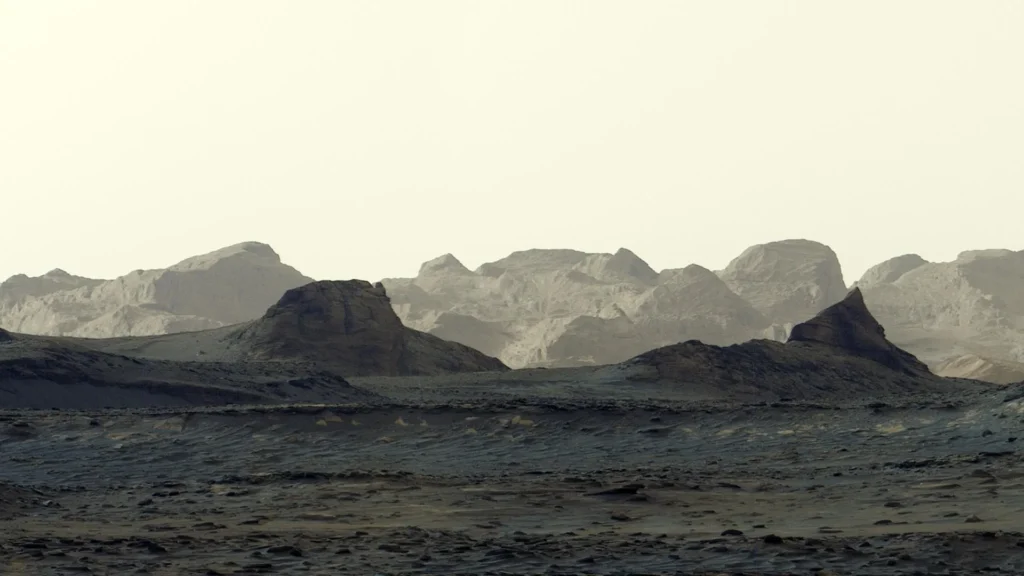
NASA’s Mars Science Laboratory (MSL) rover, Curiosity, has captured a breathtaking new panorama of the Red Planet, offering scientists an unprecedentedly clear glimpse of a series of enigmatic cliffs sculpted by ancient Martian winds. This latest transmission from the Gale Crater provides an exciting visual preview of the geological wonders that await closer investigation, fueling scientific curiosity about the planet’s dynamic past. The panorama, recorded at 8:30 a.m. local Mars time, showcases a striking interplay of light and shadow, with vibrant blue tones dominating the foreground and the early morning sunlight illuminating the rugged, horizon-spanning formations known as yardangs.
A Glimpse of Martian Dawn
The awe-inspiring panorama was meticulously assembled by Curiosity using its Mast Camera (Mastcam) instrument on August 11, during the mission’s 4,982nd Martian day, or sol. A total of six individual photographs, each capturing a segment of the expansive landscape, were transmitted back to Earth. These images were then artfully stitched together to create the sweeping, high-resolution vista that has captivated researchers. In a deliberate departure from standard Mastcam processing, these particular images were transmitted without white balancing. This intentional decision allowed the scene to retain its authentic colors and the distinctive lighting conditions characteristic of a Martian morning, providing a more genuine representation of the alien landscape.
The scientific community has long been eager to examine these distant formations up close. The yardangs, prominent in this new panorama, represent a significant geological feature within Gale Crater. Their peculiar shapes and textures hint at powerful erosional forces that have shaped the Martian surface over eons. The detailed imagery now available will serve as a crucial guide for Curiosity as it navigates towards these intriguing geological puzzles.
Curiosity’s Ascent: A Milestone on Mount Sharp
These remarkable yardangs stretch for approximately 10 miles (16 kilometers) across the northwestern flank of Mount Sharp, the towering central peak of Gale Crater. Mount Sharp itself is an imposing geological structure, rising an impressive 3 miles (5 kilometers) from the crater floor. Curiosity has been diligently climbing this Martian mountain since its landing in 2014, a journey that has already seen the rover achieve significant milestones. Most recently, Curiosity surpassed a remarkable elevation gain of 0.6 miles (1 kilometer) up Mount Sharp, a vertical ascent that exceeds the cumulative climb of any previous rover mission on Mars. This persistent ascent underscores the rover’s advanced mobility and its capability to explore diverse terrains on the Red Planet.
As Curiosity continues its relentless march towards these unusual cliff formations, researchers anticipate an increasingly detailed and nuanced understanding of their characteristics. The proximity of the rover to these geological anomalies is expected to yield high-resolution imagery and, more importantly, direct analysis of the rock samples. This on-site examination is deemed crucial for unraveling the complex processes that have sculpted this remarkable Martian landscape.
Unlocking Mars’ Ancient History Through Sedimentary Layers
Mount Sharp is a geological treasure trove, its stratified layers of sedimentary rock acting as a chronological record of Mars’ distant past. Each layer offers a distinct chapter in the planet’s history, preserving evidence of environmental conditions that existed billions of years ago. By meticulously investigating these layers, scientists have been able to reconstruct a compelling narrative of a time when liquid water, in the form of lakes and streams, was abundant in this very region of Mars.
The transition from a wetter Mars to the arid planet observed today is a central theme in Martian science. As the planet’s atmosphere thinned and its magnetic field weakened over billions of years, its surface water gradually disappeared. This hydrological transformation left behind significant deposits of salty minerals, a testament to evaporated bodies of water. As the accumulation of new geological material on Mount Sharp ceased, the relentless forces of wind began to play a dominant role. Powerful atmospheric currents, sweeping across the Martian surface, gradually eroded the exposed rock formations, meticulously carving out the distinctive yardangs that are now a prominent feature of the landscape.
However, the specific yardang layer that has captured the attention of NASA scientists presents a unique set of enigmas. Its appearance deviates significantly from the surrounding terrain, raising questions about its origins and formation processes. The color of this particular layer is notably different from its neighbors, and its internal rock layers are tilted at an unexpected and unusual angle. These anomalies suggest that processes beyond ordinary wind erosion may have played a role in its creation.
Scientific Hypotheses and the "Plastered On" Enigma
The perplexing nature of this yardang layer has spurred intense scientific debate and hypothesis generation. Ashwin Vasavada, Curiosity’s project scientist at NASA’s Jet Propulsion Laboratory in Southern California, articulated the scientific community’s intrigue: "The yardang layer looks out of place. It’s the wrong color, the layers tilt at an odd angle, and it almost appears plastered on." This vivid description highlights the unusual visual characteristics that set this formation apart.
Vasavada further elaborated on the excitement this anomaly generates: "But that’s what makes it exciting to reach. No one is sure exactly what created this layer, but one idea is it may be ash deposited by ancient volcanic eruptions." This hypothesis suggests a dramatic geological event, possibly a volcanic eruption, that could have deposited a significant layer of ash across the landscape. Over time, subsequent wind erosion would have sculpted this ash deposit into the yardang-like forms observed today. This potential link to volcanic activity could provide invaluable insights into the broader geological history and magmatic processes of ancient Mars.
Other potential explanations for the layer’s unusual characteristics include sedimentary deposition from a different type of water body than previously understood, or even the aftermath of impact events. The tilted layers could indicate differential erosion, or perhaps tectonic activity that occurred after deposition. The "plastered on" appearance could be a result of a unique binding agent or a rapid deposition event. The precise mechanism remains a captivating puzzle that Curiosity is poised to help solve.
The Road Ahead: Investigations Planned for 2027
Curiosity is currently in the second year of its fifth extended mission. This latest phase of exploration commenced with an in-depth investigation of unusual, spiderweb-like boxwork ridges, which also presented unique geological formations. For approximately the next year, the rover will continue its systematic traversal through rock layers that are rich in sulfates and carbonates. These minerals are particularly significant because they provide compelling evidence of ancient, arid conditions that characterized Mars at various points in its history, offering further clues about the planet’s climate evolution.
The ultimate objective for Curiosity in this region is to reach the base of the yardang formations. Mission scientists have targeted sometime in 2027 for this significant achievement. Upon arrival, Curiosity will be equipped to conduct detailed, close-up examinations of the mysterious cliffs using its sophisticated robotic arm. This arm houses a suite of advanced instruments, including cameras, spectrometers, and a drill, enabling the rover to gather unique measurements and collect rock and soil samples.
These in-situ analyses will be crucial for determining the precise formation mechanisms of the yardangs. By understanding how these formations came to be, scientists will gain a deeper appreciation for the environmental changes that have shaped Mars over billions of years. The data collected will contribute significantly to our understanding of the planet’s hydrological history, its atmospheric evolution, and its potential for past habitability.
Broader Implications for Martian Science and Future Exploration
The ongoing exploration of Mount Sharp by Curiosity is not merely about deciphering the origins of specific geological features. It is a fundamental part of a larger scientific endeavor to reconstruct the complete history of Mars, from its earliest watery epochs to its current arid state. The discoveries made by Curiosity contribute to a growing body of evidence that paints a picture of a dynamic and evolving planet.
The findings from this investigation will have far-reaching implications for future Mars missions, including NASA’s Perseverance rover and its ongoing search for signs of ancient microbial life. Understanding the geological processes that created diverse terrains and potentially habitable environments is paramount for selecting future landing sites and for designing scientific objectives. The ability to identify and analyze features like these yardangs, which may have formed under unique conditions, is crucial for a comprehensive understanding of Mars’ past.
Furthermore, the continued success of long-duration missions like Curiosity demonstrates the robust capabilities of robotic exploration. The rover’s longevity and its ability to adapt to new scientific objectives underscore the value of sustained investment in planetary science. The images and data returned by Curiosity continue to inspire and inform, pushing the boundaries of our knowledge about our neighboring world and fueling humanity’s enduring fascination with the cosmos. The mystery of the Martian yardangs, once a distant curiosity, is slowly but surely yielding its secrets to the persistent gaze of Curiosity.