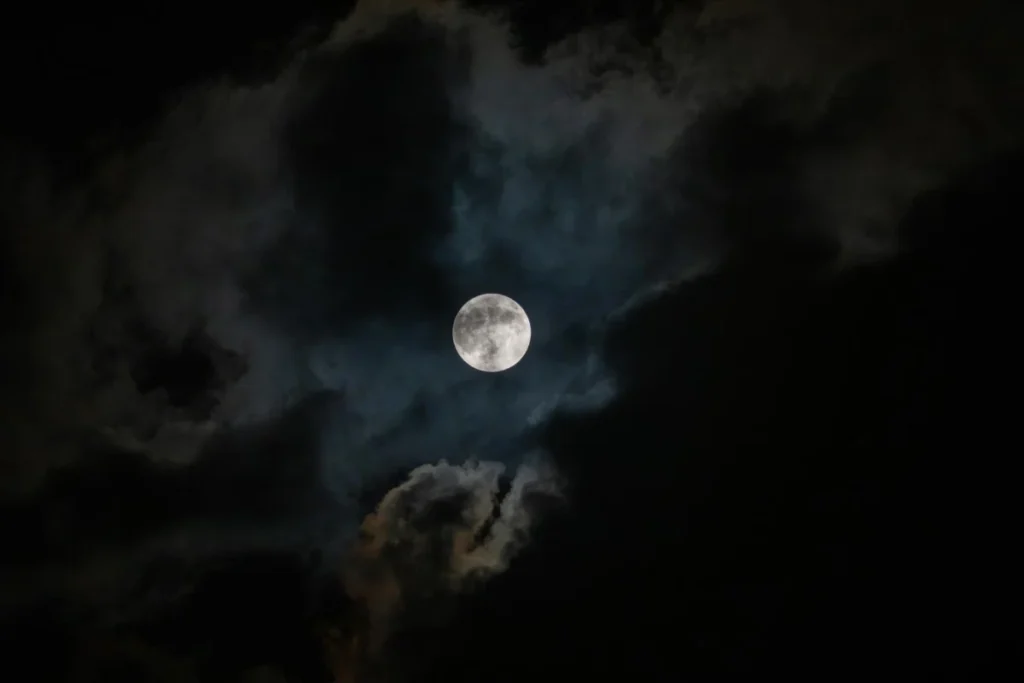
On August 28, 2026, a captivating astronomical event unfolded as the Moon gracefully traversed Earth’s shadow, resulting in a profound partial lunar eclipse. For observers in many parts of the Americas, western Europe, and western Africa, the night sky offered a dramatic display of celestial mechanics. The peak of this cosmic theater occurred at precisely 12:13 a.m. Eastern Daylight Time (EDT), a moment when an astonishing 96.3% of the lunar disk was enshrouded within Earth’s umbra. This is the darkest, central portion of our planet’s shadow, where direct sunlight is completely obscured, transforming the familiar Moon into a deeply hued, partially obscured orb. While many regions experienced this phenomenon in the early hours of August 28th, the timing shifted to the evening of August 27th in certain time zones, extending the viewing window for a global audience.
The Mechanics of a Lunar Eclipse
Lunar eclipses occur when the Earth positions itself directly between the Sun and the Moon, casting its shadow upon the lunar surface. This alignment is not a nightly occurrence because the Moon’s orbit around Earth is tilted by approximately five degrees relative to Earth’s orbit around the Sun. For an eclipse to take place, the Moon must be at or near one of the two points where its orbit intersects the plane of Earth’s orbit, known as the nodes. During a partial lunar eclipse, only a portion of the Moon passes through the umbra. The extent of this immersion determines the depth of the eclipse. In this instance, with nearly 97% of the Moon submerged in the umbra, it qualified as a deep partial lunar eclipse, a spectacle that often elicits wonder and awe.
The Earth’s shadow is not uniform. It consists of two parts: the umbra and the penumbra. The umbra is the darker, inner shadow where direct sunlight is completely blocked. The penumbra is a lighter, outer shadow where sunlight is only partially blocked. A lunar eclipse can be a total lunar eclipse (when the entire Moon passes through the umbra), a partial lunar eclipse (when only a portion of the Moon passes through the umbra), or a penumbral lunar eclipse (when the Moon passes only through the penumbra, resulting in a subtle dimming). The eclipse of August 28, 2026, was a significant partial event, offering a dramatic visual of Earth’s shadow’s reach.
A Glimpse from Southern Louisiana
The striking image accompanying this report was captured from southern Louisiana, a region with profound ties to the United States’ space exploration endeavors. This area is home to NASA’s Michoud Assembly Facility, a national treasure renowned as the premier site for the manufacturing and assembly of large-scale space structures and systems. For decades, Michoud has been instrumental in building critical components for America’s space program, from the Saturn V rockets of the Apollo era to the external fuel tanks of the Space Shuttle. Most recently, it has been the birthplace of the core stages for the Space Launch System (SLS) rocket, the colossal launch vehicle powering NASA’s ambitious Artemis program. The Artemis program aims to return humans to the Moon and establish a sustainable lunar presence, paving the way for future missions to Mars. The backdrop of this celestial event against the landscape of a region so intrinsically linked to humanity’s reach for the stars adds a layer of poetic resonance to the astronomical display.
Timeline of the Celestial Event
The lunar eclipse of August 28, 2026, progressed through several distinct phases, offering varying degrees of visibility and spectacle:
- Partial Eclipse Begins: The Moon first began to enter Earth’s penumbra, a subtle dimming that is often difficult to observe without careful attention. This marked the official start of the eclipse.
- Partial Eclipse Deepens: As the Moon continued its transit, it entered the umbra. This is when the most dramatic visual changes become apparent. The dark shadow of the Earth began to creep across the lunar disk, gradually obscuring more and more of its surface.
- Maximum Eclipse: This was the peak of the event, occurring at 12:13 a.m. EDT. At this precise moment, 96.3% of the Moon was engulfed in the umbra, presenting the deepest phase of the partial eclipse. Observers would have witnessed a significant portion of the Moon appearing darkened, with only a sliver remaining illuminated.
- Partial Eclipse Ends: The Moon began to emerge from the umbra, with the shadow receding from the lunar surface. The illuminated portion of the Moon gradually increased.
- Penumbral Eclipse Ends: Finally, the Moon exited the penumbra, and the eclipse concluded. The subtle dimming caused by the penumbra is often overlooked, but it signifies the full duration of Earth’s shadow interaction with the Moon.
The duration of the partial eclipse phase, from the moment the Moon entered the umbra to the moment it exited, was substantial, allowing ample time for observation. The period of greatest eclipse, when the obscuration was at its maximum, was a particularly captivating moment for stargazers.
Supporting Astronomical Data and Context
The distance between the Earth and the Moon varies throughout their orbits. At the time of the eclipse, the Moon was at a distance of approximately 384,400 kilometers (238,900 miles) from Earth. The size of Earth’s umbra at the Moon’s orbital distance is significant, typically around 90,000 kilometers (56,000 miles) in diameter. The fact that 96.3% of the Moon’s disk was immersed indicates that the Moon’s path through the umbra was very close to its center.
Lunar eclipses are predictable events, governed by the orbital mechanics of the Earth-Moon-Sun system. The Saros cycle, a period of approximately 18 years, 11 days, and 8 hours, is a remarkable astronomical phenomenon that describes a recurring pattern of eclipses. Eclipses that occur during one Saros cycle are eerily similar to those that occur during the next, with the Moon shifting slightly north or south with each cycle. This predictability allows astronomers and skywatchers to anticipate these celestial events years in advance.
The color of the Moon during a total or deep partial lunar eclipse can also be quite striking. While the Moon is in Earth’s umbra, it doesn’t disappear entirely. Instead, it often takes on a reddish or coppery hue. This phenomenon, known as "Blood Moon," occurs because sunlight that passes through Earth’s atmosphere is refracted (bent) and scattered. Blue light is scattered more effectively by atmospheric particles, leaving the longer, redder wavelengths to pass through and illuminate the Moon. The exact color and brightness depend on the state of Earth’s atmosphere at the time of the eclipse, including factors like cloud cover and the presence of volcanic dust. While this particular eclipse was partial, the deepest stages of immersion can still exhibit subtle colorations.
Broader Implications and Public Engagement
Astronomical events like this deep partial lunar eclipse serve as powerful catalysts for public engagement with science. They offer accessible opportunities for people of all ages to connect with the cosmos and appreciate the wonders of our solar system. Educational institutions, amateur astronomy clubs, and science museums often organize viewing parties and educational programs around such events. The visual spectacle encourages curiosity about astronomy, physics, and the scientific methods used to predict and understand these celestial occurrences.
Furthermore, the image captured from southern Louisiana highlights the intersection of space exploration and terrestrial phenomena. The Michoud Assembly Facility, a hub of innovation for future space missions, was bathed in the dim light of an eclipsed Moon, a poignant reminder of humanity’s place within the vastness of the universe. As NASA continues to push the boundaries of space exploration with programs like Artemis, the public’s connection to space is fostered not only through the achievements of astronauts and engineers but also through shared experiences of witnessing celestial marvels from our own planet.
The successful observation of this deep partial lunar eclipse across such a wide geographical area underscores the interconnectedness of our planet and the shared experience of observing the cosmos. It serves as a reminder that despite our terrestrial differences, we all share the same sky, and the celestial ballet above offers a unifying spectacle for humanity. The continued study and observation of lunar eclipses contribute to our understanding of orbital mechanics, Earth’s atmosphere, and the intricate workings of our solar system, inspiring future generations of scientists, explorers, and curious minds.