Physicists at the U.S. Department of Energy’s Thomas Jefferson National Accelerator Facility have announced the identification of two previously unknown subatomic structures, a discovery that promises to reshape the understanding of the "particle zoo" and the fundamental forces that govern the universe. These findings, emerging from the GlueX Collaboration, provide critical new data on the enigmatic XYZ states—particles that defy the traditional classifications of the quark model. By utilizing a high-energy photon beam to probe the internal structure of protons, the research team has opened a new window into the "strangeonium" sector of particle physics, revealing signals that suggest the existence of exotic matter configurations beyond the standard two-quark or three-quark systems.
The Evolution of the Particle Zoo: From Simplicity to Complexity
The journey to this discovery began in the mid-20th century, an era often referred to as the "Golden Age" of particle physics. Throughout the 1950s and 1960s, high-energy collision experiments began to reveal an overwhelming number of subatomic particles known as hadrons. Initially, these discoveries were met with confusion, as the sheer volume of new particles—collectively dubbed the "particle zoo"—seemed to contradict the idea of a simple, elegant universe.
In 1964, Murray Gell-Mann and George Zweig independently proposed the quark model to bring order to this chaos. They suggested that hadrons were not fundamental but were instead composed of smaller entities called quarks. In this original framework, hadrons were divided into two main categories: baryons (such as protons and neutrons), which contain three quarks, and mesons, which consist of a quark and an antiquark pair. At the time, only three "flavors" of quarks were known: up, down, and strange.
The landscape of physics was further transformed in 1974 during the "November Revolution," when the discovery of the J/psi particle confirmed the existence of a fourth quark flavor: charm. This discovery was pivotal in establishing the Standard Model of particle physics, which eventually grew to include six flavors of quarks (up, down, strange, charm, top, and bottom) and the gluons that carry the strong nuclear force. However, as experimental technology advanced in the 21st century, researchers began to encounter particles that did not fit the neat "three-quark" or "quark-antiquark" descriptions. These anomalies became known as the XYZ states.
Deciphering the XYZ States and the Mystery of Strangeonium
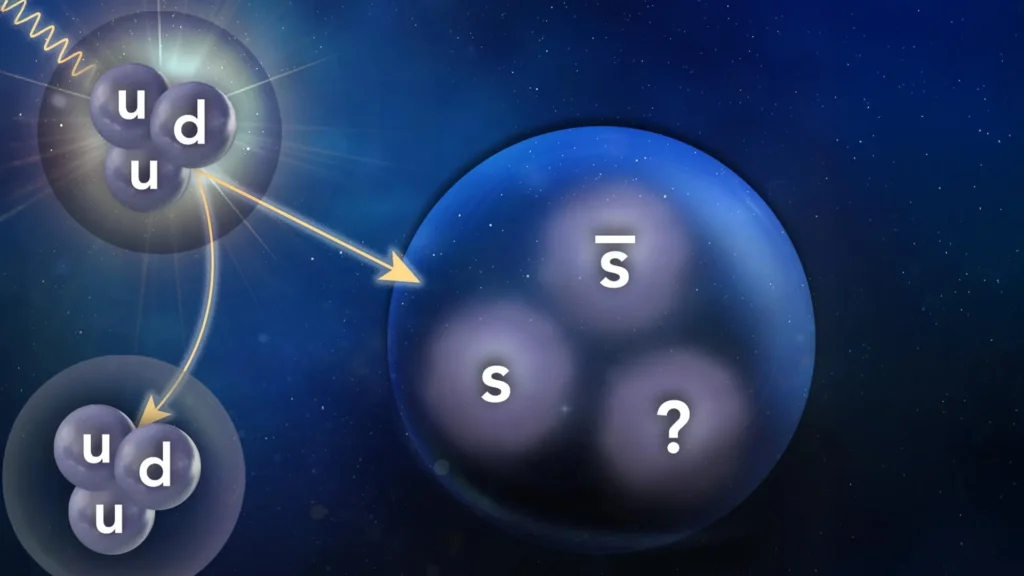
The XYZ states represent a frontier of modern nuclear physics. Unlike conventional hadrons, these states exhibit quantum properties and decay patterns that suggest more complex internal structures. Theorists have proposed several possibilities for what these states might be: tetraquarks (four quarks), pentaquarks (five quarks), hadronic molecules (two mesons loosely bound together), or hybrid mesons (a quark-antiquark pair with an "excited" or active gluonic field).
Much of the research into these exotic states has focused on the "charmonium" sector, which involves particles containing charm and anti-charm quarks. However, the "strangeonium" sector—particles containing strange and anti-strange quarks—offers an equally vital but less explored testing ground for Quantum Chromodynamics (QCD), the theory describing the strong force.
In 2006, the BaBar experiment at the SLAC National Accelerator Laboratory identified a potential strangeonium XYZ state named Y(2175), with a mass of approximately 2.16 billion electron volts (GeV). This state was produced through electron-positron ($e^+e^-$) annihilation, a process where matter and antimatter collide to create a burst of energy that then condenses into new particles. While subsequent experiments like BESIII in China and Belle in Japan confirmed the existence of Y(2175), its exact nature remained a subject of intense debate. Was it a simple meson, a tetraquark, or a hybrid state containing excited gluons? To solve this mystery, scientists needed to see if the particle could be produced through different physical processes, such as photoproduction.
The GlueX Experiment: A Unique Approach to Particle Detection
The GlueX Collaboration at Jefferson Lab set out to investigate these exotic states using a fundamentally different method. Located in Experimental Hall D, the GlueX experiment is uniquely designed to search for hybrid mesons. Instead of colliding electrons and positrons, GlueX utilizes the Continuous Electron Beam Accelerator Facility (CEBAF) to produce a beam of high-energy photons.
The process is a marvel of modern engineering. CEBAF’s electron beam is directed at an ultrathin diamond wafer. Through a process called coherent bremsstrahlung, the electrons decelerate as they pass through the diamond’s crystal lattice, emitting a beam of "linearly polarized" photons. These photons—possessing specific energy and spin characteristics—then strike a target of liquid hydrogen. When a photon interacts with a proton in the hydrogen target, it can produce a spray of subatomic particles.
"No other experiment has a facility with a photon beam of this intensity at the energy we have available," noted Malte Albrecht, a staff scientist at Jefferson Lab. This unique setup allows researchers to probe hadronic structures that are inaccessible to electron-positron colliders, providing a complementary view of the subatomic world.
Unexpected Signals: The Discovery of Y(2240) and X(1830)
The primary objective of the GlueX study, recently published in Physical Review Letters, was to search for the Y(2175) state via photoproduction. However, in a surprising twist that frequently characterizes breakthrough science, the expected signal for Y(2175) did not appear. Instead, the data revealed two entirely different structures at nearby masses.
The first signal, designated Y(2240), was detected at a mass of approximately 2.24 GeV. The statistical significance of this discovery is exceptionally high, reaching the "five-sigma" ($5sigma$) threshold. In particle physics, a five-sigma result represents a confidence level of 99.9994%, effectively ruling out the possibility that the signal is a statistical fluke. This level of certainty is the gold standard for claiming a formal discovery of a new particle or state.
The second signal, labeled X(1830), appeared at a lower mass of approximately 1.82 GeV. While its significance was lower—reaching three-sigma ($3sigma$), or a 99.7% confidence level—it remains a highly notable observation that warrants further investigation.
The absence of Y(2175) in the photoproduction data is as significant as the discovery of the new signals. It establishes a rigorous "upper limit" on the production cross-section of Y(2175), suggesting that its internal structure may not couple easily with photons. Conversely, the clear appearance of Y(2240) suggests that this new state has properties that make it more susceptible to being created through photon-proton interactions.
Statistical Rigor and Scientific Implications
The precision of the GlueX data allows theorists to begin the arduous task of modeling these new states. The transition from observation to classification requires a deep dive into the dynamics of the strong force.
"The next step is to figure out which exotic quark configurations nature might have realized here," said Frank Nerling, a collaborator from the GSI Helmholtz Centre for Heavy Ion Research. The discovery of Y(2240) and X(1830) provides two new data points in a region of the mass spectrum that was previously poorly understood.
One of the most exciting prospects is that these structures could be "hybrid mesons." In a typical meson, the gluons act merely as the "glue" holding the quark and antiquark together. In a hybrid meson, the gluonic field itself is excited and contributes directly to the particle’s quantum numbers (spin, parity, and charge conjugation). Identifying such states would provide a direct confirmation of a key prediction of Quantum Chromodynamics: that gluons, which carry the color charge of the strong force, can themselves exist in excited states within matter.
Broader Impact on the Standard Model and Nuclear Physics
The implications of the GlueX findings extend beyond the identification of two new particles. They represent a significant step forward in our understanding of how matter is assembled. While the Standard Model has been remarkably successful at predicting the behavior of elementary particles, the transition from individual quarks to complex hadrons remains one of the "great mysteries" of physics. This is known as the problem of confinement—the fact that quarks are never found in isolation, but are always locked inside hadrons.
By mapping the XYZ states in the strangeonium sector, researchers are essentially stress-testing the Standard Model. If these new states are confirmed as tetraquarks or hybrid mesons, they will provide vital information on how the strong force operates at the scale of the atomic nucleus.
Furthermore, the GlueX results highlight the importance of diverse experimental approaches. The fact that $e^+e^-$ colliders and photon beam experiments see different "slices" of the particle landscape underscores the necessity of facilities like Jefferson Lab. Klaus Goetzen, a GSI physicist, emphasized the complexity of this collaborative effort: "The challenge is that you have many measurements around the world in very different experiments that have to find consensus about what they are seeing."
A New Era of Hadron Spectroscopy
The discovery of Y(2240) and X(1830) marks the beginning of a new chapter for the GlueX Collaboration and the global physics community. The experiment has already collected vast amounts of data—filling petabytes of storage—that researchers are only beginning to sift through.
"It really opens the door for a whole new set of hadron spectroscopy measurements we can make with GlueX," said Justin Stevens, a professor at William & Mary and spokesperson for the collaboration. "We’ve got much more data to sort through, so this is just the beginning of the story."
As the scientific community digests these results, the focus will shift toward higher-statistics studies and the search for other "missing" states. The goal is not just to find new particles, but to construct a comprehensive map of the subatomic world that accounts for all possible configurations of quarks and gluons. In doing so, physicists hope to finally answer the fundamental question: what are the ultimate building blocks of the universe, and how does the "glue" of the strong force hold them together? For now, the "particle zoo" has two new residents, and the map of reality has become a little more detailed, and a lot more interesting.