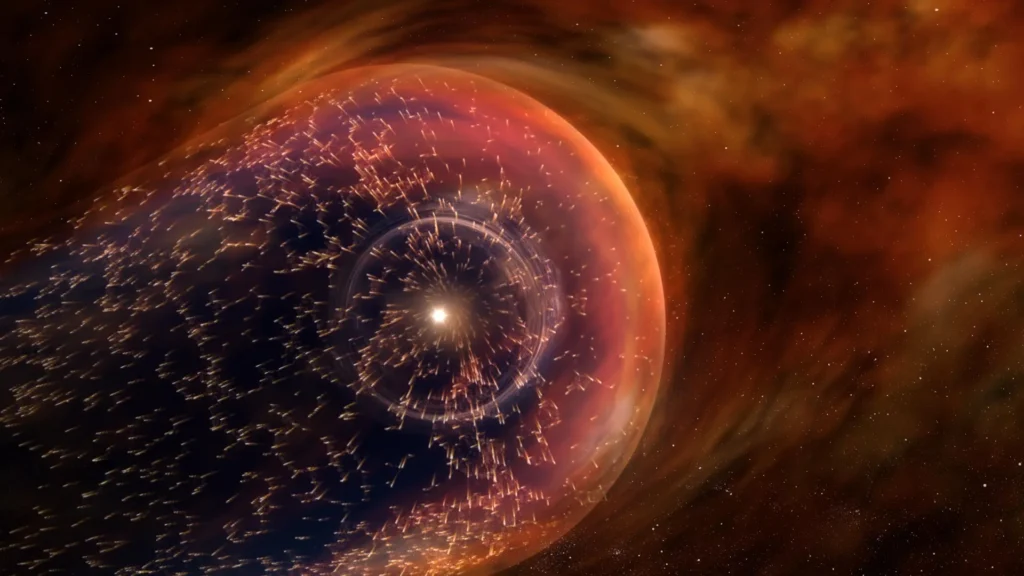
The Sun, our star, is far more than just a celestial lamp and heater. Two recent NASA-funded research initiatives are illuminating previously unseen ways in which solar events from Earth’s deep past may have profoundly influenced our planet’s climate, from driving ancient temperature fluctuations to providing the crucial warmth needed for liquid water and the genesis of life on our nascent world. These studies, one focusing on the heliosphere’s cosmic journey and the other on the volatile nature of the young Sun, paint a complex picture of Earth’s long-standing dependence on its star.
The Heliosphere’s Galactic Odyssey: A Shield Under Pressure
One of the groundbreaking studies, emanating from NASA’s SHIELD (Solar Wind with Hydrogen Ion charge Exchange and Large-Scale Dynamics) center, a key component of NASA’s DRIVE (Diversify, Realize, Integrate, Venture, Educate) Science Centers, has delved into the heliosphere’s ancient travels through the Milky Way galaxy. The heliosphere, an immense protective bubble sculpted by the solar wind, envelops our entire solar system. The research suggests that fluctuations in the galactic environment surrounding this bubble could have exerted significant influence on Earth’s atmospheric conditions and, consequently, its climate.
For eons, Earth’s climate has undergone dramatic transformations. Epochs of glaciation have seen global average temperatures plummet by several degrees Celsius, while other periods have been characterized by volatile swings between warmer and cooler conditions. Traditionally, scientists have attributed these climatic shifts to factors originating within our own planet, such as variations in Earth’s orbital parameters, fluctuations in atmospheric greenhouse gas concentrations, and changes in ice coverage. However, this new research posits that the external space environment, particularly the dynamic conditions encountered by the heliosphere, may have played a pivotal, yet previously underestimated, role.
The heliosphere, analogous to Earth’s atmosphere but far vaster, is formed by the ceaseless outward flow of charged particles from the Sun, known as the solar wind. This constant outward pressure creates a protective bubble that shields the inner solar system from the harsher interstellar medium. The entire solar system, nestled within this heliospheric embrace, embarks on a grand, billions-of-years-long journey around the center of the Milky Way galaxy. Over the Sun’s 4.6-billion-year existence, this cosmic voyage has taken the solar system through a diverse array of galactic environments.
Reconstructing the Heliosphere’s Path Through Interstellar Space
Published on August 21st in the esteemed journal Annual Review of Astronomy and Astrophysics, the SHIELD study utilized sophisticated computer simulations to meticulously reconstruct the heliosphere’s historical trajectory through the galaxy. The findings indicate that certain regions traversed by the solar system may have triggered discernible changes on Earth.
Merav Opher, the principal investigator for SHIELD at Boston University, and her team meticulously simulated the solar system’s encounters with exceptionally cold regions rich in gas and dust. Their modeling suggests that the Sun has passed through such environments at least three times over the past several million years. During these encounters, immense interstellar "cold clouds" may have exerted substantial pressure on the heliosphere, compressing it significantly. The simulations indicate that the heliosphere could have shrunk to a size smaller than Earth’s orbit, effectively leaving our planet temporarily exposed to the raw interstellar environment, stripped of its solar shield.
When Earth Lost Its Solar Sanctuary
The modeled periods of heliospheric contraction are estimated to have occurred approximately 2 to 3 million years ago, 6 to 7 million years ago, and 13 to 14 million years ago. If these simulations accurately reflect past events, Earth’s atmosphere would have been directly exposed to a markedly different interstellar medium during these crucial junctures.
Intriguingly, the timing of these modeled events aligns remarkably well with geological evidence. The presence of elements typically associated with interstellar dust has been detected in deep-sea sediment cores, Antarctic snow samples, and lunar samples, all dating back to these specific prehistoric periods. This corroboration lends significant weight to the hypothesis that Earth’s protective heliospheric bubble may have indeed collapsed.
These episodes of heliospheric contraction could also offer an explanation for some of Earth’s ancient climatic patterns. The simulations revealed that when Earth’s atmosphere was exposed to dense, cold clouds of galactic hydrogen, it led to an increase in atmospheric water vapor and significant alterations in the conditions of the upper atmosphere. These changes, in turn, would have propagated downwards, influencing surface-level climate. The research thus raises the compelling possibility that the solar system’s passages through colder, denser regions of the Milky Way contributed to long-term climatic shifts on Earth, potentially including the onset of ice ages.
Building a Digital Twin of Our Cosmic Shield
NASA’s commitment to advancing heliophysics is underscored by its funding of SHIELD as one of several dedicated DRIVE Science Centers. These centers foster collaboration among researchers with diverse expertise, methodologies, and scientific viewpoints. A primary objective for SHIELD is the creation of a detailed computational model, or "digital twin," of the heliosphere. Such a model is anticipated to enhance our understanding of how the Sun’s protective bubble responds to interactions with various interstellar features, such as dense clouds.
The study of our heliosphere’s history and structure also holds implications for understanding the evolution of life itself. By gaining deeper insights into the conditions that fostered habitability within our own solar system, scientists may be better equipped to identify other star systems that harbor potentially habitable worlds.
The Riddle of the Faint Young Sun: A Violent Beginning
A second, equally significant study tackles a different, yet equally ancient, puzzle: how early Earth managed to sustain liquid water and potentially harbor life when the young Sun was considerably dimmer than it is today. This conundrum, known as the Faint Young Sun paradox, presents a stark contradiction between theoretical expectations and geological evidence.
Vladimir Airapetian, a scientist at NASA’s Goddard Space Flight Center in Greenbelt, Maryland, and his research collaborators investigated the conditions on early Earth. Approximately three billion years ago, the Sun’s luminosity was only about 70% of its current output. Based on this reduced energy flux, theoretical models predict that Earth should have been a frozen, inhospitable planet. However, geological records unequivocally demonstrate the existence of stable liquid water on Earth from a much earlier epoch.
Superflares: The Key to an Early Warmth?
The prevailing hypothesis to resolve this paradox involves examining the behavior of young stars elsewhere in the Milky Way that bear resemblance to our early Sun. These "toddler" stars are characterized by significantly higher levels of activity compared to mature stars. Observations from NASA’s now-retired Kepler space telescope have revealed that young Sun-like stars can unleash colossal superflares on a nearly daily basis, propelling streams of high-energy particles through space.
Airapetian’s team proposes that if the young Sun exhibited similar energetic behavior, these particle streams could have triggered crucial chemical reactions within Earth’s early atmosphere, thereby generating enough heat to keep the planet warm. To test this compelling hypothesis, the researchers meticulously recreated the presumed atmospheric conditions of early Earth within a sealed laboratory chamber. Their experimental setup involved a mixture of key atmospheric gases, including molecular nitrogen, ammonia, carbon dioxide, and carbon monoxide.
They then subjected this gas mixture to bombardment by protons, simulating the energetic particle flux expected from solar superflares.
Superflares and the Genesis of a Potent Greenhouse Gas
The simulated particle bombardment yielded a series of significant chemical transformations, most notably the production of nitrous oxide (N₂O). Nitrous oxide is a potent greenhouse gas, estimated to be roughly 300 times more effective at trapping heat than carbon dioxide. This discovery, published in Astrophysical Journal Letters, offers a plausible mechanism for warming early Earth.
The generated nitrous oxide would have acted to trap the Sun’s radiant heat, preventing it from escaping into space. However, the researchers acknowledge that not all of the produced nitrous oxide would have remained in the atmosphere indefinitely. The intense ultraviolet radiation from the young Sun would have gradually broken down some of these molecules, reverting them back into nitrogen and oxygen.
Despite this degradation, the study’s findings suggest that even a relatively small amount of sustained nitrous oxide could have been sufficient to maintain habitable temperatures. Computer simulations indicated that if just 10% of the laboratory-produced nitrous oxide had persisted in the atmosphere, it could have elevated temperatures near Earth’s equator to approximately 5 degrees Celsius (41 degrees Fahrenheit), a temperature well above the freezing point of water.
Favorable Conditions for the Emergence of Life
A cooler, yet unfrozen, early Earth may have offered another serendipitous advantage. The reduced, but still present, levels of nitrous oxide could have also facilitated prebiotic chemical reactions. Research has indicated that temperatures only slightly above freezing can be more conducive than warmer conditions for the complex assembly of amino acid chains, the fundamental building blocks of life.
This suggests that the violent activity of the young Sun might have accomplished more than simply preventing Earth from freezing. It may have also played a role in creating an environment where the complex chemistry that preceded the origin of life could flourish.
A Cosmic Dance: The Sun’s Enduring Influence on Earth
Taken together, these two remarkable studies underscore the profound and intricate connection between Earth’s history and the Sun. The solar system’s dynamic journey through the Milky Way may have periodically exposed Earth to altering interstellar environments, capable of significantly influencing its climate. Furthermore, billions of years prior, the intense energetic activity of the young Sun may have provided the essential warmth to keep our planet from succumbing to a perpetual freeze, at a time when its own light would have been insufficient.
Earth, while possessing unique characteristics, has never existed in isolation. It formed within a complex star-planet system and has remained inextricably linked to the evolving behavior and surrounding environment of its star throughout its long history. Unraveling this profound relationship promises to yield new insights into Earth’s climate dynamics, the evolution of life, and the fundamental conditions that might render other planetary systems capable of supporting life. This ongoing research not only deepens our understanding of our own planet’s past but also informs our search for habitable worlds beyond our solar system.