A groundbreaking study spearheaded by researchers at the University of Warwick has introduced the first unified methodology for identifying "spacetime fluctuations"—minute, random distortions within the fabric of spacetime, long theorized as a crucial link between quantum physics and gravity. This innovative framework translates abstract theoretical predictions into concrete, measurable signals, paving the way for experimental validation of some of the most profound theories in modern physics using existing laser interferometers.
The Quest for Quantum Gravity and Spacetime Foam
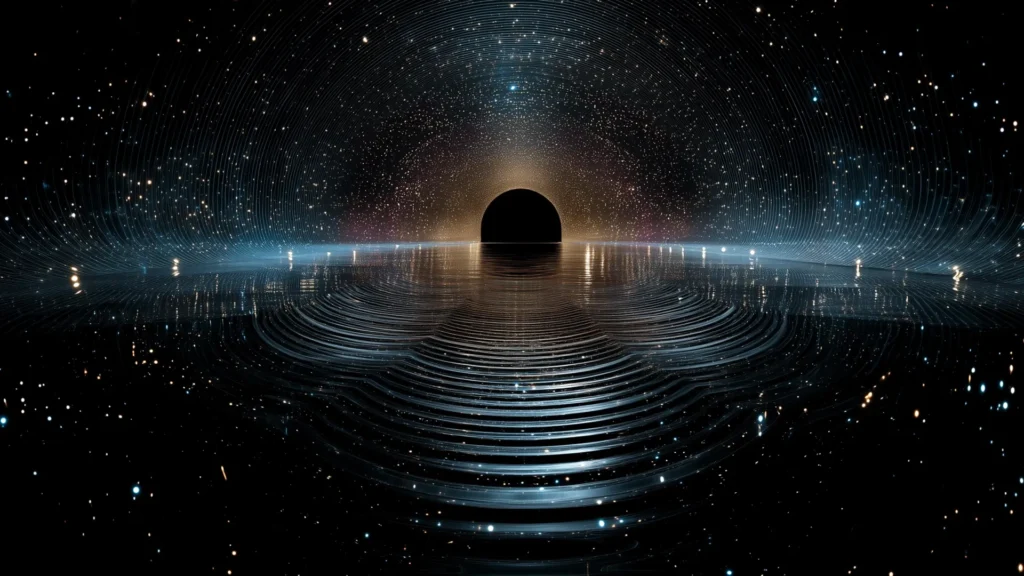
The universe, as understood through general relativity, describes gravity as the curvature of a smooth, continuous spacetime fabric. However, at the minuscule scales governed by quantum mechanics, the very notion of a smooth spacetime is challenged. Here, the quantum realm predicts a fundamentally "foamy" or fluctuating structure, a concept famously dubbed "spacetime foam" by physicist John Wheeler in the mid-20th century. Wheeler, in his seminal work in the 1950s and 1960s, proposed that at the Planck scale—an unimaginably small distance of approximately 10⁻³⁵ meters—spacetime itself might cease to be smooth and instead exhibit chaotic, quantum-driven fluctuations, akin to the turbulent surface of a boiling liquid. These minute variations are not merely theoretical curiosities; they are central to various leading quantum gravity theories, including string theory, loop quantum gravity, and other quantum field theories in curved spacetime.
The fundamental challenge in unifying quantum mechanics, which governs the microscopic world of particles and forces, with general relativity, which describes gravity and the large-scale structure of the cosmos, lies in the incompatibility of their underlying mathematical frameworks and conceptual descriptions of reality. Quantum mechanics posits that energy, momentum, and other quantities are quantized, existing in discrete packets, and that phenomena are inherently probabilistic. General relativity, on the other hand, describes gravity as a deterministic curvature of a continuous spacetime manifold. Spacetime fluctuations are precisely the quantum effects that are expected to manifest when gravity itself becomes subject to quantum rules, bridging this theoretical chasm.
Despite their theoretical ubiquity, the diversity of quantum gravity models has presented a significant hurdle for experimental physicists. Different theories predict different types, magnitudes, and characteristics of these fluctuations, making it exceedingly difficult to pinpoint exactly what signals to look for in laboratory settings. This ambiguity has, until now, left experimentalists without a clear, consolidated target, rendering the search for empirical evidence of quantum gravity a formidable task.
A Unified Approach: Categorizing the Elusive
The new research, recently published in the prestigious journal Nature Communications, directly addresses this long-standing experimental bottleneck. The team has developed a comprehensive methodology that groups spacetime fluctuations into three primary categories, based on their distinct behaviors across spatial and temporal dimensions. This categorization is not arbitrary; it systematically organizes the myriad predictions from various quantum gravity theories, making them amenable to experimental detection.
While the specific mathematical details of these categories are complex, they broadly encompass fluctuations that might manifest predominantly as temporal jitter (affecting the flow of time), spatial distortions (affecting distances), or intricate spatio-temporal correlations. For each of these categories, the researchers meticulously identified clear, measurable patterns—or "signatures"—that could be detected using highly sensitive laser interferometers.
These interferometers are sophisticated instruments designed to measure tiny changes in distance with extraordinary precision, typically by splitting a laser beam into two paths, reflecting them off mirrors, and then recombining them. Any minuscule distortion in spacetime that alters the length of one path relative to the other would manifest as an interference pattern, which can then be analyzed. The research indicates that these detectable signals range from those observable by colossal, kilometer-scale systems like the Laser Interferometer Gravitational-Wave Observatory (LIGO) to smaller, yet incredibly precise, experimental setups currently under development, such as QUEST (Quantum Experiments at Space-Time) in the UK (led by Cardiff University) and GQuEST (Gravitational Quantum Experiment for Space-Time) in the USA (at Caltech).
Turning Theoretical Abstraction into Measurable Reality
Dr. Sharmila Balamurugan, Assistant Professor at the University of Warwick and the lead author of the study, emphasized the transformative nature of this work. "Different models of gravity predict very different underlying trends in the random spacetime fluctuations, and that has left experimentalists without a clear target," Dr. Balamurugan explained. "Our work provides the first unified guide that translates these abstract, theoretical predictions into concrete, measurable signals. It means we can now test a whole class of quantum-gravity predictions using existing interferometers, rather than waiting for entirely new technologies. This is an important step towards bringing some of the most fundamental questions in physics firmly into the realm of experiment."
This statement highlights a critical advantage: the framework’s compatibility with current technology. Building new instruments capable of probing quantum gravity scales would be an endeavor spanning decades and billions of dollars. By providing a roadmap for existing interferometers, the Warwick-led team has significantly accelerated the potential for empirical discoveries in this field.
The Power of Laser Interferometers in the Quantum Gravity Hunt
Laser interferometers have revolutionized astrophysics and fundamental physics, most notably through the direct detection of gravitational waves in 2015 by LIGO. The LIGO experiment, with its two detectors in Hanford, Washington, and Livingston, Louisiana, each featuring 4-kilometer-long arms, can detect changes in distance as small as one-thousandth the diameter of a proton over that immense length. Its success, along with that of its sister detectors VIRGO (Italy) and KAGRA (Japan), demonstrates the unparalleled sensitivity of these instruments.
Dr. Sander Vermeulen, a co-author of the study from Caltech, underscored the unique capabilities of these detectors. "Interferometers can measure spacetime with extraordinary precision. However, to measure spacetime fluctuations with an interferometer, we need to know where—i.e., at what frequency—to look, and what the signal will look like. With our framework, we can now predict this for a wide range of theories. Our results show that interferometers are powerful and versatile tools in the quest for quantum gravity."
The ability to predict the frequency and specific waveform of a potential signal is paramount. Just as astronomers search for specific radio frequencies to detect signals from distant galaxies, physicists need to tune their interferometers to the predicted characteristics of spacetime fluctuations. This framework provides that crucial tuning guide, transforming a blind search into a targeted investigation. The findings also detailed important insights into how different types of interferometers might be optimally configured or sensitive to particular categories of fluctuations. For instance, large-scale ground-based interferometers like LIGO might be more attuned to certain low-frequency fluctuations, while smaller, tabletop experiments like QUEST and GQuEST could probe higher-frequency or localized phenomena.
Broader Implications and Future Directions
An important strength of this newly developed framework lies in its remarkable flexibility. It does not depend on any single, specific theoretical explanation for how these spacetime fluctuations arise. Instead, it only requires a mathematical description of the proposed fluctuations and detailed information about the measurement setup. This inherent adaptability makes the framework incredibly useful beyond the immediate scope of quantum gravity.
Professor Animesh Datta, Professor of Theoretical Physics at Warwick and a co-author, elaborated on this versatility. "With this methodology, we can now treat any proposed model of spacetime fluctuations in a consistent, comparable way," he stated. "In the coming years, we can use this to design smarter tabletop interferometers to confirm or refute possible theories of quantum or semiclassical gravity and even test new ideas about dark matter and stochastic gravitational waves."
This flexibility opens up several exciting avenues for future research:
- Stochastic Gravitational Waves: The framework can be applied to characterize and search for stochastic gravitational wave backgrounds—a persistent hum of gravitational waves from numerous unresolved astrophysical sources (like binary black hole mergers across cosmic history) or even from events in the very early universe.
- Dark Matter Signals: Certain theoretical models propose that dark matter particles could interact with or manifest as subtle fluctuations in spacetime. The unified framework provides a new lens through which to search for these elusive particles, potentially guiding experiments designed to detect non-gravitational dark matter interactions.
- Experimental Noise Characterization: Even within existing experiments, understanding and distinguishing between fundamental spacetime fluctuations and various sources of experimental noise (seismic activity, thermal fluctuations, quantum noise) is critical. The framework can help characterize these noise sources and refine detection strategies.
- Designing Next-Generation Experiments: By systematically categorizing and predicting signals, the research offers invaluable guidance for the design and optimization of future interferometer experiments, ensuring they are optimally configured to detect specific types of fluctuations or probe particular theoretical predictions.
The development of this framework is a testament to the collaborative nature of modern physics, bringing together theoretical insights with experimental ingenuity. It marks a significant shift from purely theoretical speculation about quantum gravity to a more empirical, data-driven approach. While the direct detection of spacetime fluctuations remains a monumental challenge, this research provides the essential toolkit to embark on that journey with renewed purpose and precision.
Chronology of a Decades-Long Quest:
- Mid-20th Century (1950s-1960s): John Wheeler proposes the concept of "spacetime foam," suggesting that spacetime is not smooth at the Planck scale but rather chaotic and fluctuating due to quantum effects. This lays the theoretical groundwork for spacetime fluctuations.
- Late 20th Century (1970s-1990s): Development of various quantum gravity theories (e.g., string theory, loop quantum gravity) which inherently predict different manifestations of spacetime fluctuations. The challenge of experimental verification becomes apparent due to the diversity of predictions.
- Early 2000s: Large-scale laser interferometers like LIGO begin operation, initially designed for gravitational wave detection, but also possessing the extraordinary sensitivity potentially needed for quantum gravity effects.
- 2015: LIGO makes the first direct detection of gravitational waves, demonstrating the incredible precision and capability of interferometric detectors and validating a key prediction of general relativity. This success fuels optimism for using such instruments for even more subtle phenomena.
- 2020s: Continued development of smaller, highly sensitive interferometers (e.g., QUEST, GQuEST) focused on exploring fundamental quantum effects in spacetime.
- Recent Publication (Nature Communications): The University of Warwick-led team publishes their unified framework, offering the first systematic guide for experimentalists to search for spacetime fluctuations across various quantum gravity theories using existing and near-future interferometers.
This work was made possible through crucial funding and collaborative efforts. The project received support from the UK STFC "Quantum Technologies for Fundamental Physics" program (Grant Numbers ST/T006404/1, ST/W006308/1, and ST/Y004493/1) and the Leverhulme Trust under research grants ECF-2024-124 and RPG-2019-022. These investments underscore the global commitment to unraveling the deepest mysteries of the universe, bringing the abstract concepts of quantum gravity closer to the realm of empirical observation. The unified framework represents a pivotal step in this ongoing scientific odyssey, transforming the elusive quest for spacetime fluctuations into a tangible experimental pursuit.