On August 12, 2026, a rare celestial event will captivate audiences across parts of Europe: a total solar eclipse. This phenomenon, where the Moon will completely obscure the Sun’s bright disc for a fleeting period, will unveil the Sun’s mysterious outer atmosphere, the solar corona, to naked-eye observers. While a breathtaking spectacle for the public, this event also represents a critical window for scientific inquiry, offering unique opportunities to study the Sun’s dynamic processes and their profound impact on Earth. European space agencies and research institutions are deploying a multi-pronged strategy, combining natural observations with advanced artificial eclipse technologies and sophisticated computer modelling, to maximize the scientific yield from this extraordinary cosmic alignment.
The impending eclipse path will traverse Greenland, Iceland, Spain, and Portugal, with totality lasting for a maximum of just over two minutes in specific locations. During this brief interval, daylight will recede into an eerie twilight, revealing the incandescent tendrils of the solar corona. This ethereal halo, normally lost in the Sun’s overwhelming glare, is the genesis of space weather – the dynamic conditions in space driven by solar activity that can significantly affect our technological infrastructure. Understanding the corona is paramount to predicting and mitigating these disruptive events.
The Science Behind the Shadow: Understanding Space Weather
The solar corona is not merely a beautiful visual phenomenon; it is the origin of the solar wind, a continuous stream of charged particles that propagates outward into the Solar System. It is also the source of energetic phenomena such as solar flares and coronal mass ejections (CMEs). These eruptions can unleash vast quantities of plasma and magnetic fields into space, posing a significant threat to our increasingly technology-dependent society. Disruptions to satellite networks, global communication systems, power grids, and even aviation are potential consequences of severe space weather events.
Historically, the study of the full solar corona has been largely confined to the brief and geographically dispersed moments of total solar eclipses. These natural events occur infrequently, typically once or twice a year, and their visibility is limited to narrow swathes of the Earth’s surface, with totality lasting mere minutes. This scarcity of observation time has presented a persistent challenge for solar physicists striving to unravel the complexities of the corona.
Artificial Eclipses: ESA’s Innovative Approach
To overcome the limitations of natural eclipses, scientists have developed ingenious methods to create "artificial eclipses" through instruments known as coronagraphs. These sophisticated telescopes incorporate a precisely engineered disc that blocks the Sun’s direct light, mimicking the Moon’s obscuring effect. However, conventional coronagraphs often struggle to capture detailed imagery of the inner corona, the crucial region immediately surrounding the Sun’s surface.
Addressing this observation gap, the European Space Agency (ESA) spearheaded the development and deployment of the Proba-3 mission, a groundbreaking initiative that effectively creates eclipses on demand. Proba-3 is not a single spacecraft but a carefully orchestrated pair of satellites, designated the Occulter and the Coronagraph. These two satellites fly in precise formation, maintaining a separation of approximately 150 meters, and operate autonomously as a unified system.
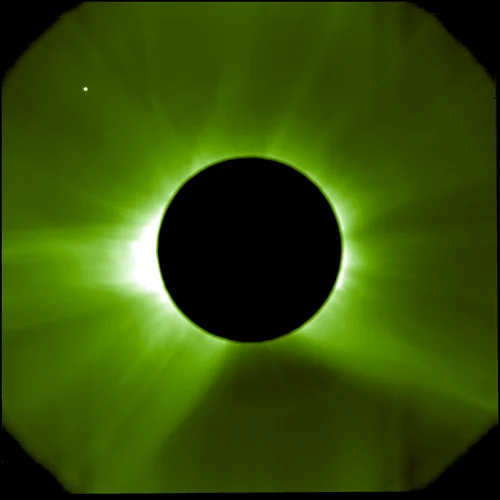
The Occulter spacecraft’s primary role is to position itself precisely between the Sun and the Coronagraph, effectively acting as an artificial Moon to eclipse the Sun. This controlled occultation allows the Coronagraph spacecraft’s scientific instrument, the Advanced Spaceborne Coronagraph for Imaging of Solar Activity (ASPIICS), to capture high-resolution images of the solar corona for extended periods, often spanning several hours.
Dr. Andrei Zhukov, principal investigator for the ASPIICS instrument at the Royal Observatory of Belgium, highlighted the mission’s recent achievements. "This marks the 62nd eclipse observed during Proba-3’s nominal operations," Dr. Zhukov stated. "What makes this particular observation exceptionally valuable is that it was acquired approximately two weeks prior to the upcoming natural eclipse on August 12th. Given the Sun’s rotation period, if we horizontally mirror this image, it provides an accurate prediction of what the corona will look like during the natural eclipse as viewed from Earth. The large-scale coronal structures typically exhibit stability over such periods, making this a powerful predictive tool."
Proba-3’s capability to generate prolonged artificial eclipses offers a unique advantage, allowing scientists to gather data that would be impossible to obtain during the fleeting moments of a natural eclipse. This continuous observation capability is crucial for understanding the evolution and dynamics of coronal structures.

Solar Orbiter: A Unique Vantage Point for a Comprehensive View
Complementing the innovative approach of Proba-3, ESA’s Solar Orbiter mission is undertaking a dedicated observation campaign in the lead-up to the August 12th eclipse. Solar Orbiter, a collaborative mission between ESA and NASA, boasts a unique trajectory around the Sun, providing perspectives that differ significantly from those of Earth-based observatories. This off-ecliptic vantage point is critical for a truly three-dimensional understanding of the Sun.
During totality, the structures within the solar corona, which are intricately shaped by the Sun’s magnetic field, become clearly visible. This presents an invaluable opportunity to validate and refine sophisticated computer models that simulate the Sun’s magnetic environment. "A total solar eclipse allows us to verify the accuracy of our models by comparing predictions with actual observations," explained Jorge Amaya, ESA’s Space Weather Modelling Coordinator. "This direct comparison is essential for improving our understanding of solar physics."
Most solar observations are conducted from near Earth, offering a limited view of a vast and complex three-dimensional system. Solar Orbiter’s distinct orbital path allows it to observe the side of the Sun that will be facing Earth during the eclipse. This "side view" provides crucial context for ground-based observations, enabling scientists to identify specific targets of interest and focus their eclipse observations more effectively.
Magnetograms: Unlocking the Sun’s Magnetic Secrets
A particularly valuable asset in Solar Orbiter’s arsenal is its Polarimetric and Helioseismic Imager (PHI) instrument. PHI captures detailed magnetic maps, or magnetograms, of the Sun’s visible surface. These magnetograms are essential for understanding the underlying magnetic field that drives coronal activity.
"The magnetic field lines we see in simulations can often appear like hairs in a fuzzy ball," Dr. Amaya elaborated. "By observing the Sun from multiple viewpoints, such as those provided by Solar Orbiter, we can determine the orientation of these field lines in three dimensions. This capability is key to dramatically improving our forecasts of how solar activity will impact our technology."
Recently, PHI has detected a newly emerging active region on the Sun, a phenomenon that is highly likely to influence the appearance of the corona during the August 12th eclipse. Identifying such active regions prior to an eclipse, thanks to Solar Orbiter’s unique perspective, allows for more targeted and informative observations. This advanced foresight was previously unattainable.
Furthermore, Solar Orbiter’s current position provides a preview of what ESA’s future space weather forecasting mission, Vigil, will observe. Vigil, slated for launch in 2031, is designed to maintain a position trailing Earth, offering continuous, near real-time monitoring of the Sun’s side. This will revolutionize space weather prediction and mitigation efforts.
Miho Janvier, ESA’s project scientist for both Proba-3 and Solar Orbiter, underscored the synergy between these missions. "With Proba-3 and Solar Orbiter, we have an unprecedented view of our star," Janvier stated. "Both missions are instrumental in deepening our understanding of the Sun, from its surface to its extensive atmosphere. The upcoming total solar eclipse presents a unique opportunity to see how this knowledge converges, comparing direct observations with sophisticated modelling."
Predictive Science: Crafting Virtual Totality
In parallel with the space-based missions, a significant effort is underway to create highly accurate predictions of the solar corona’s appearance during the eclipse. The Solar Orbiter team is actively sharing its unique data with Predictive Science Inc., a leading research organization specializing in solar physics. This collaboration aims to generate precise forecasts of the corona’s structure and dynamics during the August 12th event. These predictions are being made publicly available, allowing researchers and the public alike to visualize what to expect.

Furthermore, KU Leuven is contributing to ESA’s Space Weather Office by developing predictions specifically for the August 12th eclipse. These efforts by various scientific groups are converging to provide a comprehensive pre-eclipse understanding of the Sun’s behavior.
A Timeline of Discovery: From Natural Phenomena to Artificial Innovations
The scientific pursuit of understanding the solar corona has evolved significantly over time.
- Early Observations (Pre-20th Century): Total solar eclipses were the primary, albeit rare, occasions for observing the corona. Early astronomers noted its presence but lacked the tools and understanding to study it in detail.
- Invention of the Coronagraph (1930s): Bernard Lyot’s invention of the coronagraph revolutionized solar observation, allowing for continuous study of the corona from ground-based observatories, though still with limitations in observing the inner corona.
- Space Age Advancements (Mid-20th Century Onwards): The advent of space exploration opened new avenues. Satellites equipped with coronagraphs provided unobstructed views above Earth’s atmosphere, leading to significant advances in understanding solar wind and CMEs.
- Proba-3 Mission (Launched 2023): ESA’s Proba-3 mission represents a significant leap in artificial eclipse technology, enabling extended and detailed observation of the inner corona. Its successful operations are providing unprecedented data.
- Solar Orbiter Mission (Launched 2020): Solar Orbiter’s unique orbit and sophisticated instruments offer a novel perspective on the Sun, crucial for building a three-dimensional picture of its magnetic field and its influence on space weather.
- August 12, 2026, Total Solar Eclipse: This natural event serves as a focal point for consolidating data from natural and artificial observations, as well as advanced modelling, offering a unique opportunity to validate and advance our understanding of the Sun.
Broader Implications: Safeguarding Our Technological Future
The insights gained from the August 12, 2026, eclipse, amplified by the ongoing efforts of missions like Proba-3 and Solar Orbiter, have profound implications for our ability to forecast and mitigate space weather. Accurate predictions of solar activity are becoming increasingly critical as our reliance on space-based and terrestrial technologies grows.
The ability to understand the Sun’s magnetic field in three dimensions, as facilitated by multi-perspective observations, is key to developing more robust forecasting models. These improved forecasts will enable authorities to take preventative measures, such as temporarily shutting down sensitive power grids or rerouting satellite communications, thereby minimizing the impact of potentially disruptive solar events.
The synergy between observing natural phenomena like total solar eclipses and employing advanced technological solutions represents a powerful paradigm in modern scientific research. It underscores humanity’s persistent drive to comprehend our cosmic environment and its influence on our lives.
Witnessing the Event: Safety and Accessibility
For those fortunate enough to be in the path of totality on August 12, 2026, the experience promises to be unforgettable. However, ESA strongly emphasizes the critical importance of safe solar viewing practices. Looking directly at the Sun without proper protection, even during the partial phases of an eclipse, can cause severe and permanent eye damage. Regular sunglasses are entirely inadequate for this purpose.
Certified eclipse glasses that meet international safety standards are essential. These must be worn at all times during the partial phases of the eclipse. Only during the brief period of totality, when the Moon completely obscures the Sun, is it momentarily safe to look without protection. As soon as the Sun begins to reappear, eclipse glasses must be put back on immediately. Detailed safety guidelines are available from ESA and other reputable astronomical organizations.
For individuals unable to witness the eclipse in person, ESA will be providing a live broadcast of the event on August 12, from 19:30 to 20:45 CEST. This livestream will offer a safe and accessible way to experience the wonder of totality, accompanied by expert commentary.
The August 12, 2026, total solar eclipse is more than just a celestial spectacle; it is a pivotal moment in our ongoing quest to understand the Sun and its pervasive influence on our planet. Through a combination of fortunate natural alignments and human ingenuity, this event promises to unlock new secrets of our star, enhancing our preparedness for the challenges of space weather and reinforcing the vital role of scientific exploration.