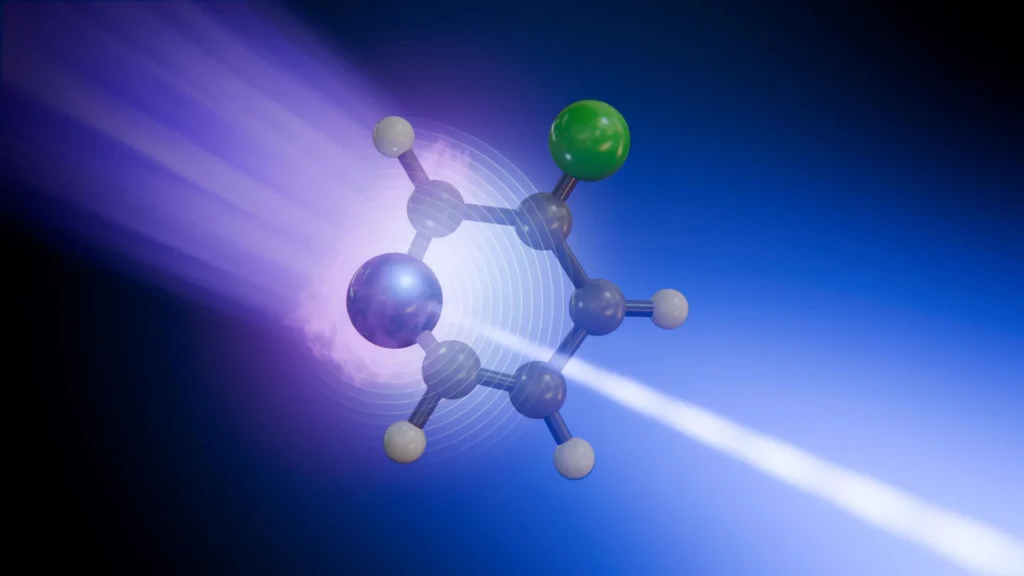
A groundbreaking study conducted at the European XFEL has provided an unprecedented look into the ultrafast dynamics of how energy propagates through a molecule immediately after it absorbs light. The research, which utilized rapid X-ray flashes, has revealed that individual atoms within a molecule can record distinct and nuanced parts of the complex energy transformation, challenging previous generalized understandings of molecular energy transfer. This precise observation capacity marks a significant leap forward in photochemistry, offering a real-time, atomic-scale window into some of nature’s fastest chemical reactions.
Unveiling Ultrafast Molecular Transformations
The core of the discovery lies in the ability to discern how different atoms within a single molecule respond to and participate in the redistribution of absorbed energy. Scientists observed that exposure to light can dramatically alter an atom’s responsiveness to the movements of its neighbors, creating a localized "memory" of the transformation. This multi-site sensitivity is crucial, as it suggests that the chemical story told by one atom might differ significantly from that told by another, even within the same molecule.
Antonio Picón from the Instituto de Ciencia de Materiales de Madrid Consejo Superior de Investigaciones Científicas (ICMM-CSIC), a co-author of the study, articulated this revelation: "We can now see that not every atomic site tells the same story in the signals we capture from our X-ray pulses. Some atoms report where the charge is going, while others reveal how the whole molecule vibrates." This insight moves beyond a simplistic view of energy dissipation, highlighting the intricate, atom-specific roles played during these picosecond-scale events.
The implications of this enhanced understanding are profound. It paves the way for a deeper comprehension of fundamental light-driven processes, ranging from how biological molecules like DNA resist damage from UV light to how advanced materials efficiently harvest solar energy. By dissecting these ultrafast mechanisms, scientists hope to engineer new materials with tailored photochemical properties and to develop novel strategies for light-based technologies and therapies.
The Experimental Crucible: European XFEL and tr-XPS
To achieve this unprecedented resolution, the research team employed time-resolved X-ray photoelectron spectroscopy (tr-XPS) at the Small Quantum Systems (SQS) instrument of the European XFEL. The European XFEL, located primarily in Germany, is the world’s largest X-ray free-electron laser facility, capable of generating ultrashort, high-brightness X-ray pulses. These pulses are millions of times brighter than those from conventional synchrotron light sources and can capture atomic-scale events occurring on femtosecond (quadrillionths of a second) timescales.
The Power of X-rays: A Closer Look at European XFEL
The European XFEL operates on a principle where high-energy electrons are accelerated to nearly the speed of light and then guided through a special magnetic structure called an undulator. In the undulator, the electrons are forced to oscillate, emitting intense X-ray flashes. These flashes, with their extremely short duration and high intensity, act like ultra-fast strobes, freezing the motion of atoms and electrons in real-time. This capability is indispensable for studying dynamic processes in matter, which often unfold at incredibly rapid rates, far beyond the reach of traditional imaging or spectroscopic techniques. The facility’s ability to produce "hard" and "soft" X-rays allows for versatile probing of various materials and energy scales, making it a critical tool for cutting-edge research in physics, chemistry, materials science, and biology.
Time-Resolved X-ray Photoelectron Spectroscopy: Peeking into Picoseconds
The tr-XPS technique is a specialized form of photoelectron spectroscopy. In conventional XPS, a sample is irradiated with X-rays, causing core-level electrons to be ejected. By measuring the kinetic energy of these ejected electrons, scientists can deduce the binding energy of the electrons within the atoms, which in turn provides information about the elemental composition and chemical state of the sample.
In the time-resolved variant, the process is adapted to capture changes over time. The experimental setup involves two precisely synchronized laser pulses: an initial ultraviolet (UV) laser pulse to trigger the chemical reaction or energy absorption, followed by a carefully timed soft X-ray pulse. The UV pulse excites the molecule, initiating the energy transformation. Then, the X-ray pulse ionizes the molecule by removing deeply bound electrons, specifically from target atoms like nitrogen or fluorine in this study. By varying the delay between the UV pump pulse and the X-ray probe pulse, researchers can effectively create a molecular "movie," reconstructing how the chemical environment surrounding each atom evolves over mere picoseconds (trillionths of a second). The kinetic energies of the released electrons are meticulously recorded, providing a sensitive fingerprint of the electronic structure and local environment of the atoms at each time step.
The Chosen Subject: 3-Fluoropyridine and Its Dynamic Journey
The molecule chosen for this intricate investigation was 3-fluoropyridine, a relatively small, ring-shaped organic molecule containing both nitrogen and fluorine atoms. Its compact structure and the presence of these distinct atoms made it an ideal candidate for observing localized effects of energy redistribution.
Chronology of a Picosecond Transformation:
The experiment meticulously tracked the molecular dynamics through several critical phases:
- Initial Excitation (Ultraviolet Laser Pulse): The journey began when 3-fluoropyridine molecules were struck by a brief ultraviolet laser pulse. This pulse delivered a precise quantum of energy, causing the molecule’s electrons to jump into a higher energy state, a process known as electronic excitation. This initial absorption of energy sets off a cascade of subsequent events.
- Structural Distortion: Immediately following electronic excitation, the molecule, which is normally flat, rapidly begins to bend and contort. This change in molecular geometry is a direct consequence of the altered electronic configuration; the forces holding the atoms together shift, initiating a structural rearrangement.
- Crossing the Conical Intersection: As the molecule changes shape, it passes through a crucial, albeit short-lived, state known as a conical intersection. These intersections are vital crossing points on the potential energy surface where the electronic states of the molecule become strongly coupled with the movements of the atomic nuclei. They act as ultrafast funnels, allowing the molecule to efficiently transfer energy from its electronic degrees of freedom into vibrational motion. This rapid conversion is essential in many light-triggered reactions, preventing the molecule from staying in a high-energy, potentially damaging, electronic state for too long.
- Return to Ground State: After traversing the conical intersection, the molecule quickly returns to its electronic ground state. However, the excess energy it absorbed is not simply gone; it has been converted.
- Vibrational Energy Redistribution: The electronic energy is now manifested as intense vibrations that travel throughout the molecular structure. These vibrations are essentially atomic movements – oscillations and stretches of bonds – that carry and redistribute the absorbed energy across the molecule.
- Relaxation and Thermalization: Over time, these vibrations will eventually dissipate, often into the surrounding environment as heat, bringing the molecule back to its equilibrium state.
The Dance of Electrons and Nuclei: Conical Intersections Explained
Conical intersections are quantum mechanical phenomena that play a central role in photochemistry and photobiology. They represent points where two or more electronic potential energy surfaces touch or nearly touch, forming a "cone-like" shape. At these points, the Born-Oppenheimer approximation, which assumes that electronic and nuclear motions can be treated separately, breaks down. This breakdown allows for extremely efficient and rapid non-adiabatic transitions between electronic states, often on the femtosecond timescale. Without conical intersections, many photochemical reactions, including vision, photosynthesis, and DNA repair, would proceed very differently, potentially leading to destructive outcomes. Their discovery and characterization have revolutionized our understanding of how light energy drives chemical change.
The Unprecedented Resolution: Atomic-Level Insights
The power of this study truly comes from its ability to differentiate the signals from individual atoms within 3-fluoropyridine. The researchers specifically targeted the fluorine and nitrogen atoms, expecting them to reveal distinct aspects of the energy transformation due to their different chemical environments and roles in the molecule.
The fluorine atom, situated somewhat peripherally in the molecule, served as a remarkably clear and relatively straightforward indicator. Its signal primarily reflected the relaxation of the molecule’s vibrations over time. This observation provided a clean channel to monitor how the absorbed energy, now converted into atomic motion, propagated and dissipated across the molecular framework.
In contrast, the nitrogen atom presented a more intricate narrative. Because nitrogen is directly involved in the electronic structure that initially absorbs the ultraviolet light and is part of the molecule’s core, its signal was complex. It reflected not only the redistribution of electrons but also the molecule’s significant structural changes as it bent and twisted. The nitrogen atom’s signal was a superposition of electronic and structural dynamics, offering a more comprehensive, yet more challenging, view of the initial stages of energy processing. This distinction underscores the innovative aspect of the research: the capacity to dissect these intertwined processes at the atomic level.
A Collaborative Endeavor: Theory Meets Experiment
The success of such a complex experiment relies heavily on a synergistic approach combining advanced experimental techniques with sophisticated theoretical models and computer simulations. The experimental data, which consists of electron energies measured at various time delays, provides raw signals. However, interpreting these signals and connecting them to the underlying electronic and structural changes requires robust computational support.
Researchers employed advanced quantum chemistry calculations to simulate the behavior of 3-fluoropyridine after light absorption. These simulations predicted how the electron distribution and molecular geometry would evolve, generating theoretical photoelectron spectra that could be directly compared with the experimental measurements. This iterative process of experimental data acquisition and theoretical validation was critical for unambiguously assigning the observed signals to specific atomic events and for reconstructing the full picosecond transformation with high fidelity. The international team, comprising experts in experimental physics, theoretical chemistry, and computational science, exemplifies the interdisciplinary nature of modern ultrafast science.
Broader Horizon: Implications for Science and Technology
The findings from this study at the European XFEL carry profound implications across various scientific and technological domains, extending far beyond the specific molecule studied.
Advancing Photochemistry and Materials Science
A deeper understanding of how energy moves through molecules at the atomic level is fundamental to photochemistry – the study of chemical reactions induced by light. This knowledge is crucial for designing new functional organic molecules with specific light-responsive properties. For instance, in the field of organic electronics, being able to track energy transfer could lead to the development of more efficient organic light-emitting diodes (OLEDs) or organic solar cells. By controlling how light energy is absorbed, converted, and transferred within these materials, scientists can optimize their performance and longevity.
Similarly, in catalysis, many industrial processes rely on light-activated catalysts. Understanding the initial atomic-scale energy redistribution can help design more selective and efficient photocatalysts for chemical synthesis, pollution control, or hydrogen production from water.
Biomedical Applications: Understanding Light’s Impact on Life
One of the most compelling implications lies in biology. DNA, the blueprint of life, is constantly exposed to ultraviolet radiation from the sun. While UV light can cause damaging mutations, living organisms have evolved sophisticated repair mechanisms. These mechanisms often involve ultrafast processes that dissipate excess UV energy harmlessly before it can cause permanent damage. This research offers a new tool to study these photoprotective mechanisms in DNA and other biomolecules, potentially leading to new insights into skin cancer prevention or the development of more effective phototherapy treatments. Understanding how light interacts with biological systems at this fundamental level could also inform the design of photosensitive drugs or diagnostic agents.
Daniel Rivas, a former instrument scientist and now guest scientist at SQS and co-author of the study, emphasized this broader vision: "This is what European XFEL was built to enable: watching chemical change where it begins, at specific atomic sites and on its natural timescale. By combining multi-site sensitivity with femtosecond resolution, we are opening a new window on the microscopic mechanisms that govern photochemistry."
Looking Ahead: The Future of Ultrafast Science
While the current experiment focused on a relatively simple molecule, the established methodology is highly versatile. Researchers are already planning to apply this approach to increasingly complex systems. Potential targets include:
- Larger Functional Organic Molecules: Investigating how energy flows through molecules used in advanced materials, pharmaceuticals, or dyes.
- Biomolecular Building Blocks: Studying amino acids, nucleotides, or small peptides to understand fundamental biological processes.
- Materials for Energy Applications: Probing the efficiency of energy transfer in light-harvesting complexes, quantum dots, or perovskite materials designed for solar energy conversion.
The next steps will involve pushing the boundaries of both experimental resolution and theoretical modeling. Improving the signal-to-noise ratio, developing even faster X-ray pulse sequences, and refining computational algorithms will allow for the study of even more intricate molecular systems and more subtle energy transfer phenomena. The challenge will be to handle the exponentially increasing complexity of larger molecules while retaining the atomic-level detail achieved in this pioneering study.
This research at the European XFEL represents a monumental step forward in ultrafast science. By providing a truly atomic and real-time perspective on energy redistribution within molecules, it has not only answered long-standing questions about light-matter interactions but has also opened up entirely new avenues for scientific inquiry. The ability to observe these fleeting, picosecond-scale transformations with such clarity promises to accelerate discoveries in fundamental chemistry, materials science, and biology, ultimately leading to innovative solutions for some of humanity’s most pressing challenges, from sustainable energy to advanced healthcare.






