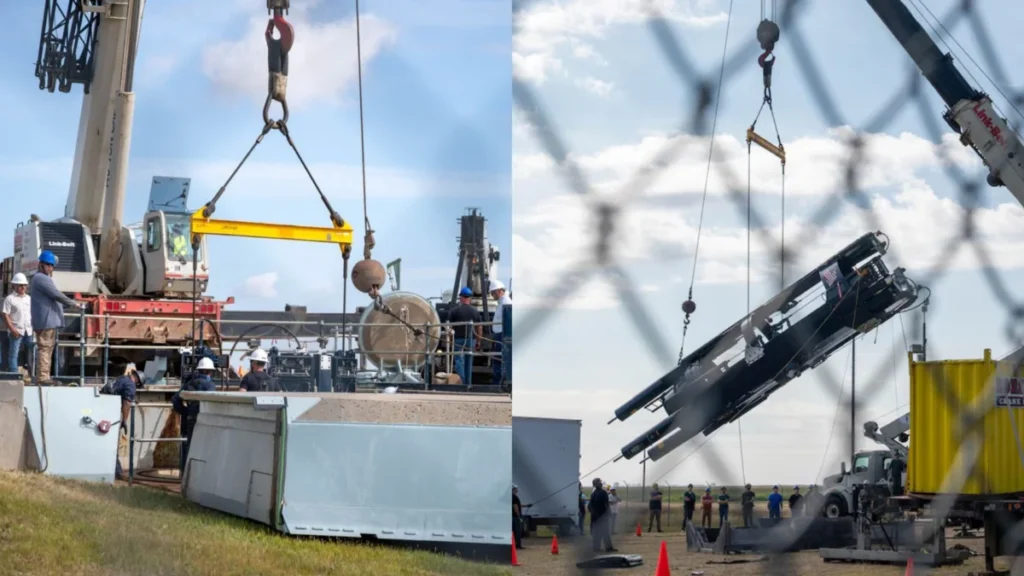
The United States Air Force recently achieved a significant milestone in its efforts to maintain the nation’s aging intercontinental ballistic missile (ICBM) arsenal, completing an unprecedented cross-country refurbishment of a critical Minuteman III missile component. This complex logistical and engineering feat, executed by the specialized 583rd Missile Maintenance Squadron, saw a massive suspension system removed from an underground launch facility near Minot Air Force Base in North Dakota, transported thousands of miles to Vandenberg Space Force Base in California for extensive depot-level work, and subsequently returned for reinstallation. The successful completion of this intricate operation on August 18 marks the first time such an extensive overhaul of this specific component has been conducted away from an operational Minuteman III site at Minot, establishing a new precedent for the sustainment of America’s nuclear deterrent.
The Minuteman III: A Cornerstone of U.S. Nuclear Deterrence
To fully appreciate the significance of this maintenance endeavor, it is crucial to understand the role and context of the Minuteman III missile. The LGM-30G Minuteman III, first deployed in 1970, represents the land-based leg of the U.S. nuclear triad, a strategic framework designed to ensure robust deterrence through a combination of land-based ICBMs, submarine-launched ballistic missiles (SLBMs), and strategic bombers. With approximately 400 Minuteman III missiles currently deployed across three primary missile wings – Minot Air Force Base in North Dakota, F.E. Warren Air Force Base in Wyoming, and Malmstrom Air Force Base in Montana – these systems stand on continuous alert, forming a critical component of national security.
Each Minuteman III missile is housed within a hardened underground silo, designed to protect it from attack and maintain its readiness for rapid deployment. These silos are complex structures, incorporating advanced environmental controls, security measures, and intricate mechanical systems to ensure the missile’s integrity and operational capability. The Minuteman III fleet has undergone numerous upgrades and life-extension programs over its five-decade service life, far exceeding its initial design lifespan. Despite these efforts, the age of the system presents ongoing challenges for maintenance and sustainment, as original parts become scarce and infrastructure shows signs of wear. The U.S. Air Force plans to replace the Minuteman III with the new LGM-35A Sentinel ICBM, with initial operational capability projected for the early 2030s. Until the Sentinel program fully comes online, maintaining the readiness and reliability of the existing Minuteman III fleet remains an paramount national priority.
Unprecedented Logistics: A Transcontinental Journey for Critical Hardware
The recent overhaul project at Minot AFB unfolded over several months, representing a carefully orchestrated sequence of operations that showcased specialized engineering and logistical prowess. The chronology began earlier this year when maintenance crews from the 583rd Missile Maintenance Squadron meticulously removed the suspension system from its underground launch facility near Minot. This initial extraction is itself a complex task, requiring specialized equipment and precise coordination to safely decouple the massive component from the missile and its silo structure without compromising the facility’s integrity or the missile’s readiness.
Once removed, the suspension system embarked on a transcontinental journey spanning thousands of miles. Its destination was Vandenberg Space Force Base in California, a hub for missile testing, space launch operations, and, critically, a designated site for depot-level maintenance work. Transporting such a large, sensitive, and strategically vital component across state lines necessitates stringent security protocols, specialized heavy-haul carriers, and careful route planning to navigate diverse terrains and ensure safe passage. The journey itself highlights the extensive geographical footprint of the U.S. nuclear enterprise and the interconnectedness of its various operational and maintenance facilities.
Upon arrival at Vandenberg, the suspension system underwent comprehensive depot-level refurbishment. This level of maintenance is far more extensive than routine preventative measures performed at the launch facility. It involves disassembling the component, inspecting every part for wear, fatigue, and potential defects, repairing or replacing worn-out elements, and reassembling the system to original or improved specifications. This meticulous process ensures the component’s structural integrity and operational reliability for years to come. After technicians completed this intensive overhaul, the system was prepared for its return journey, again traversing the vast distances back to Minot Air Force Base. The final phase involved the precise reinstallation of the refurbished suspension system into the underground launch facility, a process that concluded on August 18. This round trip represents not just a logistical triumph but also a proof of concept for managing major structural work away from active missile sites, a capability that could prove invaluable for future sustainment efforts.
The Critical Role of the Suspension System
Within the confines of a Minuteman III launch facility, the suspension system serves a crucial engineering function. It acts as the primary support structure for the missile itself, cradling it securely within the silo. More than just a passive support, it plays an active role in maintaining the precise alignment and stability of the missile, which is essential for ensuring accurate targeting and launch readiness. Furthermore, the suspension system helps to absorb and mitigate various stresses, including seismic activity, temperature fluctuations, and vibrations, thereby protecting both the missile and the surrounding silo infrastructure from damage. Its integrity is paramount for the operational lifespan and reliability of the entire launch complex.
Routine maintenance on these systems typically involves preventative checks, minor adjustments, and localized repairs conducted directly at the launch facility by field maintenance teams. However, a complete overhaul, like the one recently undertaken, signifies a much larger intervention, addressing deeper structural or mechanical issues that cannot be resolved through on-site, in-situ methods. Such extensive refurbishment operations are exceptionally rare across the Minuteman III fleet, underscoring the severity of the need when they do occur and the specialized nature of the expertise required.
Roy Ring, production superintendent for the 583rd Missile Maintenance Squadron, emphasized the longevity of the expertise involved, stating that crews have maintained these complex systems for decades. The deep institutional knowledge within the squadron is a testament to the continuous dedication required to keep these legacy systems operational. This specific Minot operation, by necessitating the removal and off-site refurbishment of an entire system, pushed the boundaries of traditional maintenance practices and demonstrated a new, more comprehensive approach to addressing significant structural requirements for the Minuteman III.
The 583rd Missile Maintenance Squadron: Civilian Backbone of ICBM Readiness
At the heart of this successful operation is the 583rd Missile Maintenance Squadron, a unique and indispensable entity within the Air Force’s nuclear mission. What sets this squadron apart is its composition: it operates entirely without active-duty military personnel, relying instead on a dedicated workforce of civilian employees. This model allows for the accumulation of vast institutional knowledge and specialized skills that might otherwise be lost through the regular rotation of military personnel. The squadron’s roots trace back to the mid-1980s, when it emerged as the "Depot Maintenance Teams" under the moniker "Rivet Mile," a program specifically designed to address the unique maintenance challenges of the ICBM fleet. The organization later evolved into the 583rd Missile Maintenance Squadron, continuing its vital mission.
Today, the squadron comprises 196 highly skilled workers strategically distributed across five geographically separate units. These critical locations include the three primary ICBM bases—Minot Air Force Base (North Dakota), Malmstrom Air Force Base (Montana), and F.E. Warren Air Force Base (Wyoming)—as well as Vandenberg Space Force Base (California) and Hill Air Force Base (Utah), which serves as a major logistics and maintenance hub. This dispersed structure enables the squadron to provide comprehensive support across the entire Minuteman III enterprise. The collective experience of this civilian workforce is staggering; according to the Air Force, the teams at each base bring more than 250 combined years of Minuteman III experience, a depth of expertise that is virtually irreplaceable.
KyAnn Betz, the director of the 583rd Missile Maintenance Squadron, highlighted the unit’s official authorization for depot-level maintenance at Minuteman III facilities. This authorization underscores their unique capabilities to perform the most intensive and specialized repairs. Their technicians are proficient in working on both underground and above-ground infrastructure associated with the ICBM fleet. Furthermore, each missile wing benefits from a dedicated maintenance shop within the squadron, equipped for specialized manufacturing and repairs. Beyond these primary roles, the 583rd team also provides crucial support for field-level maintenance, offering additional expertise when local crews encounter challenges requiring a higher degree of specialization. This integrated approach ensures that complex issues, from routine inspections to rare major overhauls, are addressed with the highest level of proficiency.
Strategic Implications and Future Readiness
The successful refurbishment of the Minuteman III suspension system carries significant strategic implications for the ongoing sustainment of America’s nuclear arsenal. As the Minuteman III fleet continues its service life well into its fifth decade, challenges associated with aging infrastructure are becoming increasingly prevalent. Components originally designed for a shorter lifespan require more intensive maintenance, refurbishment, or even redesign to ensure continued reliability and operational readiness. This project at Minot AFB demonstrated that a complete suspension-system overhaul is not only feasible away from the immediate launch site but also that such a process can be effectively managed and executed.
The operation has effectively established a repeatable path for moving large, critical components through the depot-maintenance process. This is a crucial development for the crews responsible for sustaining the Minuteman III fleet, as it provides a proven methodology for addressing similar complex maintenance requirements in the future. The ability to conduct depot-level work at specialized facilities like Vandenberg, rather than attempting highly complex interventions in the field, can lead to more thorough repairs, improved quality control, and potentially reduced disruption to operational sites.
Furthermore, this achievement reinforces the United States’ commitment to maintaining a credible and effective nuclear deterrent until the next-generation Sentinel ICBMs are fully deployed. The reliability of the Minuteman III system is paramount for global strategic stability. Any perceived weakness or failure in its operational readiness could invite miscalculation by potential adversaries. By proactively addressing critical infrastructure needs through innovative maintenance strategies, the Air Force ensures that the land-based leg of the nuclear triad remains robust and ready. The economic implications are also noteworthy; extending the service life of existing components through comprehensive overhauls can be more cost-effective in the short to medium term than immediate, widespread replacements, providing valuable time and resources for the Sentinel program’s development and phased deployment. This strategic maintenance capability, spearheaded by the civilian specialists of the 583rd Missile Maintenance Squadron, will undoubtedly prove invaluable as the Minuteman III system’s service life continues, securing the foundational element of American strategic power for years to come.