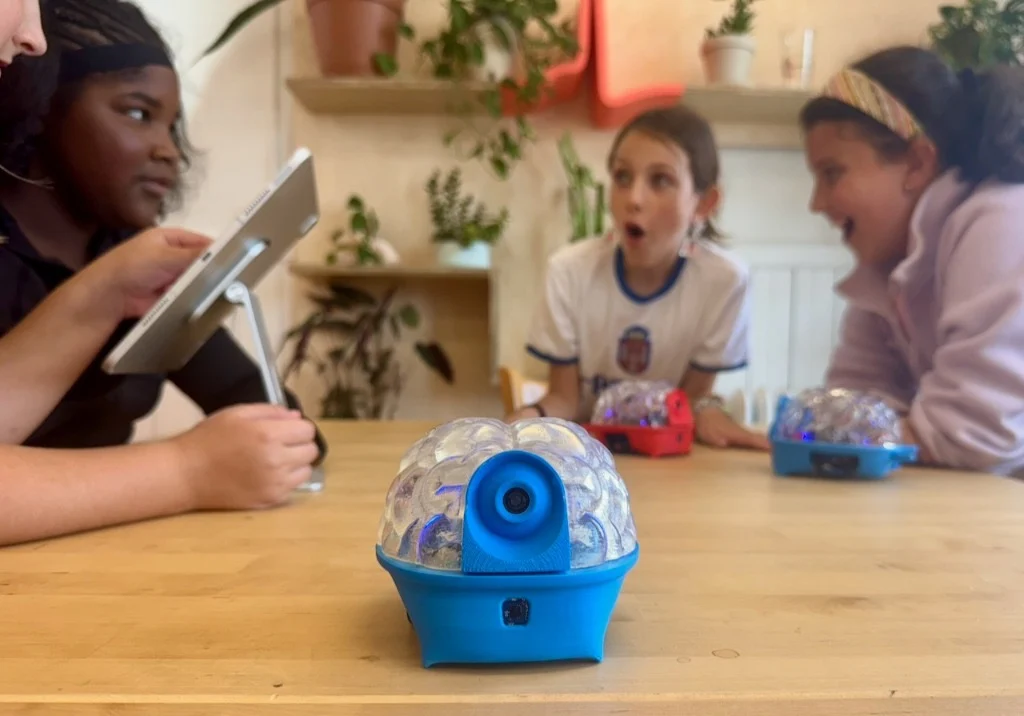
A groundbreaking development from Backyard Brains is set to transform how students and enthusiasts engage with robotics and neuroscience, introducing SpikerBot, a wheeled robot programmable entirely through virtual neurons rather than conventional code. This innovative approach aims to demystify complex biological processes and engineering principles, making them accessible to a broader audience, from elementary school students to advanced learners. By focusing on the fundamental building blocks of biological intelligence—neurons and synapses—SpikerBot fosters an intuitive understanding of how complex behaviors emerge from simple, interconnected circuits.
A Paradigm Shift in Robotics Programming
Traditional robotics education often begins with the intricacies of computer logic, requiring students to grasp abstract concepts like "if-then" statements, loops, and data structures before seeing their robots perform meaningful actions. This steep learning curve can often deter beginners and diminish the initial excitement of building a robot. SpikerBot, developed by Backyard Brains, directly addresses this challenge by sidestepping conventional coding entirely. Its accompanying application allows users to construct "sketches" using virtual neurons, creating a visual and interactive programming environment that mimics the brain’s own architecture.
"There’s no code, no LLMs, just neurons, synapses, and behavior emerging from a circuit a kid designed," explains Greg Gage, Co-Founder & CEO of Backyard Brains, highlighting the core philosophy behind SpikerBot. This radical departure from text-based or even block-based coding environments makes the process feel less like programming a machine and more like nurturing a digital organism. The inspiration for this approach draws heavily from the principles outlined in Valentino Braitenberg’s seminal 1984 book, Vehicles: Experiments in Synthetic Psychology. Braitenberg demonstrated how remarkably complex, seemingly intelligent behaviors could arise from very simple, direct connections between sensors and motors. SpikerBot embodies this philosophy, allowing users to observe lifelike behaviors emerge as the bot responds directly to sensory input, guided by their designed neural circuits.

Bridging the Neuroscience Education Gap
Beyond its innovative programming interface, SpikerBot addresses a critical gap in contemporary neuroscience education. As Gage and Designer Alex Hatch elaborated during discussions about the new bot, students typically learn about the basic function of a single neuron in elementary or middle school. However, the educational thread often abruptly halts, only to resume in college-level courses where students delve into the complex interactions of millions of neurons. This significant hiatus creates what Backyard Brains terms "neuroscience illiteracy" – a lack of understanding of how individual neuronal activity scales up to generate thoughts, emotions, and actions.
"It’d be like learning what a transistor is and then jumping to Python with no other electronics knowledge," Gage remarked, illustrating the severity of this educational void. SpikerBot aims to bridge this chasm, providing an intermediate learning tool that allows students to explore the principles of neural networks and emergent behavior in a tangible, interactive way. By visually constructing and manipulating neural circuits, learners can develop an intuitive grasp of how ensembles of neurons give rise to complex functions, a concept often difficult to convey through textbooks alone. This hands-on experience is crucial, as studies consistently show that active learning approaches significantly improve retention and comprehension in STEM subjects.
A New Language for Intelligence
The SpikerBot app provides a visually rich interface where users drag and connect virtual neurons and axons, essentially building a "brain on screen." This process is akin to patching cables on an analog synthesizer, where the entire circuit is visible at once, offering a holistic overview of the system. This visual programming paradigm provides immediate feedback, allowing for rapid experimentation and iteration. As soon as a user changes a neuron from excitatory to inhibitory, for instance, the robot’s behavior reflects that change instantaneously, eliminating the frustrating compile-and-upload cycles common in traditional robotics programming. This "pace of thought and experimentation" is key to maintaining engagement and fostering a deeper understanding.

Interestingly, this neuron-centric approach inverts the perceived difficulty of certain tasks. Behaviors that are notoriously challenging for beginner robotics, such as following a person or tracking an object, become remarkably simple to implement with SpikerBot. For example, a creature that chases objects can be created with as few as two neurons. Conversely, tasks that are trivial in conventional computer logic, like counting in binary, transform into intricate webs of neuronal connections within the SpikerBot environment. This inversion offers unique insights into the fundamental differences between artificial intelligence based on computational logic and biological intelligence rooted in neural networks.
The focus on natural behaviors and intuitive interaction is expected to significantly enhance user engagement compared to other educational robots. Instead of laboriously learning the syntax of a programming language, users can immediately begin crafting robots that exhibit lifelike responses. This allows for a gradual, organic progression, where complex "dog-like" behaviors can be incrementally added and refined, mirroring the evolutionary development of biological systems.
Grounded in Scientific Pedagogy and Design Excellence
The development of SpikerBot has been a collaborative effort, meticulously designed with feedback from both child educators and professional neuroscientists. This interdisciplinary approach ensures that the learning experience is not only engaging but also scientifically accurate and pedagogically sound. The app features a library of sample brain models, allowing users to dissect, modify, and learn from pre-built circuits. Through this exploration, users can discover and apply real neuroscience principles, such as recurrent pairs (where neurons mutually excite each other, leading to persistent activity, a basis for short-term memory) and lateral inhibition (where the activation of one neuron inhibits its neighbors, crucial for sensory processing and pattern recognition). Understanding these patterns provides a foundation for comprehending more complex neurological functions like working memory.
Backyard Brains’ commitment to quality extends to the user experience. The app’s polished interface and seamless interaction are the result of extensive development and refinement, demonstrating that groundbreaking innovation can also be aesthetically pleasing and highly functional. This attention to detail is crucial for widespread adoption and sustained user interest.

The Hardware: A Brain on Wheels
The SpikerBot itself is an elegantly designed, brain-shaped robot, echoing Backyard Brains’ corporate logo. More than just a charming aesthetic, its form houses a sophisticated array of sensors that enable it to perceive and interact with its environment. Equipped with a camera, a microphone, and a distance sensor, SpikerBot can "see," "hear," and "feel" its surroundings, providing the necessary inputs for its virtual neural circuits to process. The robot also incorporates carefully crafted lights and sounds, designed to react more organically than typical machine outputs. Its lights illuminate and fade with a bioluminescent quality, and its sound effects are described as charming and quirky, further enhancing the illusion of a living creature.
A thoughtful design choice is the inclusion of connection points for 3D-printed attachments, allowing users to customize their bot’s appearance to match its evolving personality. This feature encourages creativity and extends the educational experience into design and fabrication. Furthermore, SpikerBot supports peripherals, including Backyard Brains’ existing Spiker:bit board. This compatibility opens up exciting possibilities, such as controlling the robot’s "brain" using real muscle signals from a user’s own arm, creating a direct, embodied connection to neuroscience.
Broader Societal Impact and Accessibility
The educational value of SpikerBot extends beyond traditional STEM fields. By providing a shared language and understanding of fundamental brain patterns, it can foster greater empathy and awareness regarding neurological conditions. With an estimated 1 in 5 people worldwide experiencing some form of neurological condition, understanding the basic mechanisms of the brain can help demystify these experiences, reduce stigma, and encourage informed conversations. This perspective highlights SpikerBot’s potential as a tool for promoting health literacy and societal understanding.

Backyard Brains has also prioritized long-term usability and accessibility in SpikerBot’s design. The companion app is entirely free and does not require cloud-based authentication, ensuring continuous access without subscription fees or reliance on external servers. The robot is powered by easily swappable AA batteries, a conscious decision to avoid the obsolescence associated with non-replaceable, constantly degrading lithium cells. To support this, Backyard Brains offers its own custom, high-performance NiMh AA batteries, promoting a sustainable and user-friendly power solution.
Launch and Future Prospects
SpikerBot was officially launched via a Kickstarter campaign, which is slated to conclude on June 14. The robot is projected to retail at $299, but early supporters through the crowdfunding platform can secure a unit for $219. Backyard Brains has a well-established track record of delivering successful and innovative educational projects, including their popular Neuron SpikerBox, which allows users to record action potentials from insects. This history inspires confidence in their ability to bring SpikerBot to market successfully, mitigating some of the inherent risks associated with crowdfunding.
The development team has ambitious plans for additional features and capabilities, but they also emphasize the importance of community input. "A lot we haven’t seen because you guys haven’t built anything yet," Alex Hatch noted, underscoring the collaborative spirit and the potential for users to discover unforeseen applications and behaviors. This open-ended approach encourages creativity and positions SpikerBot not just as a product, but as a platform for ongoing exploration and learning in the fascinating intersection of robotics, engineering, and neuroscience. As educational institutions increasingly seek engaging and interdisciplinary tools, SpikerBot stands poised to become a foundational resource in teaching the complexities of the brain in an intuitive, accessible, and deeply engaging manner.