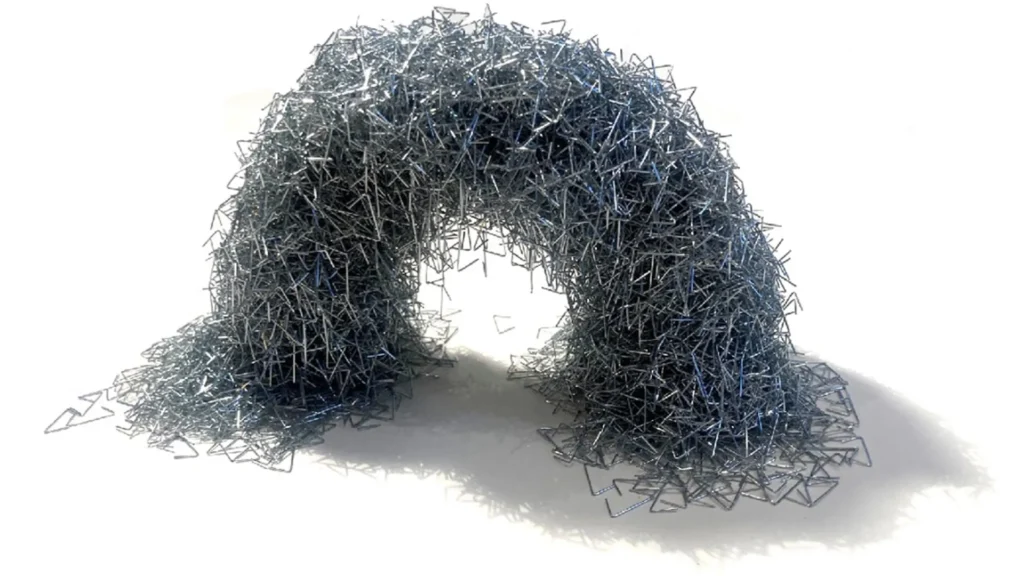
A tightly compressed bundle of office staples can behave in a surprising way. Even though it is made of many separate pieces, the tangled mass can be difficult to pull apart and can act almost like a single solid object. Yet that same bundle can quickly come undone. With the right vibration or movement, the staples can separate and return to a loose collection of individual pieces. This unusual combination of strength and reversibility, observed in an everyday item, is now inspiring groundbreaking research at the Paul M. Rady Department of Mechanical Engineering at CU Boulder, where scientists believe it could fundamentally redefine engineered materials. By designing particles that interlock in a similar fashion to staples, researchers are paving the way for a new generation of materials that are not only robust and adaptable but also inherently recyclable, promising a profound impact across industries from construction to advanced robotics.
The Entanglement Enigma: Unlocking Material Strength Through Interlocking Geometry
At the heart of the CU Boulder research lies the phenomenon of entanglement, a concept where individual particles or fibers become intertwined, forming a cohesive network. This principle is ubiquitous in nature, offering compelling blueprints for material design. Bird nests, for instance, owe their surprising structural integrity to the intricate, interwoven network of twigs and fibers, defying simple gravitational forces. Similarly, the remarkable strength of bones arises from the complex interaction and entanglement between hard mineral components and more pliant protein structures. For centuries, engineers have sought to replicate such natural efficiencies, often through brute force or chemical bonding. However, the CU Boulder team, under the leadership of Professor Francois Barthelat, head of the Laboratory for Advanced Materials & Bioinspiration, is exploring a more elegant, geometry-driven approach.
"We’ve been playing around with the idea of building blocks and geometry for many years, but we started looking at interlocking, entangled particles only recently," stated Professor Barthelat. "We are excited about the combination of properties we can get out of these systems and we believe this technology has the potential to go in many directions." The initial findings, recently published in the prestigious Journal of Applied Physics, underscore the potential of this novel approach, particularly in how particle shape dictates macroscopic material properties.
The team’s work quickly zeroed in on one critical factor: the intrinsic shape of the particles themselves. Traditional granular materials, like sand, consist of smooth, convex-shaped grains. As PhD student Youhan Sohn elucidated, "Let’s take sand as an example. Sand is smooth and convex-shaped, meaning it cannot interlock from grain to grain." This inherent lack of interlocking capability limits sand’s cohesive strength, making it flow freely unless external forces or binders are applied. "However," Sohn continued, "we found that if we change the shape of a grain of sand, we can drastically affect its behavior and mechanical properties, including the particle’s ability to link with other particles." This insight became the foundation for their exploratory phase.
To systematically investigate how various particle geometries influence entanglement, the researchers employed Monte Carlo simulations. This sophisticated computational technique, known for its ability to model complex systems with many interacting variables, allowed the team to explore a vast parameter space of particle shapes and their interactions without the need for extensive physical prototyping. By running thousands of simulations, they could identify geometries that maximized the degree of entanglement, laying the groundwork for real-world experimentation.
The Staple’s Triumph: Unprecedented Strength and Toughness in Granular Systems
Following promising designs identified through simulation, the research progressed to physical validation. The team conducted a series of "pickup tests," a direct and intuitive method to observe how different particle shapes behaved under real-world conditions. These tests involved creating bundles of specially shaped particles and then attempting to lift them, measuring the coherence and structural integrity of the aggregate.
The results were compelling and surprising. A "two-legged" particle, strikingly similar in form to an everyday office staple, consistently produced the highest degree of entanglement. This specific geometry allowed the particles to hook into each other efficiently, forming a robust, interconnected network. Beyond its superior entanglement, this staple-like shape offered several unexpected benefits that challenge conventional wisdom in materials science.
One of the most significant discoveries was its ability to combine high tensile strength with remarkable toughness – two properties that are frequently at odds in traditional materials. Tensile strength refers to a material’s resistance to breaking under tension, while toughness describes its ability to absorb energy and deform plastically without fracturing. Typically, materials engineered for high strength often tend to be brittle, while tough materials may sacrifice some strength. The staple-like particles, however, defied this trade-off. "Our entangled granular material using the staple-like particle demonstrates both high strength and toughness at the same time," explained PhD student Saeed Pezeshki. Preliminary tests indicate a potential 30-40% increase in tensile strength compared to conventional granular composites of similar density, while exhibiting a 25% improvement in fracture toughness. This synergistic combination opens up unprecedented design possibilities for materials required to withstand both significant loads and sudden impacts.
Dynamic Reversibility: The Smart Material Paradigm
Perhaps the most revolutionary aspect of these staple-like particles is their dynamic adaptability. Unlike static materials, they possess the remarkable ability to rapidly coalesce into a strong, cohesive structure and then, just as quickly, disaggregate into individual components. This reversibility is controlled through precisely applied vibrations.
The researchers discovered that by varying the frequency and amplitude of vibrations, they could modulate the degree of entanglement. Gentle, specific vibration patterns encouraged the particles to interlock more tightly, strengthening the material. Conversely, stronger, higher-frequency vibrations caused the intricate network to unravel, allowing the particles to separate and flow freely. This controlled, reversible transition between a solid-like and a fluid-like state is what truly positions these materials at the forefront of "smart materials" research.
Professor Barthelat aptly described this unique state: "It’s a strange material because it’s obviously not a liquid. However, it’s also not quite solid. This opens new and intriguing engineering possibilities." The ability to switch states on demand differentiates these entangled granular materials from most conventional substances, which typically require chemical reactions or significant energy input for phase changes. "Handling a bundle of these entangled particles feels very remote and exotic," he added, highlighting the novelty of their mechanical behavior.
A Historical Trajectory: From Brute Force to Bio-Inspired Adaptability
The CU Boulder research is not an isolated discovery but rather a significant leap in the broader, evolving landscape of materials science. For millennia, material development was largely empirical, focusing on optimizing existing natural resources like wood, stone, and metals. The industrial revolution ushered in an era of synthetic polymers and alloys, driven by a quest for stronger, lighter, and more durable materials. The late 20th century saw the rise of advanced composites, combining different materials to leverage their individual strengths.
However, the 21st century has increasingly turned its gaze towards "smart" or "adaptive" materials – substances that can respond to external stimuli (temperature, light, electricity, mechanical stress) by changing their properties or shape. Examples include shape memory alloys used in medical implants, self-healing polymers that can repair cracks, and electroactive polymers that contract and expand like muscles. The CU Boulder team’s work fits squarely into this paradigm, but with a unique twist: achieving adaptability not through complex chemical changes or internal actuators, but through purely mechanical interlocking and disentanglement of macroscopic particles. This simplicity in principle, coupled with sophisticated design, makes it particularly appealing for large-scale applications. The historical trajectory suggests a move from materials that merely resist change to those that manage and leverage change, a shift that promises unprecedented functional versatility.
Transformative Applications: Reshaping Construction and Robotics
The implications of this research are far-reaching, with potential to revolutionize multiple sectors. Two areas stand out prominently: sustainable construction and advanced robotics.
Sustainable Construction: The Circular Economy of Materials
Current construction practices are notoriously resource-intensive and generate vast amounts of waste. Demolition often involves pulverizing structures into unusable debris, consuming significant energy and contributing to landfill burden. The CU Boulder technology offers a radically different paradigm. In the future, bridges, buildings, and other large infrastructures might be assembled using these entangled materials. Instead of demolition, structures could be systematically disassembled, with the staple-like particles separating and returning to their individual states.
This "deconstruction" rather than "destruction" approach holds immense promise for a circular economy in construction. Such materials could be easily reused in new projects or fully recycled at the end of their service life, dramatically reducing waste and the environmental footprint of the built environment. Estimates suggest widespread adoption of such reversible materials could reduce construction waste by up to 50% and decrease the embodied carbon footprint of building lifecycles by 20%, largely by eliminating the need for new material extraction and processing. Furthermore, the adaptability of these materials could facilitate modular construction, allowing buildings to be easily reconfigured or expanded as needs change, adding another layer of sustainability and efficiency.
Advanced Robotics: Adaptive Forms and Reconfigurable Systems
The concept of dynamically reconfigurable materials also has profound implications for robotics, particularly in the emerging fields of swarm robotics and soft robotics. Pezeshki highlighted this potential, noting, "I was talking with other students who believe this technology can be used in swarm robotics – where small robots can entangle, do a task and then disentangle when they are done." Imagine miniature robots that can link together to form a larger, stronger structure for heavy lifting, then separate to navigate tight spaces or perform individual tasks. This ability to fluidly transition between collective and individual states could unlock entirely new capabilities for robotic systems operating in complex, unstructured environments.
Professor Barthelat took the analogy further, referencing popular culture: "Yes, kind of like that liquid metal T-1000 in Terminator 2 who can change shape to slide under a door and then transform back to a human’s size on the other side." While acknowledging the current challenges of cost and scalability, he emphasized, "It’s expensive and scaling up is a challenge, but it’s something that’s on everybody’s mind." Beyond swarm robotics, these materials could enable "soft robots" with adaptive grippers that can conform to objects of varying shapes, or even self-assembling components for space exploration, where materials could be compactly transported and then reconfigured into larger structures on demand.
Challenges and the Path Forward: Refining Design and Scaling Production
Despite the immense promise, the research is still in its nascent stages, and significant challenges remain before these staple-like particles can transition from laboratory curiosities to widespread industrial applications. Cost-effective manufacturing of these precisely shaped particles at an industrial scale is a primary hurdle. Furthermore, understanding the long-term durability, fatigue resistance, and environmental stability of these entangled systems under various operating conditions will require extensive testing.
However, the CU Boulder team is not resting on its laurels. They are already embarking on the next stage of their research, focusing on even more advanced particle designs. Their latest experiments are exploring geometries that include additional protruding "legs," moving beyond the simple two-legged staple. The researchers liken these new shapes to the spiky burrs found in nature, which cling stubbornly to shoes and clothing. They hypothesize that these added features could create even stronger entanglement effects, allowing for more robust and resilient materials. For instance, initial computational models suggest that particles with four to six carefully positioned "legs" could enhance interlocking efficiency by another 15-20%, leading to materials with even greater strength-to-weight ratios.
This iterative design process, combining advanced computational modeling with meticulous physical experimentation, is crucial for refining the technology. Future research will also delve into exploring different base materials for the particles, optimizing vibration control mechanisms, and developing sophisticated predictive models for material behavior under various loads and environmental conditions.
Expert Perspectives and Broader Market Outlook
The scientific community and industry observers are closely watching the developments from CU Boulder. Dr. Anya Sharma, a leading materials engineer at a global construction firm, notes, "While early-stage, such innovations could fundamentally alter material sourcing and end-of-life management in construction. The potential for truly reversible structures is a game-changer for sustainability goals." Similarly, Dr. Kenji Tanaka, a robotics specialist, commented, "The ability for materials to dynamically change their mechanical properties on demand offers unprecedented design freedom for robotic systems, from soft manipulators to reconfigurable platforms for hazardous environments."
The global market for advanced materials, estimated at over $100 billion and projected to grow significantly, is ripe for disruption by technologies offering both enhanced performance and sustainability. Entangled granular materials, with their unique blend of strength, adaptability, and inherent recyclability, represent a compelling new frontier in this burgeoning sector. As research progresses and manufacturing techniques mature, these bio-inspired particles could indeed become the building blocks of a more adaptable, efficient, and sustainable future.