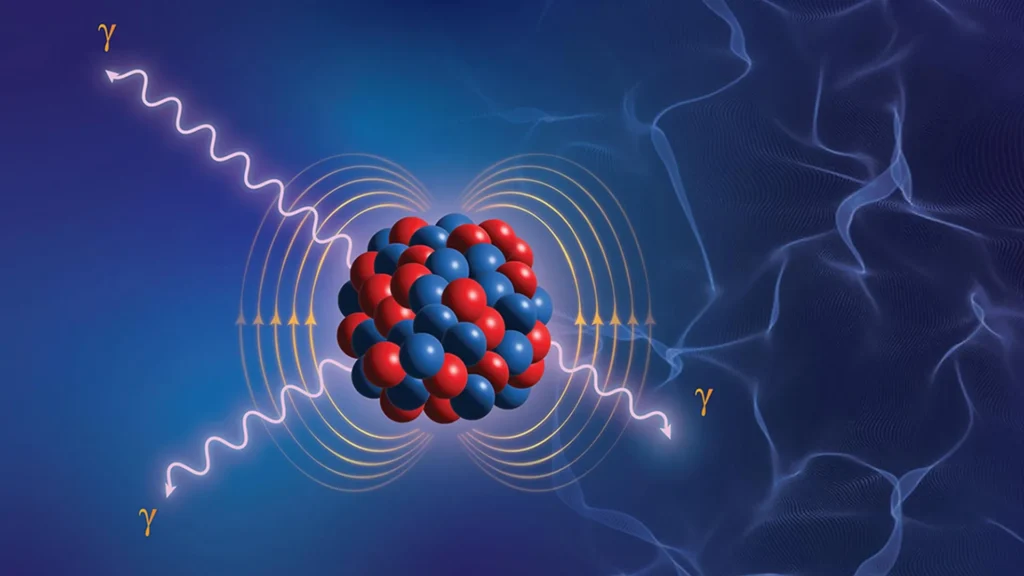
In a landmark achievement for the field of nuclear physics, a collaborative research team has resolved a perplexing mystery that has challenged the scientific community for over twenty years. The study, led by the Facility for Rare Isotope Beams (FRIB) at Michigan State University in partnership with Lawrence Livermore National Laboratory (LLNL), has identified the underlying mechanism behind a phenomenon known as "low-energy enhancement" in gamma-ray emission. Published recently in the prestigious journal Nature, the findings provide a definitive link between experimental observations and nuclear theory, offering a new framework for understanding the internal dynamics of atomic nuclei. This discovery is expected to have far-reaching consequences, influencing everything from our understanding of how heavy elements are forged in the hearts of dying stars to the precision of nuclear forensics and national security protocols.
For decades, nuclear physicists have been puzzled by an anomaly in the way certain atomic nuclei undergo radioactive decay. According to traditional theoretical models, as the energy of emitted gamma rays decreases, the probability of their emission should also decrease. However, experimental data consistently showed that some nuclei emit an unexpectedly high number of these low-energy gamma rays—an "up-bend" in the data that contradicted established expectations. This discrepancy, while subtle, suggested a fundamental gap in the scientific understanding of nuclear structure and the electromagnetic transitions that occur within the nucleus.
The Nature of Gamma Rays and Nuclear Decay
To understand the significance of this discovery, one must first consider the role of gamma rays in the atomic world. Gamma rays are a high-energy form of electromagnetic radiation. They are produced when an "excited" atomic nucleus—one that possesses excess energy—transitions to a lower, more stable energy state. This process is analogous to an electron in an atom moving from a high-energy orbital to a lower one and releasing a photon of light, but it occurs at the much higher energy scales found within the nucleus itself.
In most cases, these transitions follow predictable patterns. However, the discovery of low-energy enhancement (LEE) threw these predictions into disarray. Because scientists could not reliably predict which nuclei would exhibit this enhancement or why it occurred, nuclear models used in astrophysics and energy research remained incomplete. The FRIB-led study sought to isolate the specific type of nuclear transition responsible for this phenomenon, focusing on whether the enhancement was "electric" or "magnetic" in nature.
The FRIB Experiment: Isolating the Copper-to-Zinc Transition
The breakthrough was made possible by the advanced instrumentation at the Facility for Rare Isotope Beams. FRIB is a world-leading user facility for the U.S. Department of Energy Office of Science, capable of producing rare isotopes that do not exist naturally on Earth. For this specific experiment, the researchers focused on the decay of a radioactive isotope of copper (Copper-70) as it transformed into zinc (Zinc-70).
The research team, co-led by Eleanor Ronning, a former FRIB graduate student, and Andrea Richard, an assistant professor at Ohio University and former LLNL postdoctoral researcher, utilized FRIB’s specialized capabilities to separate and observe distinct decay states. This level of precision allowed the team to differentiate between two primary types of electromagnetic transitions:
- Electric Transitions (E1): These occur when the distribution of protons within the nucleus shifts, effectively changing the "shape" or spatial arrangement of the electric charge.
- Magnetic Transitions (M1): These occur when the internal magnetic moments—essentially the "spins"—of the protons and neutrons within the nucleus flip or reorient.
By isolating these transitions, the researchers observed a clear divergence in the data. The electric transitions followed the expected theoretical path, showing no unusual increase at low energies. However, the magnetic transitions exhibited a sharp increase in gamma-ray production at low energy levels. This "smoking gun" evidence confirmed that the low-energy enhancement is a magnetic phenomenon, specifically tied to the way nucleons (protons and neutrons) reorient their magnetic spins.
A Chronology of the Gamma Ray Puzzle
The journey to this discovery began in the early 2000s, when researchers using the "Oslo Method"—a technique developed at the University of Oslo—first noticed an unexpected "up-bend" in the gamma-ray strength function of various iron and molybdenum isotopes. At the time, the observation was met with skepticism, as it seemed to violate the Brink-Axel hypothesis, a long-standing principle in nuclear physics which suggests that the probability of gamma-ray emission depends primarily on the photon’s energy and not on the specific properties of the initial and final states of the nucleus.
Over the following two decades, various experiments around the world confirmed the existence of the up-bend in other isotopes, but the physical cause remained elusive. Theoretical physicists proposed several competing explanations, ranging from collective "scissors modes" (where protons and neutrons oscillate against each other like the blades of scissors) to complex many-body effects.
In the mid-2010s, the emergence of more powerful facilities like FRIB and the development of the Summing NaI(Tl) (SuN) detector provided the tools necessary to move beyond simple observation. The project that led to the recent Nature publication was proposed jointly by Ronning and Richard several years ago, initiating a rigorous period of experimental design and testing. The actual experiment involved a continuous, week-long run where scientists from multiple institutions monitored the decay of Copper-70 around the clock, ensuring the integrity of the data collected.
Data and Statistical Significance
The results of the FRIB experiment provide a high degree of statistical confidence. By measuring the gamma-ray strength function (a measure of the nucleus’s ability to absorb or emit gamma rays), the team showed that the M1 (magnetic dipole) strength increases significantly as the gamma-ray energy approaches zero.
This data aligns with modern theoretical calculations known as the "shell model," which describes the nucleus as a series of shells filled by protons and neutrons. The shell model calculations performed by the team indicated that as the nucleus de-excites, there is a high density of states that can be reached via low-energy magnetic transitions. When these theoretical predictions were compared with the experimental results from the Zinc-70 daughter nucleus, the correlation was nearly perfect, providing the "consistent explanation" that Dr. Andrea Richard noted was a key step forward for the field.
Implications for Astrophysics and the Origin of Elements
One of the most profound impacts of this discovery lies in the field of nuclear astrophysics. Scientists have long struggled to fully explain the "r-process" (rapid neutron-capture process), which is responsible for creating approximately half of the elements heavier than iron, including gold, platinum, and uranium. This process occurs in extreme environments, such as supernovae or the mergers of neutron stars.
The rate at which nuclei capture neutrons in these environments is heavily influenced by the gamma-ray strength function. If a nucleus is more likely to emit low-energy gamma rays (as the new study proves it is), the probability of neutron capture changes. By incorporating the magnetic low-energy enhancement into astrophysical models, researchers can more accurately simulate the chemical evolution of the universe. This could resolve long-standing discrepancies between the predicted and observed abundances of heavy elements in our galaxy.
National Security and Nuclear Forensics
Beyond the stars, the findings have immediate practical applications for national security and nuclear forensics. Lawrence Livermore National Laboratory, a key partner in the study, is responsible for ensuring the safety and reliability of the United States’ nuclear stockpile.
Darren Bleuel, an LLNL scientist and co-author of the study, emphasized that improving nuclear models is essential for interpreting the results of past nuclear tests and predicting the performance of current systems without the need for underground testing. "We can improve the knowledge of our stockpile performance and interpretation of past test program results using the improved theory based on these discoveries," Bleuel stated.
Furthermore, the discovery enhances nuclear forensics—the science of identifying the source and history of nuclear materials. In the event of an illicit nuclear explosion or the interception of radioactive materials, forensic scientists rely on gamma-ray signatures to determine the isotopes involved and the age of the material. A more precise understanding of how gamma rays are emitted, especially at low energies, allows for more accurate "fingerprinting" of nuclear events.
Advancing Nuclear Energy and Future Research
The implications also extend to the nuclear energy sector. Modern reactor designs, including small modular reactors and fusion concepts, require highly accurate data on how neutrons interact with structural materials and fuel. The magnetic transitions identified in this study affect the "cross-sections" (the probability of interaction) for various nuclear reactions. By refining these values, engineers can design safer and more efficient reactors with better-predicted lifespans for their internal components.
The success of the Copper-70 experiment has opened a new door for nuclear physics. While the study focused on a specific isotope, the underlying physics—the magnetic nature of the low-energy enhancement—is believed to be a universal feature of many medium-to-heavy nuclei. Future research at FRIB will likely expand this investigation to even more exotic, short-lived isotopes that are further from the "valley of stability."
As Eleanor Ronning noted, the shock of the initial observation has now been replaced by a sense of clarity. The "shock to the community" has evolved into a foundational piece of knowledge that bridges the gap between the microscopic world of nuclear spins and the macroscopic world of stellar explosions and national defense. With a consistent explanation now in hand, the next generation of nuclear models will be more robust, more predictive, and more capable of unlocking the remaining secrets of the atomic nucleus.