The landscape of aviation surveillance has undergone a radical transformation over the last two decades, moving away from traditional primary radar systems toward more precise, satellite-based technologies. At the heart of this transition is Automatic Dependent Surveillance–Broadcast (ADS-B), a protocol that allows aircraft to determine their position via satellite navigation and periodically broadcast it. This information enables the aircraft to be tracked by air traffic control ground stations and other aircraft to provide situational awareness and allow for self-separation. While professional aviation has long utilized high-end, proprietary hardware to manage these signals, a new open-source project known as ADSBee is democratizing access to this data, providing a low-power, cost-effective solution for makers, researchers, and drone enthusiasts.

The Technical Foundation of ADS-B and Mode S
To understand the significance of the ADSBee project, one must first grasp the underlying technology of modern aviation communication. ADS-B operates primarily on two frequencies: 1090 MHz and 978 MHz. The 1090 MHz frequency utilizes a pulse position modulation (PPM) protocol known as Mode S. This protocol is internationally recognized and is the standard for commercial airliners and high-altitude traffic. Because the signals are unencrypted, they can be intercepted and decoded by anyone with the appropriate radio equipment.
The data transmitted via ADS-B is comprehensive, including the aircraft’s unique ICAO 24-bit address, callsign, altitude, heading, airspeed, and precise GPS coordinates. Over the years, this open nature has fostered a massive community of "aviation buffs" who maintain ground stations to feed data into global aggregators such as FlightAware, FlightRadar24, and the community-driven Airplanes.live. These platforms are used for a myriad of purposes, ranging from simple plane spotting to sophisticated academic research, such as validating global weather models using aircraft wind data or identifying geographic regions experiencing GPS jamming and spoofing.

The ADSBee Project: Overcoming Hardware Limitations
Despite the popularity of ADS-B tracking, hardware options have historically been divided into two inconvenient categories. On one end are DIY ground stations, typically built using a Raspberry Pi single-board computer paired with a generic Software Defined Radio (SDR) USB dongle. While functional, these setups are often bulky, power-hungry (drawing several watts), and generate significant heat, making them poorly suited for portable or embedded applications. On the other end are commercial-grade ADS-B receivers. These devices are often based on Field Programmable Gate Arrays (FPGAs), which offer high performance but come with a steep price tag, frequently exceeding $350.
ADSBee was conceived by developer John McNelly to fill the void between these two extremes. The project’s primary objective was to create a small, low-power, and affordable receiver that could be integrated into diverse environments—from autonomous drones to solar-powered remote weather stations. The "secret sauce" of the ADSBee is its novel demodulator, which leverages the RP2040 microcontroller from Raspberry Pi Ltd. By utilizing the RP2040’s unique Programmable I/O (PIO) state machines, McNelly was able to handle the high-speed bitstream of Mode S signals without the need for an expensive FPGA or a high-wattage application processor.

A Chronology of ADSBee Development
The development of ADSBee has followed a rigorous two-year trajectory, moving from a conceptual prototype to a robust ecosystem of hardware and firmware.
- Inception (2023): The project began as an exploration into whether low-cost microcontrollers could handle the 1090 MHz PPM decoding requirements of Mode S.
- Beta Phase Launch (Late 2024): The first "ADSBee 1090" units were released to a select group of beta testers. These initial units focused on the standard 1090 MHz frequency and proved that the RP2040-based architecture could deliver commercial-grade performance with a power draw of approximately 1 Watt.
- Community Iteration (Early 2025): Feedback from the beta community led to rapid firmware improvements, including more sophisticated aircraft position filtering algorithms and the introduction of a standardized command set for device configuration.
- Dual-Band Expansion (July 2025): Recognizing the unique needs of the United States market, where approximately 5% of aircraft—mostly general aviation—use the 978 MHz Universal Access Transceiver (UAT) protocol, the project introduced the ADSBee 1090U. This hardware revision features an additional radio and microcontroller, allowing for simultaneous monitoring of both ADS-B bands.
- Modular Ecosystem (Present): The project has moved toward a modular "Pants" architecture, allowing users to stack additional functionality onto the base receiver.
Hardware Variations and the "Pants" Ecosystem
The ADSBee project is not a single device but a family of hardware designed for different integration levels. The flagship ADSBee 1090U is a dual-band receiver capable of providing aircraft data over USB, UART, Wi-Fi, and Ethernet. For industrial or custom PCB applications, the ADSBee m1090 is a solder-down module that allows engineers to bake ADS-B reception directly into their own circuit designs.

One of the most distinctive aspects of the project is its expansion system. In a humorous nod to the developer’s business, "Pants for Birds LLC," the accessory boards—traditionally called "hats" in the Raspberry Pi community—are referred to as "pants." Current and upcoming modules include:
- PoE Pant: Enables the ADSBee to be powered and transmit data over a single Ethernet cable, ideal for attic or roof-mounted ground stations.
- GNSS Pant: Adds a dedicated GPS receiver, allowing the ADSBee to report its own precise location—a critical feature for mobile tracking stations.
- Battery Pant: Provides a power management solution for portable, handheld operation.
Community Reactions and Real-World Applications
The open-source nature of ADSBee has invited a wave of creative applications from the global maker community. These projects demonstrate the versatility of a low-power, embedded ADS-B receiver.

Aviation Safety in FPV Flight:
In the Czech Republic, hobbyist Petr Čada integrated an ADSBee into a T1 Ranger R/C aircraft used for first-person-view (FPV) flying. By connecting the ADSBee to the flight controller via the MAVLINK protocol, air traffic data is overlaid directly onto the pilot’s video feed. This allows the drone operator to see the position of nearby full-sized aircraft in real-time, significantly enhancing safety and regulatory compliance in shared airspace.
Visualizing the Skies:
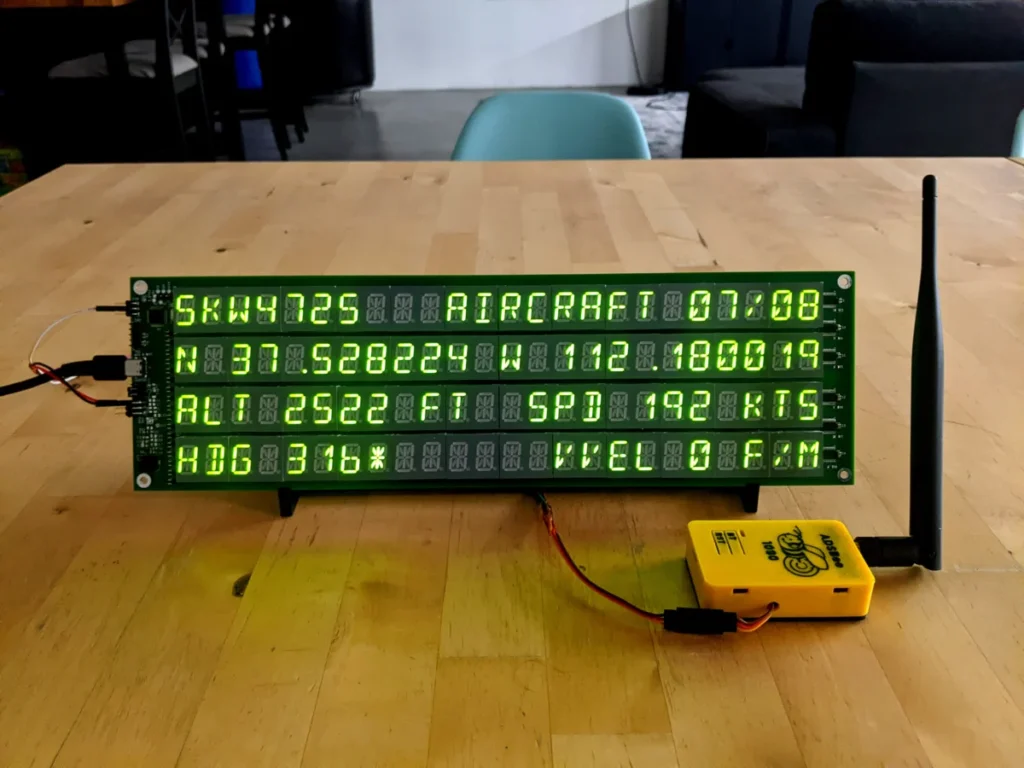
Steve Mo in California developed a custom 14-segment flight display. Powered by an STM32F103 microcontroller, the device reads data from the ADSBee and cycles through nearby aircraft, displaying their latitude, longitude, altitude, and airspeed. This project highlights the potential for ADSBee to serve as the core of educational or decorative "smart" displays for aviation enthusiasts.

Remote Ground Stations:
Ryan Null, also based in California, addressed the challenge of mounting receivers in optimal high-altitude locations without access to mains power. He developed a solar-powered base station that utilizes the ADSBee’s low power consumption to run indefinitely on a small LiPo battery and solar panel. This decentralized approach to data collection is vital for filling gaps in global ADS-B coverage, particularly in rural or mountainous areas.
Broader Impact and Industry Implications
The emergence of ADSBee arrives at a critical juncture for the aviation industry. As the Federal Aviation Administration (FAA) in the United States and similar bodies globally mandate Remote ID for drones and move toward more integrated "NextGen" air traffic systems, the demand for small, reliable ADS-B receivers is surging.

By providing an open-source alternative to proprietary hardware, ADSBee facilitates a faster pace of innovation. Proprietary systems are often "black boxes" with closed firmware that may harbor bugs or lack specific features needed by researchers. In contrast, the ADSBee firmware is transparent, allowing the community to identify vulnerabilities, suggest optimizations, and adapt the hardware for specialized use cases—such as tracking wildlife tagged with custom transmitters or monitoring localized weather patterns.
Furthermore, the ADSBee project lowers the barrier to entry for academic institutions and hobbyists to contribute to global data networks. Increased receiver density improves the accuracy of multilateration (MLAT), a technique used to track older aircraft that transmit Mode S signals but do not yet broadcast GPS coordinates.

Conclusion
The ADSBee project represents a significant milestone in the democratization of aviation technology. By leveraging modern, low-cost silicon like the RP2040 and fostering a collaborative open-source environment, it has transformed what was once a prohibitively expensive niche into an accessible tool for the wider public. As the project moves out of its beta phase, its influence is likely to expand beyond the maker community into professional UAV operations and decentralized atmospheric research, ensuring that the "speech" of the airplanes remains audible to all who wish to listen. Through its unique combination of technical ingenuity and community engagement, ADSBee is helping to ensure that the future of the skies is as open as the code that tracks them.