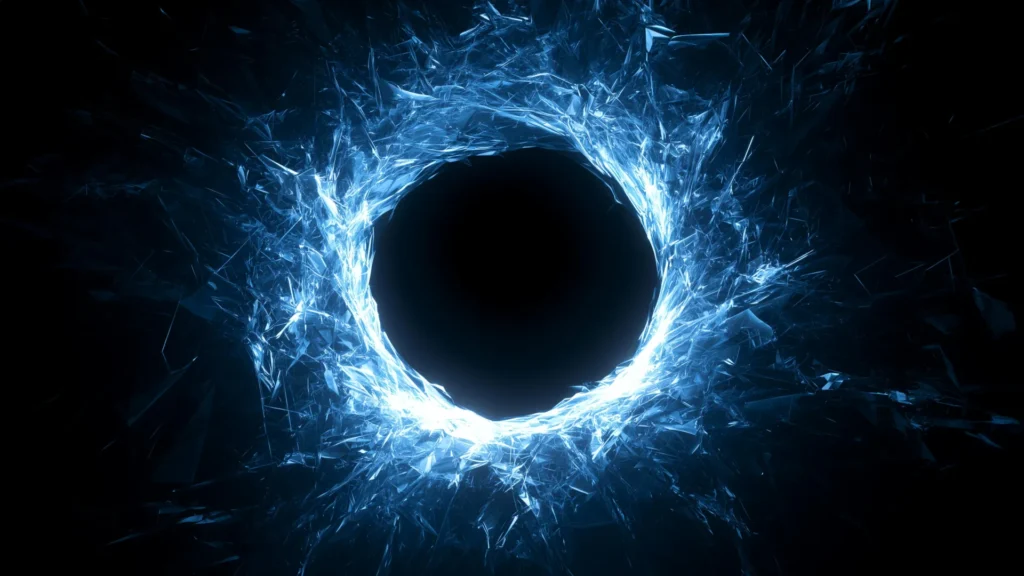
In a significant advancement for theoretical physics, researchers from Goethe University Frankfurt and TU Wien have successfully derived a precise mathematical description of how spacetime can organize itself into repeating, crystal-like patterns before collapsing into microscopic black holes. This discovery, achieved through an unconventional approach involving an infinite number of dimensions, provides the first analytical formula for a phenomenon known as "critical collapse," a process that has puzzled physicists for more than three decades. By bridging the gap between complex computer simulations and fundamental equations, the team has opened a new window into the extreme conditions of the early universe and the fundamental nature of gravity itself.
The Genesis of Microscopic Black Holes
While the general public often associates black holes with the gravitational monsters residing at the centers of galaxies, such as Sagittarius A*, or the remnants of collapsed massive stars, the laws of physics do not mandate a minimum size for these objects. According to Albert Einstein’s General Theory of Relativity, any amount of mass, if compressed into a sufficiently small volume—known as the Schwarzschild radius—will inevitably collapse into a singularity.
Theoretical models suggest that under specific, highly energetic conditions, black holes far smaller than an atom could be created. These microscopic black holes are not the product of stellar evolution but are instead born from "critical states." In these states, a system exists in a precarious equilibrium where the slightest addition of energy can fundamentally alter its destiny. This threshold is known as critical collapse. If the energy density is just below the threshold, the matter and energy disperse back into the void of space. If it is just above, the curvature of spacetime becomes infinite, and a black hole is born.
The conditions required for such events are believed to have existed in the fleeting moments following the Big Bang. During this primordial epoch, the universe was a dense, chaotic plasma of energy and particles. Fluctuations in density could have triggered the formation of "primordial black holes," which some scientists hypothesize could account for a portion of the mysterious dark matter that permeates the cosmos.
The Spacetime Crystal: A New State of Matter and Geometry
At the heart of the new research is the concept of a "spacetime crystal." To explain this abstract idea, Prof. Daniel Grumiller from TU Wien utilizes a familiar earthly analogy: the phase transition of water. When liquid water is cooled to exactly zero degrees Celsius, it enters a critical state. A microscopic nudge or a tiny drop in temperature causes the molecules to spontaneously arrange themselves into a rigid, repeating geometric lattice—an ice crystal.
In the realm of General Relativity, spacetime itself acts as the medium. Einstein’s theory posits that mass and energy curve the fabric of space and time. The researchers found that just before the point of total gravitational collapse, spacetime can enter a state analogous to the freezing of water. Instead of a chaotic or smooth curvature, the geometry of the universe organizes itself into a discrete, repeating pattern across both space and time.
"This spacetime crystal is a very peculiar and fascinating object," Prof. Grumiller noted. He describes it as an unstable intermediate state, a "knife-edge" between existence as ordinary, flat spacetime and existence as a black hole. Because this state is self-similar—meaning it looks the same regardless of the scale at which it is observed—it represents a unique phase of gravitational interaction that had previously only been seen in digital environments.
A Thirty-Year Mathematical Challenge
The quest to understand critical collapse began in earnest in 1993, when physicist Matthew Choptuik published groundbreaking computer simulations. Choptuik discovered that the collapse of a scalar field (a theoretical form of matter) exhibited "universal" behavior. He found that the mass of the resulting black hole followed a specific power-law scaling, and the spacetime geometry showed a repeating, "discrete self-similarity."
For thirty years, these findings remained largely in the domain of numerical relativity. While computers could simulate the "what" and the "how," physicists struggled to find the "why" in the form of a clean, analytical equation. The math required to solve Einstein’s field equations under these critical conditions is notoriously difficult, involving non-linear partial differential equations that usually defy exact solutions.
The breakthrough by the Frankfurt and Vienna teams came from a change in perspective—specifically, a change in the number of spatial dimensions. While our lived experience is confined to three dimensions of space and one of time, mathematical physics allows for calculations in any number of dimensions ($D$).
The Power of Infinite Dimensions
The researchers employed a technique where they initially calculated the behavior of spacetime as the number of dimensions approaches infinity. While it may seem counterintuitive that adding more dimensions would simplify a problem, this is a well-established strategy in various fields of physics, such as thermodynamics and quantum field theory. In a universe with infinite dimensions, certain complex interactions average out or become simplified, allowing for the derivation of exact formulas.
"Our universe has four dimensions," explains Christian Ecker from the Institute for Theoretical Physics at Goethe University Frankfurt. "But in principle, nothing prevents us from writing down physical equations for a larger number of dimensions. Surprisingly, the calculations become much easier when the number of dimensions is very high."
By solving the problem for $D to infty$, the team obtained a "master formula" for critical collapse. They then used a systematic method to "translate" this solution back down to the four-dimensional reality of our universe. This "1/D expansion" allowed them to approximate the behavior in 4D with unprecedented accuracy, effectively solving with "paper and pencil" what had previously required hours of supercomputer processing.
Timeline of Discovery: From Schwarzschild to Frankfurt
The journey toward this discovery follows a clear chronological path of scientific evolution:
- 1916: Karl Schwarzschild derives the first exact solution to Einstein’s field equations, predicting the existence of black holes.
- 1970s: Stephen Hawking and Roger Penrose develop the singularity theorems, proving that black holes are a robust prediction of General Relativity.
- 1974: Hawking proposes "Hawking Radiation," suggesting that small black holes could evaporate over time.
- 1993: Matthew Choptuik discovers the critical phenomena in gravitational collapse via computer simulations, revealing the scaling laws and self-similarity of spacetime.
- 2000s–2010s: Researchers attempt various approximations to derive Choptuik’s scaling constant analytically, with limited success.
- 2024: The joint team from Goethe University and TU Wien publishes their derivation using the infinite-dimension shortcut, providing the first exact analytical framework for the spacetime crystal and critical collapse.
Implications for Cosmology and Dark Matter
The ability to mathematically describe the formation of microscopic black holes has profound implications for our understanding of the early universe. If primordial black holes were indeed formed during the Big Bang, their size and distribution would depend heavily on the "critical exponent" and the "scaling laws" now described by the new formula.
If these microscopic black holes are stable enough, they could be the primary components of dark matter—the invisible substance that makes up roughly 85% of the matter in the universe. Understanding the exact mathematical trigger for their formation allows cosmologists to refine their models of the "inflationary period" and the density fluctuations that occurred less than a second after the beginning of time.
Furthermore, this research provides a new tool for studying "quantum gravity." Because critical collapse happens at the boundary between classical gravity and the high-energy regimes where quantum effects become dominant, the "spacetime crystal" serves as a theoretical bridge. It allows scientists to probe how the continuous fabric of spacetime might break down into discrete units.
Expert Analysis and Future Directions
The methodology developed by the Frankfurt and Vienna researchers is praised for its stability and versatility. Florian Ecker from TU Wien emphasized that the technique can be systematically improved. "Depending on the desired precision, we can improve our formulas using additional approximation methods," he stated. This suggests that the "infinite dimension" approach could be applied to other unsolved problems in General Relativity, such as the merging of neutron stars or the behavior of gravity in the immediate vicinity of a singularity.
The scientific community views this as a victory for analytical physics. In an era where "black box" computer simulations often dominate, the ability to derive a "paper and pencil" formula provides a level of insight that numbers alone cannot offer. It allows physicists to see the underlying symmetry and logic of the universe’s most extreme events.
As next steps, the researchers plan to apply their formula to more complex scenarios, such as rotating black holes or systems with charge. They also hope to collaborate with experimentalists who search for the signatures of primordial black holes in cosmic microwave background radiation or through gravitational wave detectors like LIGO and the future LISA mission.
While the "spacetime crystal" remains a theoretical construct for now, the mathematical proof of its existence marks a turning point. It demonstrates that even the most chaotic and violent events in the cosmos—the birth of a black hole—obey a hidden, beautiful geometric order. Through the lens of infinite dimensions, the most complex puzzles of our four-dimensional world are finally beginning to unravel.