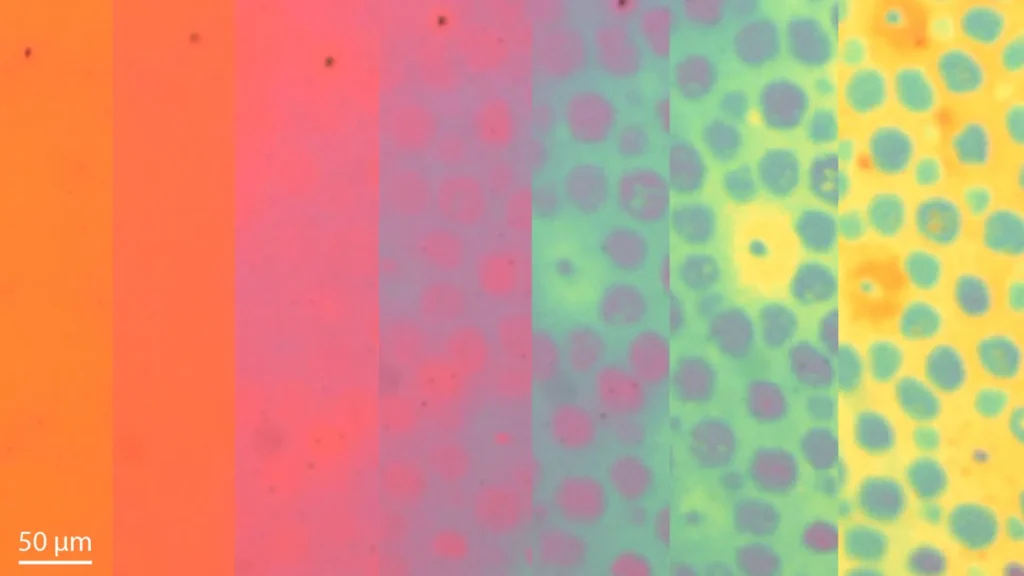
A groundbreaking development from Stanford University has introduced a flexible material capable of rapidly altering its surface patterns and colors, forming features smaller than a human hair, marking a significant step forward in the quest to replicate nature’s most sophisticated camouflage mechanisms. Published in the prestigious journal Nature, this innovation draws direct inspiration from the unparalleled ability of cephalopods like octopuses and cuttlefish to blend seamlessly into their surroundings by instantly changing their skin’s appearance and texture. This breakthrough holds profound implications for a diverse range of fields, from advanced military camouflage and adaptable robotics to next-generation flexible displays and cutting-edge nanophotonics.
Emulating Nature’s Master Disguisers: The Cephalopod Blueprint
For centuries, the mesmerizing camouflage prowess of cephalopods has captivated scientists and artists alike. Octopuses, cuttlefish, and squids possess an extraordinary biological toolkit that enables them to achieve near-instantaneous changes in their skin’s coloration, brightness, and even texture. This remarkable ability is orchestrated by specialized organs embedded in their skin: chromatophores, iridophores, and leucophores. Chromatophores are sacs of pigment that can be expanded or contracted by muscle contractions, rapidly changing the visible color. Iridophores reflect and refract light to create iridescent blues, greens, and silvers, while leucophores scatter all wavelengths of light, producing white and increasing overall brightness. Beyond color, these animals can also manipulate their skin’s topography, raising papillae to create spiky or bumpy textures that further enhance their disguise, allowing them to mimic rocks, coral, or even seaweed.
The biological complexity and speed of these transformations have long presented a formidable challenge for materials scientists seeking to develop artificial systems with similar capabilities. Efforts in biomimetics have aimed to engineer materials that can dynamically respond to environmental cues, but achieving simultaneous, rapid, and high-resolution control over both color and texture in a flexible, soft material has remained an elusive goal. Previous attempts often involved complex mechanical systems, limited color palettes, or lacked the fine spatial resolution required for truly effective camouflage. The Stanford team’s new material directly addresses these limitations, pushing the boundaries of what is possible in soft, adaptive materials.
The Stanford Innovation: A Marriage of Lithography and Polymer Science
The core of this new technology lies in the ingenious combination of established microfabrication techniques with responsive polymer chemistry. Siddharth Doshi, a doctoral student in materials science and engineering at Stanford and the lead author of the paper, explained the significance of this achievement. "Textures are crucial to the way we experience objects, both in how they look and how they feel," Doshi stated. "These animals can physically change their bodies at close to the micron scale, and now we can dynamically control the topography of a material – and the visual properties linked to it – at this same scale." This micron-scale control, where one micron is one-millionth of a meter, is critical for achieving realistic and nuanced visual and tactile alterations, mirroring the precision seen in natural camouflage.
The fabrication process begins with electron-beam lithography, a technique widely used in the semiconductor industry for creating incredibly small patterns on surfaces. This method involves using a focused beam of electrons to selectively modify the properties of a material. In this case, the Stanford researchers applied it to a water-responsive polymer film. When specific regions of the polymer film are exposed to the electron beam, their absorbency characteristics are altered. Subsequently, when the material is introduced to water, these modified regions swell differently compared to their unexposed counterparts. This differential swelling creates intricate, three-dimensional patterns that emerge only when the film is wet, offering a dynamic and reversible control over the material’s surface topography.
A Serendipitous Discovery Paves the Way
The crucial insight that unlocked this innovation was, as often happens in scientific discovery, quite unexpected. Doshi recounted how, during an earlier experiment, he used a scanning electron microscope to examine nanostructures on a polymer film. Rather than discarding these samples, he repurposed them for subsequent tests. It was during these later experiments that he observed an intriguing phenomenon: the areas previously exposed to the electron beam behaved distinctly when subjected to other stimuli, displaying different colors and properties. "We realized that we could use these electron beams to control topography at very fine scales," Doshi explained, describing the breakthrough as "definitely serendipitous." This accidental observation sparked the targeted research that led to the development of the dynamic patterning material.
Nicholas Melosh, a professor of materials science and engineering and a senior author on the paper, underscored the uniqueness of their creation. "There’s just no other system that can be this soft and swellable, and that you can pattern at the nanoscale," Melosh remarked. "You can imagine all kinds of different applications." The ability to pattern at the nanoscale, which refers to dimensions typically between 1 and 100 nanometers (one nanometer being one-billionth of a meter), allows for an unprecedented level of detail and control over the material’s optical and physical properties.
From Flat Surfaces to Dynamic 3D Landscapes and Vibrant Colors
The precision afforded by this technique is truly remarkable. To illustrate its capability, the researchers successfully fabricated a miniature, three-dimensional replica of Yosemite’s iconic El Capitan. When dry, the material’s surface remains perfectly flat and featureless. However, upon the addition of water, the intricate geological formations of El Capitan gracefully rise from the film, transforming a two-dimensional surface into a detailed 3D structure. This dramatic transformation is fully reversible; by introducing an alcohol-like solvent, the water is removed, and the material returns to its initial flat state.
Beyond topographical changes, the team demonstrated the ability to control how the material interacts with light, enabling shifts between glossy and matte finishes. This is achieved by carefully adjusting the degree of swelling, which in turn alters the surface roughness and light scattering properties. Such dynamic control over visual effects surpasses the static capabilities of current display technologies, opening new avenues for interactive and immersive visual experiences.
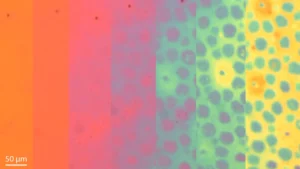
The material’s versatility extends to complex color patterning. By strategically layering thin metal films on both sides of the polymer, the researchers created structures known as Fabry-Pérot resonators. These optical devices are designed to selectively transmit or reflect specific wavelengths of light. As the polymer film expands or contracts in response to water or solvent, the thickness of the resonator changes, thereby altering the wavelengths of light that are reinforced or cancelled. This allows the material to display a wide spectrum of colors. With precise manipulation of water and solvent levels, a seemingly plain surface can be made to morph into a vibrant, multicolored array of dynamic patterns.
Mark Brongersma, a professor of materials science and engineering and another senior author on the paper, highlighted the transformative potential of this approach. "By dynamically controlling the thickness and topography of a polymer film, you can realize a very large variety of beautiful colors and textures," Brongersma stated. "The introduction of soft materials that can expand, contract, and alter their shape opens up an entirely new toolbox in the world of optics to manipulate how things look."
The Road Ahead: Automated Camouflage and Beyond
The immediate and perhaps most intuitive application of this technology lies in advanced camouflage systems. By combining multiple layers of these responsive films, researchers envision the ability to independently adjust both color and texture, allowing the material to adapt to its surroundings with an unprecedented level of sophistication, akin to the natural abilities of an octopus. While the current prototype requires manual tuning of water and solvent levels to match a background, the Stanford team is already looking towards automating this process. Their ambition is to integrate computer vision and artificial intelligence (AI) systems that can analyze the environment in real-time and autonomously adjust the material’s properties.
"We want to be able to control this with neural networks – basically an AI-based system – that could compare the skin and its background, then automatically modulate it to match in real time, without human intervention," Doshi elaborated. Such a system would represent a paradigm shift for military applications, stealth technology, and surveillance, offering dynamic, adaptive camouflage far superior to static patterns. Imagine a robotic vehicle or even a soldier’s uniform that could instantly blend into a desert, then a forest, then an urban environment, adapting to light conditions and changing textures.
The implications of this breakthrough, however, extend far beyond camouflage. The fine control over surface texture could be harnessed to regulate friction, a critical parameter in robotics. Small robots, for instance, could dynamically alter their surface to either firmly grip surfaces for climbing or manipulate objects, or to reduce friction for smooth gliding across different terrains. This would enable a new generation of highly versatile and adaptable microrobots.
At the nanoscale, alterations in surface structure can profoundly influence biological interactions. This opens up exciting possibilities in bioengineering, where dynamic surfaces could be used to guide cell growth, control cell differentiation, or develop smart implants that interact more effectively with biological systems. The material could also find applications in advanced sensors, where nanoscale changes in topography could be used to detect specific molecules or environmental conditions.
The team’s vision even includes exploring the artistic and creative potential of this material. Collaborations with artists are already underway, suggesting that these dynamic surfaces could lead to entirely new forms of interactive art, architecture, and design, where physical objects themselves become dynamic canvases.
Melosh concluded with an optimistic outlook on the broader impact of their work: "Small changes in the properties of soft materials over micron distances are finally possible, which will open up all sorts of possibilities. I think there are a lot of exciting things coming up."
A Collaborative Effort and Robust Support
This pioneering research is a testament to interdisciplinary collaboration and robust institutional support. Professor Mark Brongersma holds appointments as a professor, by courtesy, of applied physics, and is affiliated with Stanford Bio-X, the Wu Tsai Human Performance Alliance, and the Wu Tsai Neurosciences Institute, as well as the Precourt Institute for Energy. Professor Nicholas Melosh is also a member of Stanford Bio-X and the Wu Tsai Neurosciences Institute, an affiliate of the Precourt Institute for Energy, and a faculty fellow of Sarafan ChEM-H.
The extensive list of additional Stanford co-authors highlights the collaborative nature of this project, including Professor Alberto Salleo, the Hong She and Vivian W. M. Lim Professor and professor of photon science; Associate Professor Polly Fordyce; postdoctoral researchers Nicholas A. Güsken and Gerwin Dijk; Stanford Microfluidics Foundry director Jennifer E. Ortiz-Cárdenas; and graduate students Johan Carlström, Peter Suzuki, and Bohan Li.
The funding for this ambitious endeavor was provided by a consortium of prestigious organizations and fellowships, underscoring the perceived importance and potential of the research. These include a Stanford Graduate Fellowship, a Meta PhD Fellowship, the Wu Tsai Human Performance Alliance at Stanford University and the Joe and Clara Tsai Foundation, the German National Academy of Sciences Leopoldina, the Department of Energy, the Air Force Office of Sponsored Research, and the National Science Foundation. This broad base of support underscores the high expectations for the future impact of this innovative material science.
The development of this dynamically responsive material represents a significant leap forward in materials science, pushing the boundaries of what artificial systems can achieve. By meticulously mimicking the exquisite camouflage abilities of cephalopods, Stanford researchers have not only unveiled a new class of adaptive materials but have also laid the groundwork for future innovations that could redefine industries and enhance human capabilities in ways previously confined to science fiction.