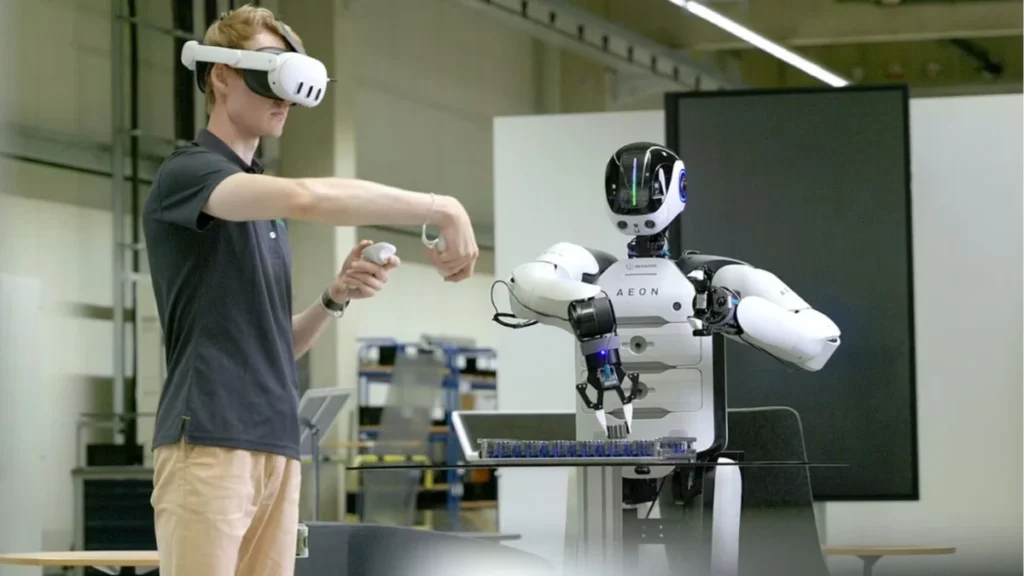
Last month, a pivotal development in the realm of advanced industrial automation unfolded as Hexagon Robotics, a pioneering force in humanoid robotics, announced that its AEON humanoid robot had commenced training at Schaeffler’s state-of-the-art Humanoid Gym in Germany. This strategic move marks a significant advancement in the ongoing collaboration between Hexagon Robotics and the global motion technology company Schaeffler, aimed at integrating highly capable humanoid robots into complex industrial environments. The facility is meticulously designed to immerse AEON in a structured learning curriculum, where it will acquire and validate new manufacturing capabilities, undergoing rigorous preparation for eventual deployment across Schaeffler’s extensive operations. This initiative is a cornerstone of an ambitious long-term vision, with both partners working towards the planned deployment of at least 1,000 AEON humanoids in the coming years, signifying a transformative shift in the landscape of industrial automation.
The Genesis of a Strategic Alliance: Hexagon Robotics and Schaeffler
The partnership between Hexagon Robotics and Schaeffler did not emerge overnight but is the culmination of a shared understanding of the evolving demands of modern manufacturing and the immense potential of humanoid robotics. Hexagon Robotics, while relatively new compared to some industrial automation giants, has quickly gained recognition for its innovative approach to developing human-centric robots capable of performing a wide array of tasks traditionally executed by humans. Their flagship creation, AEON, is designed with advanced dexterity, perception, and AI-driven intelligence, enabling it to navigate complex environments and interact with tools and machinery in a manner that traditional industrial robots often struggle with.
Schaeffler, on the other hand, is a global automotive and industrial supplier with a rich history of innovation in motion technology. Operating across 50 countries with over 80,000 employees, the company understands the critical need for efficiency, flexibility, and resilience in its manufacturing processes. As industries worldwide grapple with challenges such as skilled labor shortages, the increasing complexity of production lines, and the imperative for greater operational flexibility, Schaeffler recognized that advanced automation, particularly in the form of humanoids, could offer a strategic advantage. This collaboration represents Schaeffler’s proactive step towards embracing Industry 4.0 principles, where smart factories and intelligent automation play a central role in optimizing production.
The initial announcement of their collaboration underscored a shared commitment to developing and scaling humanoid robot applications that address these industrial pain points. The decision to establish a dedicated "Humanoid Gym" within Schaeffler’s facilities in Germany speaks volumes about the depth of this commitment, moving beyond theoretical discussions to practical, hands-on development and validation.
Inside the Humanoid Gym: A Three-Stage Route to Industrial Readiness
The Humanoid Gym is not merely a testing ground but a sophisticated training and validation center structured around a meticulously defined "train-validate-deploy" model. This systematic approach is crucial for translating advanced robotic capabilities from laboratory settings to the demanding realities of factory floors.
Each new capability identified for AEON, ranging from intricate assembly tasks to material handling and quality inspection, will first be taught to the robot. This teaching phase involves a combination of simulation, teleoperation, and potentially human demonstration, leveraging AEON’s advanced machine learning algorithms to understand and replicate tasks. For instance, the robot might learn to operate specific machinery, pick and place delicate components with precision, or perform quality checks requiring visual acuity and fine motor control. The iterative nature of this training allows for continuous refinement of AEON’s algorithms and physical movements.
Following the training, the learned capability enters the validation stage. Here, AEON will perform the task repeatedly under controlled conditions, mirroring real-world industrial scenarios. This involves assessing its accuracy, speed, consistency, and ability to handle variations or unexpected events. Performance metrics will be rigorously collected and analyzed to ensure that AEON meets the stringent safety and efficiency standards required in an industrial setting. This stage is critical for identifying any limitations or areas for improvement before deployment.
Once a capability has been thoroughly validated, AEON is prepared for deployment. This final stage involves integrating the robot into a specific manufacturing cell or production line within Schaeffler’s operations. The gym’s structured process ensures that by the time AEON reaches this stage, it is not only technically proficient but also seamlessly integrated into the existing workflow, minimizing disruption and maximizing productivity.
This modular, three-stage framework provides both companies with a clear, defined process for transitioning capabilities from initial concept to practical application. It creates a dedicated and controlled environment where AEON can be progressively prepared for increasingly complex manufacturing work, evolving alongside the partnership’s strategic objectives.
Developing Organizational Expertise: A Parallel Imperative
Beyond merely training the AEON robot, the Humanoid Gym serves a equally vital, dual purpose: to cultivate internal expertise within Schaeffler itself. The successful adoption of advanced humanoid robotics at scale requires more than just capable machines; it demands a highly skilled workforce proficient in managing, integrating, and optimizing these technologies.
Schaeffler will leverage the Humanoid Gym program to develop its comprehensive expertise in three critical areas:
- Operating Humanoid Robots: Teams will learn the daily operational protocols, supervision techniques, and troubleshooting for AEON, ensuring smooth and efficient functioning on the factory floor. This includes understanding AEON’s user interfaces, monitoring its performance, and responding to operational alerts.
- Training Humanoid Robots: Engineers and technicians will acquire the skills necessary to teach AEON new tasks, refine existing capabilities, and adapt its programming to evolving production requirements. This involves an understanding of robotic programming languages, AI training methodologies, and sensor integration.
- Integrating Humanoid Robots: Crucially, Schaeffler’s personnel will gain profound knowledge in integrating AEON into existing manufacturing infrastructure, including robotics systems, IT networks, and human-robot collaboration frameworks. This addresses the complex challenge of ensuring interoperability and seamless workflow integration.
These three areas collectively address different facets of successful technology adoption. While AEON needs to acquire the requisite industrial capabilities, Schaeffler’s teams must possess the institutional knowledge and practical skills to manage the robot effectively, ensuring its seamless incorporation into the company’s intricate manufacturing environment. This combined focus ensures that both the technology and the organization are prepared for the future, moving beyond the confines of the training facility into real-world applications.
The 1,000-Robot Vision: Scaling Next-Generation Automation
AEON’s arrival at the Humanoid Gym signifies a critical juncture in the strategic collaboration, directly propelling the partners towards their ambitious goal: the deployment of at least 1,000 humanoids over the coming years. While specific timetables for individual deployments or the initial manufacturing tasks AEON will undertake have not yet been disclosed, the establishment of this gym concretizes the process through which these capabilities will be developed, verified, and scaled.
The planned scale of 1,000 robots is particularly noteworthy within the burgeoning humanoid robotics sector. Industry analysts project a significant increase in the adoption of humanoid robots, with market reports by firms like MarketsandMarkets estimating the humanoid robot market to reach billions of dollars by the end of the decade, driven by increasing automation in manufacturing, logistics, and healthcare. However, such large-scale deployment remains a substantial undertaking, presenting both immense opportunities and complex challenges.
For Schaeffler, this vision implies a radical transformation of its production processes. The economic implications are substantial, promising increased efficiency, reduced operational costs in the long run, and enhanced flexibility to adapt to changing market demands. Humanoid robots, unlike fixed-arm industrial robots, offer unparalleled versatility, capable of being retasked for different operations with minimal retooling. This flexibility is crucial in an era of mass customization and shorter product lifecycles.
However, preparing for a fleet of 1,000 humanoids extends far beyond the robots themselves. It necessitates a robust infrastructure for maintenance, software updates, and continuous training. More importantly, it requires a profound shift in human-robot interaction within the workplace. Schaeffler must cultivate a workforce equipped with the skills to train these humanoids, oversee their operations, collaborate with them, and seamlessly integrate them into complex industrial processes. The work within the gym is specifically designed to allow this internal expertise to develop concurrently with AEON’s evolving capabilities, ensuring that organizational readiness progresses hand-in-hand with technological advancement. This integrated approach, rather than treating robot training and organizational development as separate endeavors, is a key differentiator in their strategy.
Broader Impact and Implications for Manufacturing
This collaboration between Hexagon Robotics and Schaeffler is poised to accelerate the adoption of next-generation automation across the manufacturing sector. AEON’s entry into the Humanoid Gym provides both companies with a pragmatic, industrial environment for the rigorous training and validation required before widespread deployment. This hands-on approach is crucial for building practical expertise, mitigating risks, and demonstrating the tangible benefits of humanoid robots.
The implications for the broader manufacturing landscape are profound:
- Addressing Labor Shortages: Humanoid robots can fill critical labor gaps in industries struggling to find skilled workers for repetitive, dangerous, or physically demanding tasks.
- Enhanced Flexibility and Agility: Humanoids can operate in environments designed for humans, utilizing existing tools and infrastructure, offering greater adaptability compared to traditional, often custom-built, automation solutions.
- Improved Safety: By undertaking hazardous tasks, humanoids can significantly reduce workplace accidents and improve overall safety conditions for human employees.
- Boosted Productivity and Efficiency: Operating continuously and with high precision, humanoids can dramatically increase output and optimize production flows, contributing to global competitiveness.
- New Job Creation: While some tasks may be automated, the deployment of humanoids will undoubtedly create new roles in robot management, maintenance, integration, and training, requiring a re-skilling of the workforce.
- Blueprint for Industry 5.0: This initiative aligns with the vision of Industry 5.0, where humans and robots collaborate symbiotically, leveraging their respective strengths to create more resilient, human-centric, and sustainable production systems.
Statements from both Hexagon Robotics and Schaeffler leadership, though not specifically quoted in the initial announcement, would logically emphasize the strategic importance of this milestone. Representatives from Hexagon Robotics would likely highlight AEON’s advanced capabilities and the robot’s potential to redefine industrial automation, while Schaeffler executives would underscore their commitment to innovation, operational excellence, and fostering a future-proof manufacturing ecosystem. Industry analysts view such structured development programs as crucial for the maturation of humanoid robotics, suggesting that the "train-validate-deploy" model could become a benchmark for future industrial robot integrations.
In conclusion, the entry of Hexagon Robotics’ AEON humanoid into Schaeffler’s Humanoid Gym is far more than a mere technological test; it is a foundational step in a comprehensive strategy to integrate advanced, human-like robotics into the very fabric of industrial manufacturing. By simultaneously developing robot capabilities and organizational readiness, Hexagon Robotics and Schaeffler are not just preparing for the deployment of 1,000 robots; they are actively shaping the future of smart factories, laying down a blueprint for wider adoption that promises to redefine efficiency, flexibility, and human-robot collaboration in the global industrial landscape for decades to come.