The world of vintage Seiko chronographs is a vast and intricate landscape, often celebrated for its legendary pieces that have etched their names in horological history. For seasoned collectors, the mention of Colonel William Pogue’s Speed-Timer or Bruce Lee’s distinctive Speed-Timer bracelet instantly conjures images of groundbreaking designs and compelling backstories. These well-trodden paths reveal a dizzying array of reference numbers, specific models, and endearing nicknames that have become part of the collector’s lexicon. However, beneath this well-illuminated surface lies a wealth of equally fascinating, yet often overlooked, timepieces. The mid-20th century saw Seiko producing chronographs that were a veritable explosion of design innovation, featuring bold patterns, striking color contrasts, and an underlying current of genuine technological advancement. From the revolutionary first automatic chronograph and flyback movements with sophisticated stacked register hands to collaborations with esteemed designers and daring forays into postmodern aesthetics, these watches offer a captivating journey of discovery for those willing to delve deeper. This exploration uncovers six such Seiko chronographs that push the boundaries of form and function, demonstrating that even across decades, there remain surprising and remarkable pieces waiting to be rediscovered, extending beyond the commonly known references to embrace more obscure yet equally significant offshoots.
The Enduring Appeal of Midcentury Seiko Chronographs
Seiko’s midcentury chronographs represent a pivotal era in watchmaking, characterized by a willingness to experiment with both form and function. The brand, already a formidable force in the Japanese and international markets, leveraged its engineering prowess to push the envelope of chronograph technology. The introduction of the world’s first automatic chronograph movement, the 6139, in 1969, was a landmark achievement that cemented Seiko’s reputation as an innovator. This groundbreaking movement, followed by the equally significant 6138 caliber, paved the way for a generation of watches that were not only technologically advanced but also visually distinctive.
The design language of this period was particularly vibrant. Unlike the more restrained aesthetics that would later dominate, Seiko embraced bold color palettes, often juxtaposing stark whites with deep blacks, vibrant blues, and fiery oranges. The cases themselves varied dramatically, from the sleek and integrated designs to the more robust and angular structures. This diversity allowed Seiko to cater to a wide range of tastes and applications, from the utilitarian needs of pilots and military personnel to the fashionable statements of urban dwellers. The incorporation of features like flyback mechanisms, which allowed for the immediate restarting of timing without the need to first stop and reset the chronograph, added a layer of practical sophistication that appealed to those who relied on precise timekeeping. Furthermore, collaborations with influential designers injected an element of avant-garde artistry into these timepieces, resulting in watches that were as much objects of art as they were instruments of measurement. This confluence of technological innovation, audacious design, and artistic collaboration makes the exploration of these lesser-known Seiko chronographs an immensely rewarding endeavor for collectors and enthusiasts alike.

Seiko 6138-8000 "Baby Panda": A Sophisticated Twist on a Classic
The Seiko 6138-8000, affectionately known as the "Baby Panda," stands as a testament to the nuanced design capabilities within Seiko’s chronograph offerings. Emerging shortly after the celebrated 6139, the world’s first automatic chronograph, the 6138 caliber was a dual-register movement that offered a different, yet equally compelling, horological experience. While many of its contemporaries from the 1970s embraced the era’s penchant for exaggeratedly bulky cases and audacious color schemes, earning nicknames like "UFO," "Kakume" (meaning "square eyes"), and the "John Player Special," the "Baby Panda" charts a course toward refined elegance.
In contrast to the more flamboyant designs, the 6138-8000’s classic black-and-white "panda" dial, characterized by its contrasting subdials, provides a sophisticated visual anchor. This traditional colorway, when paired with a case that exhibits smaller proportions and a more understated silhouette compared to some of its more ostentatious siblings, imbues the "Baby Panda" with a much-needed sense of sophistication. Its rarity further enhances its allure. Produced for a mere two years and exclusively for the Japanese domestic market, the 6138-8000 is a difficult piece to track down. An even rarer counterpart, a "reverse panda" variation with a radiant charcoal-gray dial, adds another layer of exclusivity. The scarcity of these models underscores a significant trend in the vintage Seiko market: the substantial value that can accrue to rare and historically significant pieces, proving that sometimes, the pursuit of the less common can lead to significant financial and collecting rewards. The "Baby Panda," with its blend of classic aesthetics and limited production, represents a prime example of such a coveted timepiece.
Seiko 6139-7012 Speed-Timer "JASDF": A Military Legacy on the Wrist
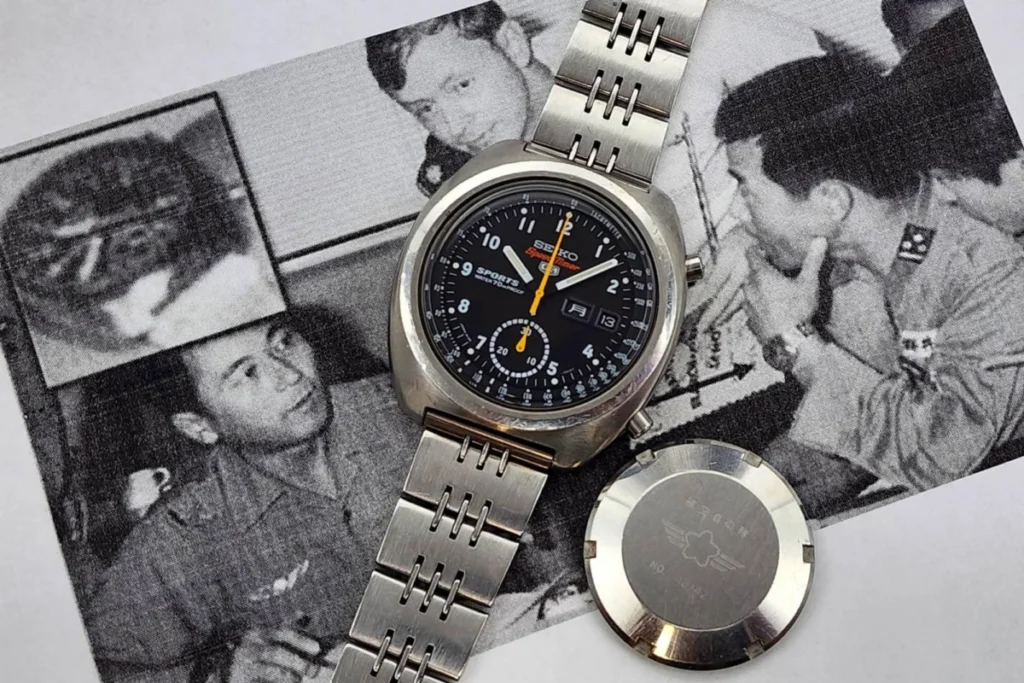
The impact of the Seiko 6139, recognized as the world’s first automatic chronograph, resonated across numerous professions and passions. Astronauts, Formula One drivers, yachtsmen, and action heroes all found this robust and innovative timepiece gracing their wrists. During the 1970s, a select group of individuals who relied on precision and reliability in the skies also sported these watches: pilots of the Japan Air Self-Defense Force (JASDF).
The JASDF variant of the 6139-7012 Speed-Timer distinguished itself from its civilian counterparts through practical modifications tailored for aerial operations. The standard baton indices were replaced with highly legible Arabic numerals, set against a contrasting black dial for optimal visibility in varying light conditions. While similar models were available to the public, the definitive mark of military issuance was found on the caseback. This was stamped with the JASDF’s distinguished cherry blossom insignia, accompanied by an individual military personnel number, signifying its official deployment.

According to historical accounts from horological experts at DC Vintage Watches, members of the elite JASDF Blue Impulse aerobatic team were frequently seen wearing these Speed-Timers while performing breathtaking maneuvers in their F-86 Sabre fighter jets. This association with high-performance aviation underscores the inherent reliability and precision demanded of military-grade equipment.
The legacy of military-issued Seiko chronographs continued decades later, most notably with Great Britain. Throughout the latter half of the 20th century, the United Kingdom played a crucial role in sustaining the tradition of military-issue watches. During this period, nearly every pilot in the Royal Air Force (RAF) was equipped with a Seiko 7A28 chronograph, a testament to Seiko’s enduring commitment to producing timepieces that met the stringent requirements of armed forces worldwide. The 7A28, a pioneering all-quartz chronograph movement, offered exceptional accuracy and durability, making it a trusted companion for aviators.
Seiko 7016-5000 "Monaco": A Compact Marvel of Engineering
The internal rivalry between Seiko’s Daini and Suwa factories in the mid-20th century was a fertile ground for innovation, pushing both entities to produce remarkable timepieces. The 70xx series, a product of the Daini factory, emerged as a significant technological advancement, directly challenging the achievements of Suwa’s 6139 caliber. The Seiko 7016-5000, often nicknamed the "Monaco" due to its distinctive case shape reminiscent of some TAG Heuer Monaco models, is a prime example of this Daini ingenuity.
This watch is a true flyback chronograph, boasting a quick-set day-date complication and a single register with elegantly stacked hands. All of this sophisticated functionality is housed within an impressively compact and slim profile. Measuring less than 40mm in diameter and a mere 5.9mm in thickness, it stands as a remarkable feat of miniaturization for its time. While the 6139 had already claimed the title of the first automatic chronograph in 1969, the 7018 movement, which powered many watches in the 70xx series, became the smallest automatic chronograph movement available, a record it held for over a decade.

The design of the 7016-5000 series often features a svelte round case with gracefully tapering lugs and sharp, faceted edges. This aesthetic shares a kinship with the renowned "Grammar of Design" principles espoused by Grand Seiko during the same era, suggesting a shared design philosophy focused on clean lines and precise execution. However, it is the "Monaco" variant that truly captures attention. Its distinctive, puffy "squircle" case, with its soft, rounded corners, evokes a playful, almost marshmallow-like quality. This unique form is echoed in the ridged bezel and the contrasting center-seconds dial, creating a visually dynamic composition. Perhaps the most captivating element is the interplay of light on the dial’s edge. Sunray brushing extends outwards, meeting the delicate railroad track minute markers, creating a subtle yet striking visual effect that even aficionados of Heuer’s iconic chronographs would likely appreciate.
Seiko 7A28-5000 "Steering Wheel": A Futuristic Collaboration
The advent of quartz chronographs in the late 1970s and early 1980s ushered in a new era of precision and affordability in timing instruments. Seiko, a pioneer in quartz technology, embraced this shift and embarked on one of the most celebrated collaborations in the watch industry: a partnership with Giorgetto Giugiaro, the visionary Italian automobile designer. Giugiaro, renowned for his work in an automotive industry then captivated by radical new ergonomics and a "form follows function" philosophy, brought his distinctive blend of practical design and futuristic vision to Seiko’s watchmaking.
Among the half-dozen watches that emerged from this groundbreaking collaboration, the Seiko 7A28-5000, aptly nicknamed the "Steering Wheel," stands out as particularly wild and exceptionally rare. This timepiece is a bold departure from conventional watch design. Its dark green, pill-shaped case is complemented by pushers strategically placed at the corners, a design choice that enhances its ergonomic appeal. A striking black plastic ring rises upwards from the bezel, resembling the railing of a ship’s prow, acting as a protective shield for the watch face. This innovative approach to ergonomics and safety, rendered in forms never before seen in watchmaking, contributed to its intensely futuristic aesthetic. The "Steering Wheel" represents a daring fusion of industrial design principles and horological engineering, resulting in a chronograph that is as much a piece of avant-garde art as it is a functional timekeeping device. Its scarcity and unique design have made it a highly sought-after item among collectors who appreciate daring innovation and the legacy of this iconic collaboration.
Seiko 5718-8000 "Counter Chrono": A Rare Olympic Marvel
While the Seiko Crown chronograph monopusher, produced for the 1964 Tokyo Olympics, is widely recognized as Seiko’s inaugural chronograph and a significant milestone, the brand simultaneously engineered another, far rarer, chronograph for the same prestigious event. In the midst of a comprehensive engineering undertaking that encompassed advanced electronic timing components, chronometers, marathon clocks, and sophisticated printers, Seiko developed the 5718-8000 "Counter Chronograph." This timepiece, by comparison, is exceptionally rare.

The 5718 "Counter Chronograph" utilized a modified version of the base caliber found in the 5179. However, its pièce de résistance was an incredibly complex date function. This consisted of a two-digit date counter displayed within square windows, with each individual digit controlled by its own dedicated pusher. Positioned above a small-seconds register featuring stacked hands, and presented against a stunning sunburst gray or silver dial, the overall design is a masterpiece of considered aesthetics. Even with the presence of dual railroad tracks, the dial remains remarkably uncluttered. A delicate touch of light blue numbering for the tachymeter scale further enhances the dial’s visual appeal, creating a harmonious and sophisticated composition.
The production of the 5718-8000 was extremely limited, with only 100 examples ever manufactured. This scarcity, coupled with a substantial retail price that exceeded that of a Rolex Submariner at the time, speaks to its exclusivity. Furthermore, these watches were only available for the two-week duration of the Olympics and could exclusively be purchased at the Olympic Village. The convergence of profound historical significance, ambitious engineering, and its status as a horological unicorn makes the 5718 "Counter Chronograph" a truly grail-worthy Seiko, representing the pinnacle of the brand’s early chronograph development and its association with a global sporting spectacle.
Seiko Sportura Kinetic Chronograph SLQ011: A 1990s Echo in the New Millennium
For those who came of age in the 1990s, the Seiko Sportura Kinetic Chronograph SLQ011 evokes a distinct sense of nostalgia. This millennium-era anomaly separates each chronograph subdial into its own distinct, small black-dial circle, nestled within a substantial chunk of titanium. The case’s unique, pear-like shape bears a subtle resemblance to the visage of "The Iron Giant," the beloved animated character. Accents such as exposed screws, an integrated curving bracelet, and a diminutive white date window, which protrudes conspicuously on the right side like a "pimple," lend the watch a decidedly brutalist aesthetic.
The SLQ011 represents a rare instance where Seiko’s innovative Kinetic system was applied to a chronograph. This technology ingeniously combines the motion generated by an automatic winding rotor with an electric capacitor and a quartz movement, offering a cost-effective approximation of the sophisticated Spring Drive system. While the Sportura line itself debuted in the year 2000, the SLQ011’s aesthetic is a clear homage to the preceding decade. Its design language is perfectly suited to complement the era of rave pants, mesh crop-top shirts, and Rollerblades, embodying a spirit of bold self-expression and energetic dynamism. The watch’s audacious style and unique technological integration make it a standout piece, capturing the zeitgeist of a particular generation while showcasing Seiko’s ongoing commitment to pushing technological and design boundaries. The rallying cry, "Hack the planet!" seems an apt, if anarchic, descriptor for this unconventional timepiece.

The enduring appeal of these often-overlooked Seiko chronographs lies not only in their individual design merits and technological innovations but also in their collective narrative. They tell a story of a brand that consistently challenged conventions, embraced experimentation, and produced timepieces of exceptional quality and character. From the military-proven reliability of the JASDF Speed-Timer to the avant-garde futurism of the Giugiaro-designed "Steering Wheel," and the Olympic-era engineering marvel of the "Counter Chrono," each watch offers a unique window into Seiko’s rich and diverse history. As collectors continue to explore the vast landscape of vintage Seiko, these lesser-known gems promise further discoveries, revealing the depth and breadth of a brand that has consistently delivered excellence across its extensive catalog.