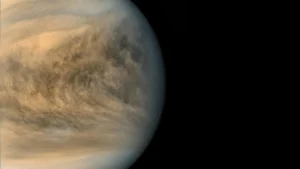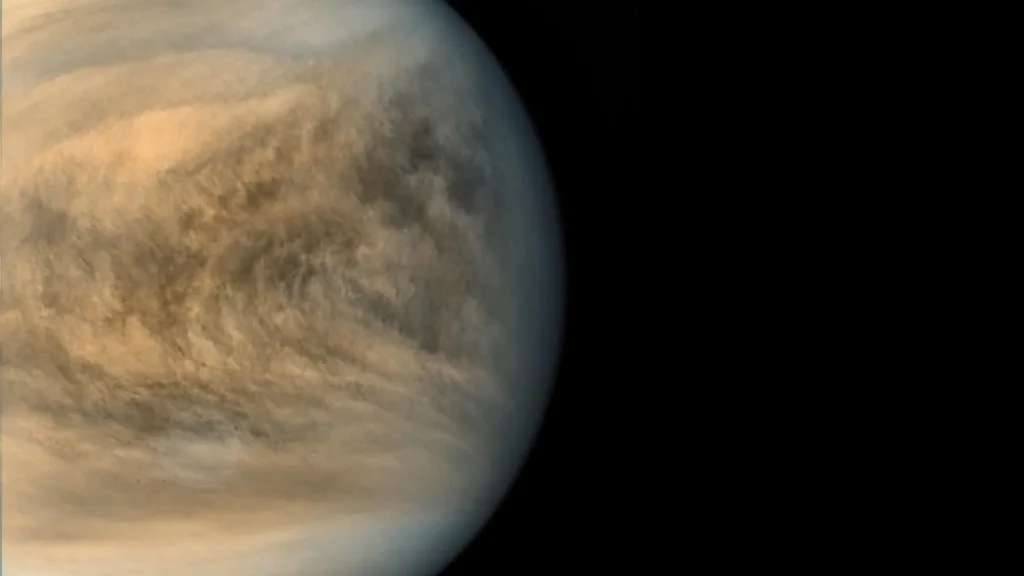
Venus, our celestial neighbor, presents a stark dichotomy in its visual appearance. While in ordinary visible light it gleams with a pale yellow hue, this placid exterior belies a dynamic and mysterious interior when observed in ultraviolet wavelengths. Across the planet’s upper atmosphere, dominated by thick clouds of sulfuric acid, swirling patterns of dark and bright features have captivated scientists for approximately a century. Yet, the very substance responsible for these dramatic ultraviolet displays, an elusive entity dubbed the "unknown absorber," has remained a profound enigma, defying identification despite decades of dedicated observation.
Now, an international consortium of researchers has taken a significant stride towards unraveling this atmospheric puzzle. By meticulously combining sophisticated observational data of Venus with advanced radiative-transfer modeling, these scientists have established stringent numerical limits on the physical and chemical properties that this mysterious material must possess. Their findings, published in the esteemed journal Astrobiology, offer a crucial glimpse into the intensity of light absorption required within Venus’s cloud droplets to account for the observed extraterrestrial phenomena.
Reimagining Venus’s Clouds: A Laboratory Perspective
The approach adopted by this research team is as innovative as it is insightful. Lead author Dr. Jan Spacek, affiliated with the Foundation for Applied Molecular Evolution in the USA, proposed a novel conceptual framework: what if Venus’s cloud material could be somehow extracted and studied as a concentrated bulk liquid within a laboratory spectrometer? This distinction between the optical properties of a dispersed cloud and a condensed liquid is paramount.
To illustrate this crucial difference, consider the familiar example of cigarette smoke. From a distance, smoke appears white due to the highly efficient scattering of light by its sub-micrometer particles. However, if those same particles are collected and concentrated within a flask, they form a dense, tar-like sludge, revealing a vastly different optical character. Venus’s clouds may operate under a similar principle. The particle size distribution within Venus’s clouds is remarkably comparable to that of cigarette smoke. This suggests that clouds which appear a pale yellow from afar could, in fact, be composed of liquids that exhibit surprisingly strong absorption when concentrated.
"Our model effectively asks what would happen if we could collect that cloud material into a cuvette and put it into a laboratory spectrometer," explained Dr. Spacek. "This is important, as light absorption in a bulk liquid may be correlated with the concentration of light-absorbing material in the solution." This paradigm shift allows for a more direct comparison between theoretical predictions and experimental measurements.
Quantifying Light Absorption: A Demandingly High Standard
To bridge the gap between telescopic observations and laboratory analysis, the researchers integrated two key components: direct observations of Venus and a sophisticated radiative-transfer model. This model meticulously tracks the intricate journey of sunlight as it is repeatedly scattered and absorbed by the myriad cloud droplets and atmospheric molecules suspended in Venus’s atmosphere.
The astronomical measurements were then translated into a metric familiar to laboratory UV-visible spectroscopy: the absorption coefficient of the liquid constituting the cloud droplets. This conversion is not a simple one, as Dr. Yeon Joo Lee of the Planetary Atmospheres Group within the Institute for Basic Science (IBS) in South Korea, who performed the complex radiative-transfer calculations, elucidated.
"The key is that Venus’s cloud particles scatter sunlight very efficiently, so the brightness observed from space cannot be directly compared with the absorption of a bulk liquid measured in the laboratory," Dr. Lee stated. "By accounting for the scattering and absorption by the cloud particles and atmosphere, the model allows us to estimate how strongly the liquid of cloud droplets itself must absorb light."
The results of this rigorous analysis revealed a demanding requirement. Across the modeled wavelength range of 365 to 455 nanometers, the calculated decadic absorption coefficient reached an astonishing approximately 1,278 cm-1 at 375 nanometers. This figure signifies that the unknown absorber must be either exceptionally efficient at absorbing light, present in extremely high concentrations within the cloud droplets, or a combination of both.
Investigating Carbon-Based Molecules: A Promising Avenue
One class of substances known for their potent light-absorbing capabilities are highly absorbing conjugated organic molecules. In this scientific context, "organic" refers to carbon-based structures and does not imply a biological origin. For molecules exhibiting absorption strengths comparable to well-known efficient pigments like porphyrinoids, the required concentration within Venus’s cloud droplets would be in the order of ten grams per liter.
The researchers are careful to emphasize that they are not proposing that familiar biological pigments such as chlorophyll or heme are the culprits behind Venus’s dark ultraviolet features. Instead, these compounds serve as valuable benchmarks, representing well-understood examples of molecules that possess exceptional light-absorbing properties.
Further insight is provided by the characteristic shape of Venus’s absorption spectrum. While simple organic compounds, when dissolved in concentrated sulfuric acid, can react to form dark, chemically complex mixtures often described as "tar-like," these mixtures typically absorb light broadly across the visible spectrum, resulting in a brown or black appearance. This broad absorption profile does not align with the pattern inferred for Venus, where absorption dramatically decreases between 365 and 455 nanometers.
"If the observed light absorption is due to conjugated organic matter, the relatively sharp absorption profile is consistent with a chemically defined absorber that resists conversion into the tar-like mixture we typically observe with organics dissolved in concentrated sulfuric acid," Dr. Spacek commented. This suggests that the unknown absorber is likely a specific, stable molecular structure rather than a general degradation product.
New Constraints Tighten the Mystery
Paradoxically, rather than immediately identifying the unknown absorber, the study’s stringent constraints have narrowed the field of plausible candidates, making the mystery even more intriguing. "Paradoxically, by placing additional constraints on the unknown absorber, we might have made the mystery even more intriguing," remarked Janusz J. Petkowski of Wroclaw University of Science and Technology, Poland, a co-author of the study.
Inorganic explanations for the phenomenon also face significant hurdles. "The model places a demanding constraint on any proposed absorber," noted Paul B. Rimmer of the University of Cambridge, UK. "Many of the proposed inorganic candidates would need to be present at very high concentrations to match the required absorption."
It is crucial to reiterate that these findings do not provide evidence for the existence of life in Venus’s clouds, nor do they definitively establish the mysterious absorber as organic. Instead, the research meticulously defines specific, quantitative requirements that any potential candidate material, regardless of its origin, must satisfy. These criteria encompass the efficiency of light absorption, the necessary concentration, its atmospheric distribution, and its realistic existence within the observed range of cloud particle sizes.
Future Missions Poised to Resolve the Enigma
The path forward involves rigorous laboratory experimentation to test these newfound constraints, followed by direct measurements from within Venus’s atmosphere. The burgeoning initiative known as the Morning Star Missions to Venus is actively developing in situ techniques designed to probe the intricate chemistry of Venus’s clouds. These efforts include dedicated searches for complex organic molecules and precise measurements that could finally pinpoint the identity of the unknown absorber.
One particularly promising instrument under development is the Autofluorescence Nephelometer. This device is specifically engineered to examine Venus’s cloud particles for fluorescence, a phenomenon strongly associated with organic molecules. Its deployment is anticipated on an upcoming Rocket Lab mission to Venus.
By forging a crucial link between remote observations, fundamental laboratory chemistry, and the promise of future spacecraft exploration, this research has illuminated a new and promising pathway toward solving one of the most enduring and fascinating mysteries of our neighboring planet. The long-sought answer to Venus’s ultraviolet puzzle may finally be within reach.