Breakthroughs in physics often emerge from diverse origins: some from entirely novel inventions, others from groundbreaking theoretical frameworks. Yet, a significant number of advances materialize when established technologies are ingeniously combined in an unforeseen manner, yielding capabilities far exceeding the sum of their individual parts. This synergistic approach is now poised to revolutionize the field of particle detection, particularly in the arduous quest for weakly interacting particles.
The search for elusive particles like neutrinos and various dark matter candidates represents one of the grandest challenges in modern physics. These subatomic entities are notoriously difficult to detect due to their infrequent interactions with ordinary matter, often passing through vast quantities of material without leaving a trace. To overcome this inherent elusiveness, researchers typically pursue two main strategies: constructing ever-larger detectors to increase the probability of an interaction, and enhancing the spatial resolution of these instruments to pinpoint the faint signals they produce. However, both avenues frequently lead to instruments of immense complexity, prohibitive cost, and significant manufacturing hurdles. Similar demands for precision and scale also apply to calorimeters, essential devices in collider experiments used to measure the energy carried by particles after collisions.
The Intricacies and Limitations of Conventional Particle Detectors
At the heart of most particle physics experiments lies the challenge of reconstructing the three-dimensional (3D) trajectories of elementary particles as they traverse substantial volumes of dense detector material. One of the most prevalent materials employed for this purpose is a scintillator. When a charged particle penetrates a scintillator, the material responds by emitting minute flashes of visible light. These faint light signals serve as crucial markers, allowing scientists to infer the particle’s path and how it interacted with the detector medium.
To achieve precise localization of a particle’s interaction point, scintillators are traditionally segmented into an immense number of small, discrete active sections. Each section is typically coupled with optical fibers that meticulously collect the photons generated within it, guiding this light to highly sensitive photodetectors such as photomultiplier tubes (PMTs) or silicon photomultipliers (SiPMs), which then count the individual photons. This method, while capable of delivering high precision, faces considerable difficulties when scaled up to the dimensions required for next-generation experiments.
Consider the T2K (Tokai to Kamioka) neutrino-oscillation experiment in Japan, a pioneering effort in understanding neutrino properties. Its sophisticated detector incorporates approximately two tons of sensitive material, meticulously assembled from around two million individual scintillator cubes and interwoven with 60,000 optical fibers. Similarly, at European research powerhouses like CERN and the Paul Scherrer Institute (PSI), experiments such as LHCb and Mu3e push the boundaries of spatial resolution, achieving sub-millimeter precision by deploying millions of thin scintillating optical fibers. These monumental endeavors unequivocally demonstrate the formidable capabilities of segmented detectors in discerning particle tracks with exquisite detail. However, they simultaneously underscore a burgeoning problem: as detectors continue to grow in size and complexity, the sheer scale of manufacturing, assembling, and reading out millions of individual components transforms into a significant technological and financial bottleneck, threatening the viability of future, even larger-scale experiments.
A Radical New Paradigm for Particle Tracking
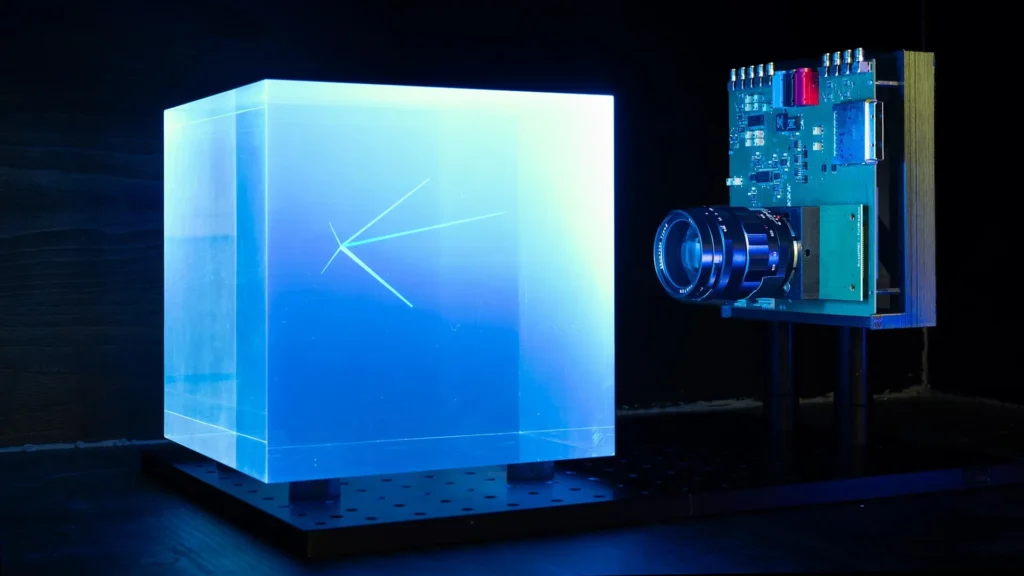
In response to these escalating challenges, researchers at ETH Zurich and EPFL (École Polytechnique Fédérale de Lausanne) in Switzerland have unveiled a profoundly different and highly innovative strategy. PhD student Till Dieminger, senior scientist Dr. Saúl Alonso-Monsalve, Professor Davide Sgalaberna, and their colleagues, in collaboration with members of the Advanced Quantum Architecture Lab at EPFL led by Professor Edoardo Charbon, have successfully developed and rigorously tested the first prototype of a detector designed to achieve ultrafast, high-resolution 3D particle imaging within a large, unsegmented block of scintillator material. This departure from conventional wisdom eliminates the need to divide the detector into millions of tiny, interconnected units. Instead, the system leverages advanced camera technology to directly reconstruct the origin point of the light within the continuous scintillator block.
This groundbreaking prototype demonstration, alongside an extensive series of corroborating simulations, was recently detailed in a pivotal publication in the prestigious journal Nature Communications, marking a significant milestone in the field of particle detection.
Turning Light Field Photography into a Precision Physics Tool
The conceptual foundation of this novel detector draws profound inspiration from plenoptic cameras, more commonly known as light field cameras. Unlike a conventional camera, which primarily registers the intensity of incoming light across a two-dimensional plane, a light field camera captures a far richer dataset. It simultaneously records not only the intensity but also crucial information about the direction from which each light ray arrives. This additional directional data empowers the camera to recover depth information and reconstruct an entire scene in three dimensions, much like how the human visual system perceives depth.
The core technology enabling this feat is a micro-lens array (MLA) strategically positioned between the camera’s main lens and its imaging sensor. Each microscopic lens within this array functions akin to a tiny, independent camera, capturing the same scene from a slightly different vantage point. When the information meticulously gathered from all these individual micro-lenses is computationally combined and processed, the system can reconstruct a comprehensive "light field." This light field provides a complete description of the intensity, precise position, and exact direction of all incoming light rays.
For the specialized application of particle detection, this inherent ability of plenoptic cameras to capture directional light information is exceptionally valuable, particularly because the light emitted inside a scintillator during a particle interaction can be extraordinarily faint, often consisting of just a few photons. When these plenoptic cameras are ingeniously paired with single-photon avalanche diode (SPAD) array sensors, their capabilities are dramatically amplified. SPAD sensors are engineered to detect individual photons with remarkable sensitivity, thereby enabling the potential reconstruction of intricate particle tracks even when the available light is at its absolute minimum. Despite this immense promise, the application of light field cameras had, until now, remained largely unexplored within the realm of high-energy particle tracking.
Inside the PLATON Prototype: A Symphony of Advanced Optics and Electronics
The new system, christened PLATON (a name derived from its foundational principles), was developed as part of a dedicated project generously funded by the Swiss National Science Foundation. The collaborative team from ETH Zurich and EPFL meticulously constructed a proof-of-concept detector that seamlessly integrates a micro-lens array with a highly specialized SPAD imaging sensor. The sensor, known as SwissSPAD2, is itself a testament to cutting-edge research, having been developed in-house by the expert team at EPFL. For the critical optical component, Raytrix GmbH, a company renowned for its expertise in light field technology, designed the micro-lens array and precisely mounted it directly onto the SwissSPAD2 sensor, thereby creating the integrated plenoptic imaging system.
A key feature differentiating SwissSPAD2 is its capability for "gated photon detection." This sophisticated functionality allows the sensor to record photons only within precisely defined, ultra-short time windows. This meticulous timing control is instrumental for researchers, enabling them to sharply focus on the fleeting periods when genuine scintillation light is most likely to be present, while simultaneously filtering out spurious signals originating from random background noise and other unwanted counts, significantly enhancing the signal-to-noise ratio.
Rigorous Testing with Minimal Light: Validating PLATON’s Performance
The researchers subjected PLATON’s spatial resolution capabilities to a series of stringent laboratory experiments. These tests were conducted across a wide spectrum of light levels, ranging from several hundred detected photons down to an astonishingly low count of just five photons. This rigorous evaluation demonstrated the system’s robustness even under extreme photon scarcity. Furthermore, the prototype’s ability to detect electrons and accurately reconstruct their positions within a block of plastic scintillator was assessed. For these tests, electrons were reliably produced using a strontium-90 source, a common radioactive isotope.
Throughout the diverse range of test conditions, the results obtained from the laboratory measurements exhibited a remarkable congruence with the predictions derived from their sophisticated simulations. This close agreement instilled a high degree of confidence among the researchers that their theoretical models accurately and reliably describe the detector’s real-world performance. The promising outcomes from this initial demonstrator have already significantly influenced and shaped the team’s ambitious plans for the subsequent, more advanced version of PLATON.
Future Horizons: Faster Timing and Enhanced Sensitivity
The development roadmap for PLATON includes several key enhancements aimed at pushing the boundaries of its performance. Researchers are actively developing a next-generation SPAD array sensor specifically engineered to achieve substantially improved photon detection efficiency. Crucially, this upgraded sensor will also provide sub-nanosecond timing resolution for individual photons. In the current prototype, photons are assigned to fixed, pre-defined time windows. In contrast, the upgraded version will assign each detected photon its own precise, individual time stamp. This wealth of added timing information is expected to significantly aid the system in more accurately determining the exact origin point of each photon, thereby leading to a dramatic improvement in the fidelity and precision of reconstructed particle tracks.
Concurrently, the plenoptic camera component of the system is being meticulously optimized to expand its effective field of view and enhance its light-gathering capabilities. Simulations presented in the research paper strongly suggest that these combined optical and electronic improvements will further elevate PLATON’s spatial resolution to unprecedented levels.
Artificial Intelligence Unveils Hidden Particle Interactions
Beyond hardware advancements, the research team has also extensively utilized simulations to project the performance of an upgraded PLATON system in the context of neutrino detection, a primary target application. A critical component of these simulations is the integration of a novel image-processing method powered by a neural network (NN). This sophisticated system employs a Transformer architecture, a type of deep learning model that has notably achieved remarkable success in natural language processing, forming the backbone of large language models.
However, instead of analyzing patterns in words or sentences, this specialized Transformer is trained to meticulously examine the intricate patterns among the scintillation photons recorded by the detector. Its purpose is to identify subtle yet crucial correlations in where and when these photons appear within the scintillator volume. By discerning these spatio-temporal relationships, the AI is designed to precisely reconstruct the original particle interaction event. The simulations indicate that an unsegmented PLATON detector with a volume of (10x10x10) cm³ could realistically achieve a spatial resolution well below 1 mm. Furthermore, these simulations suggest that the system would possess the capability to identify neutrino interactions that produce final-state low-momentum protons with both high purity (minimizing false positives) and high efficiency (maximizing true positives). In essence, the detector would be adept at isolating the desired physics events while effectively rejecting a multitude of unrelated background signals, a critical requirement for precision particle physics.
Scaling Up to a Cubic Meter: A Vision for Next-Generation Detectors
Recognizing the potential for large-scale applications, the researchers also embarked on simulations to assess how this technology might perform in a significantly larger detector environment. Due to the immense computational resources required for full neutrino simulations on such a scale, they instead modeled a simplified, point-like source of photons within a one-cubic-meter block of unsegmented scintillator. The results of these simulations are particularly encouraging, suggesting that a detector of this substantial size could realistically achieve a spatial resolution of a few millimeters. This performance would place it on par with, or even surpass, that of state-of-the-art segmented plastic scintillator detectors currently in operation.
The significance of this result cannot be overstated: PLATON would achieve this remarkable performance without the inherent complexities and costs associated with dividing the scintillator into millions of individual, meticulously manufactured pieces. The authors of the Nature Communications paper express confidence that through additional refinements to the optical design and other systemic components, it could eventually be possible to achieve sub-millimeter resolution in PLATON-type detectors with volumes exceeding one cubic meter. This represents a potential paradigm shift for future large-scale neutrino observatories and dark matter experiments, where detector size and cost are critical limiting factors.
Beyond Fundamental Physics: Broadening the Horizon of Application
The visionary researchers at ETH Zurich firmly believe that the groundbreaking technology underpinning PLATON could eventually find profound utility far beyond the specialized domains of neutrino experiments and particle colliders. Given PLATON’s core capability to reconstruct the precise 3D position of faint light signals, it holds immense promise for enhancing a wide array of existing imaging systems across various scientific and medical disciplines.
As a testament to this broader applicability, Dieminger, Alonso-Monsalve, and Sgalaberna have already filed three separate patents specifically pertaining to the use of PLATON technology in Positron Emission Tomography (PET). PET is a crucial medical imaging modality that tracks the distribution and activity of radioactive tracers introduced into the body, providing invaluable insights into the metabolic functions of organs and tissues, aiding in cancer detection, neurological research, and cardiac assessments. These comprehensive patents encompass not only novel scanner designs leveraging PLATON’s principles but also the sophisticated image-processing techniques, including the advanced neural network developed by Alonso-Monsalve, tailored for medical imaging applications.
The history of particle physics is replete with examples of fundamental research giving rise to transformative technologies that subsequently find widespread societal applications. The genesis of the World Wide Web, for instance, occurred at CERN, initially conceived as a tool for scientists to share information efficiently. Similarly, the development of proton therapy, a highly precise and effective form of radiation cancer treatment, grew directly from advancements in particle accelerators and fundamental radiation physics research. PLATON stands poised to become another compelling example in this proud lineage, representing a physics experiment whose innovative output holds the potential to spawn a new generation of technologies with major scientific, medical, and potentially industrial applications, ushering in an era of clearer, more precise 3D imaging across diverse fields.