A collaborative research team in South Korea has achieved a significant breakthrough in the field of renewable energy by identifying the shifting operational mechanisms of silver (Ag) nanocatalysts within solid oxide cells. The study, led by Professors WooChul Jung and Jeong Woo Han from the Department of Materials Science and Engineering at Seoul National University (SNU), reveals that these catalysts change their primary reaction sites depending on whether the system is generating electricity or producing hydrogen. This discovery, published in the prestigious journal Energy & Environmental Science, challenges long-standing assumptions in electrochemical engineering and provides a definitive blueprint for the next generation of high-efficiency energy conversion devices.
The research effort involved a multi-institutional partnership including Professor Sang Ouk Kim’s team at the Korea Advanced Institute of Science and Technology (KAIST) and Dr. Beomgyun Jeong’s team at the Korea Basic Science Institute (KBSI). By utilizing advanced synchrotron-based analysis and precisely engineered model electrodes, the team successfully mapped the atomic-level behavior of silver nanoparticles, offering a new strategy to optimize the performance of solid oxide fuel cells (SOFCs) and solid oxide electrolysis cells (SOECs).
The Evolution of Solid Oxide Technology
Solid oxide cells represent a cornerstone of the burgeoning hydrogen economy. These devices operate by moving oxygen ions through a solid ceramic electrolyte at high temperatures, typically between 500°C and 1,000°C. Their versatility lies in their "reversible" nature: in fuel cell mode (SOFC), they combine hydrogen or hydrocarbons with oxygen to generate electricity and heat; in electrolysis mode (SOEC), they use electricity to split water vapor into green hydrogen and oxygen.
Despite their potential for high efficiency and fuel flexibility, the widespread adoption of solid oxide technology has been hindered by the slow kinetics of oxygen reactions at the air electrode. Specifically, the Oxygen Reduction Reaction (ORR) during power generation and the Oxygen Evolution Reaction (OER) during hydrogen production often suffer from high activation energy barriers. To overcome this, researchers have historically added metal nanocatalysts to the electrode surfaces. However, because traditional electrodes possess highly complex, porous, and irregular geometries, it has been nearly impossible to determine exactly where the catalytic reactions occur or if the same mechanism governs both modes of operation.
Overcoming the Structural Complexity of Electrodes
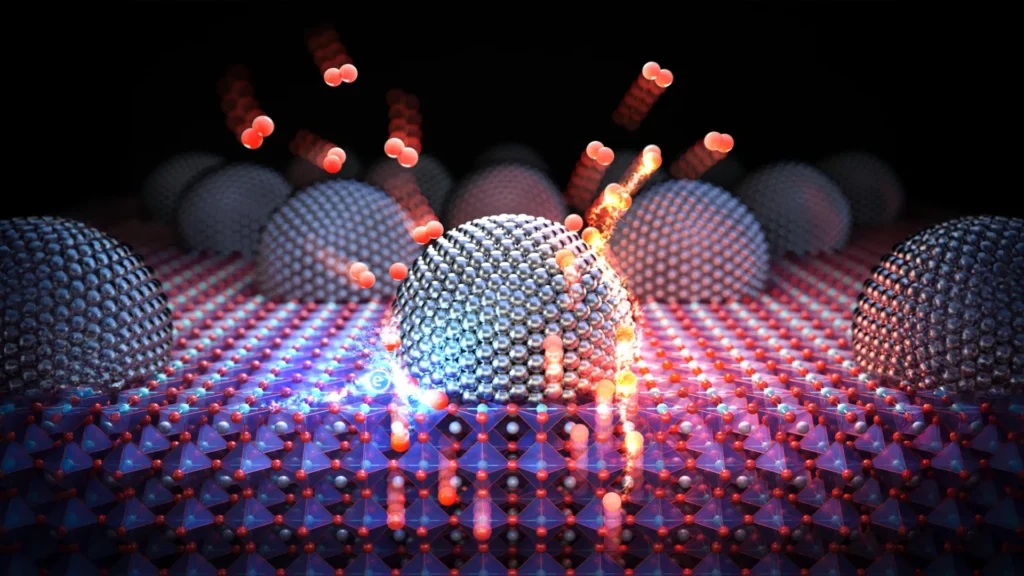
To solve this "black box" problem, the SNU-led team departed from conventional testing methods. Instead of using standard, commercially available electrodes with random pore structures, they developed a "model electrode" system. This involved creating a thin-film perovskite oxide electrode and depositing metal nanoparticles—specifically silver, cobalt, palladium, and platinum—with uniform sizes and precise spacing.
This controlled architecture allowed the researchers to isolate variables that are usually obscured in bulk materials. By adjusting the density and surface area of the nanoparticles, the team could quantitatively measure how changes in the catalyst’s physical dimensions affected the overall reaction rate. Among the metals tested, silver emerged as the most effective catalyst, significantly outperforming platinum and palladium in accelerating oxygen-related reactions.
The Discovery of Site-Switching Mechanisms
The most striking finding of the study is that silver does not function as a "static" catalyst. Instead, it exhibits a "site-switching" behavior based on the electrochemical potential applied to the cell.
In the electricity generation mode (ORR), the researchers found that the reaction rate was directly proportional to the length of the "triple-phase boundary"—the specific line where the silver nanoparticle, the electrode, and the gas phase meet. This indicates that the interface between the silver and the perovskite electrode is the primary engine for oxygen reduction. In this phase, the silver catalyst facilitates the transfer of electrons to oxygen molecules, allowing them to dissociate and incorporate into the electrode lattice as ions.
Conversely, during the hydrogen production mode (OER), the reaction rate correlated not with the boundary length, but with the total surface area of the silver nanoparticles. This shift implies that the surface of the silver itself becomes the active site. During electrolysis, oxygen ions move from the electrode to the silver surface, where the catalyst aids in the recombination of oxygen atoms into molecules (O2) and their subsequent release into the atmosphere.
This dual-functionality suggests that a "one-size-fits-all" approach to catalyst design is insufficient. A catalyst optimized for the interface may not be the most efficient for surface reactions, and vice versa.
Atomic-Scale Insights and Synchrotron Analysis
To validate these observations at the atomic level, the team employed Ambient Pressure X-ray Photoelectron Spectroscopy (AP-XPS) at the Pohang Accelerator Laboratory (PAL). This advanced synchrotron-based technique allowed the scientists to observe the chemical states of the electrode and catalyst surfaces in real-time under actual operating temperatures and gas pressures.
The spectroscopic data, combined with high-level theoretical calculations, revealed that silver nanoparticles significantly alter the electronic structure of the underlying perovskite electrode. During oxygen reduction, the presence of silver lowers the energy barrier for electron transfer. During oxygen evolution, the silver surface provides a lower-energy pathway for oxygen atoms to pair up.
Dr. Jinwook Kim, the lead author of the study and a future assistant professor at the University of Seoul, noted that these findings provide the first quantitative evidence of how nanocatalysts participate in the complex dance of ions and electrons within a solid oxide cell. The study effectively bridges the gap between theoretical surface science and practical electrochemical engineering.
Chronology of the Research and Global Context
The development of this research comes at a critical time as nations worldwide, including South Korea, the United States, and members of the European Union, ramp up investments in "Green Hydrogen." The chronology of this breakthrough follows a decade of incremental improvements in perovskite materials, which were often limited by degradation issues and slow reaction speeds.
- Initial Phase (2021-2022): The research team identified the limitations of existing "trial-and-error" catalyst application and began designing the model electrode platform.
- Experimental Phase (2023): Comparative testing of various transition and noble metals was conducted, identifying silver’s unique efficacy.
- Analytical Phase (Late 2023): Synchrotron experiments at KBSI and PAL provided the necessary atomic-scale data to confirm the site-switching hypothesis.
- Publication (2024): The findings were synthesized and published in Energy & Environmental Science, receiving international acclaim and being featured on the journal’s back cover.
The study was supported by the South Korean Ministry of Science and ICT and the National Research Foundation of Korea, reflecting the government’s strategic focus on securing domestic technologies for carbon neutrality by 2050.
Implications for the Energy Industry
The implications of this discovery are twofold: it offers a path toward higher efficiency in current power systems and opens the door for a new category of "reversible" energy storage.
Distributed Energy Systems: In buildings and factories, solid oxide fuel cells can provide combined heat and power (CHP). By utilizing the silver-enhanced electrodes, these systems can operate at lower temperatures or with higher electrical efficiency, reducing fuel consumption and operational costs.
Green Hydrogen Production: One of the primary barriers to green hydrogen is the high cost of electricity required for electrolysis. By optimizing the silver catalyst surface for the Oxygen Evolution Reaction, researchers can lower the overpotential required to split water, making hydrogen production more economically viable.
Reversible Solid Oxide Cells (RSOCs): The most ambitious application lies in RSOCs, which can act as massive "batteries" for the electrical grid. They can absorb excess renewable energy (from wind or solar) to produce hydrogen and then switch modes to generate electricity when demand is high. Understanding that silver works differently in each mode allows engineers to design "hybrid" electrodes that maximize both the interface and the surface area, ensuring peak performance regardless of the operating direction.
Future Research and Scaling
Professor WooChul Jung emphasized that this study is not the end of the road but the beginning of a new design paradigm. "This research is significant because it quantitatively evaluates the performance of nanocatalysts while also identifying their actual reaction sites and operating mechanisms," Jung stated. "We plan to further establish this as a new design principle that can be applied to various energy conversion materials and catalytic systems."
The research team plans to extend this methodology to other types of catalysts and electrochemical systems, including liquid-phase electrolysis and carbon dioxide reduction technologies. The model electrode platform developed for this study is expected to become a standard tool for researchers looking to deconstruct the complex interactions at the heart of modern energy devices.
As Dr. Jinwook Kim transitions to his new role at the University of Seoul, his continued focus on high-efficiency energy conversion materials suggests that the South Korean academic community will remain at the forefront of this field. The integration of these fundamental scientific insights into commercial products could significantly accelerate the transition to a sustainable, hydrogen-based global energy infrastructure.
The successful conclusion of this study highlights the importance of multi-institutional collaboration, combining SNU’s materials expertise, KAIST’s nanoparticle precision, and KBSI’s advanced analytical capabilities. As the world seeks cleaner ways to power the future, the humble silver nanoparticle—once thought to be a simple additive—may prove to be the key to unlocking the full potential of solid oxide technology.