The fundamental laws of physics that govern the motion of a falling apple on Earth have been found to hold true across the vast, echoing reaches of the cosmos. In a landmark study that bridges three centuries of scientific thought, researchers at the University of Pennsylvania and their international collaborators have conducted the largest-scale test of gravity to date. By observing the movements and interactions of galaxy clusters separated by hundreds of millions of light-years, the team has confirmed that the gravitational framework established by Sir Isaac Newton in 1687 and refined by Albert Einstein in 1915 remains remarkably accurate, even when applied to the largest known structures in the universe.
This validation, published in the journal Physical Review Letters, carries profound implications for our understanding of the "dark" side of the universe. For decades, a persistent discrepancy in the "cosmic ledger" has troubled astronomers: stars and galaxies often move much faster than the visible matter within them should allow. This study’s confirmation that gravity behaves exactly as predicted suggests that the solution to this mystery is not a flaw in our understanding of gravity, but rather the existence of dark matter—an invisible substance that provides the extra gravitational "glue" necessary to hold the universe together.
The Invisible Framework of the Universe
Gravity is far more than the force that keeps our feet on the ground or planets in their orbits; it is the invisible architect of the cosmos. It dictates the clustering of gas and dust into stars, the assembly of stars into galaxies, and the grouping of galaxies into massive clusters that span millions of light-years. However, the study of gravity on these gargantuan scales has long been fraught with tension.
"Astrophysics has been plagued by a massive discrepancy in the cosmic ledger," explains Patricio A. Gallardo, a research associate in the Department of Physics and Astronomy at the University of Pennsylvania’s School of Arts & Sciences. "When we look at how stars orbit within galaxies or how galaxies move within galaxy clusters, some appear to be traveling way too fast for the amount of visible matter they contain."
This observation has historically led to two competing schools of thought. The first posits that the universe is permeated by dark matter—particles that do not emit, absorb, or reflect light, making them invisible to traditional telescopes. The second suggests that our mathematical descriptions of gravity are incomplete. Proponents of the latter, such as those advocating for Modified Newtonian Dynamics (MOND), argue that on very large scales or at very low accelerations, gravity might not weaken as quickly as Newton’s inverse square law predicts.
The Atacama Cosmology Telescope: A Window into the Ancient Universe
To settle this debate, Gallardo and a team of more than 40 researchers turned to the Atacama Cosmology Telescope (ACT). Situated high in the Chilean Andes on Cerro Toco, the ACT is a six-meter-diameter instrument designed to map the Cosmic Microwave Background (CMB)—the "afterglow" of the Big Bang.
The ACT, which stands roughly three to four stories tall, was developed largely by researchers at the University of Pennsylvania under the leadership of Professor Mark Devlin. Its location in the high-altitude Atacama Desert provides an exceptionally dry and clear atmosphere, allowing the telescope to detect incredibly faint microwave signals that have been traveling through space for nearly 13.8 billion years.
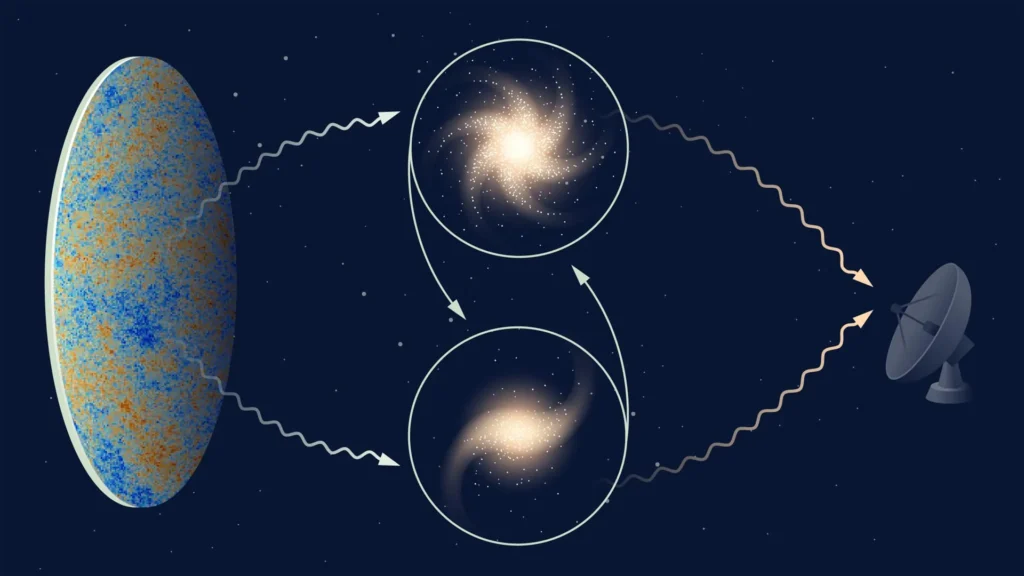
By utilizing the CMB as a cosmic "backlight," the researchers were able to observe the influence of gravity across unprecedented distances. As this ancient light passes through massive galaxy clusters, the movement and gravitational pull of those clusters cause minute distortions in the light’s temperature and polarization. By analyzing these faint signatures across hundreds of thousands of galaxy clusters, the team could measure the strength of gravity over distances of tens of millions to hundreds of millions of light-years.
Methodology: Measuring Gravity on a Grand Scale
The core of the study involved testing the "inverse square law." This principle, first proposed by Newton, states that the gravitational attraction between two objects is inversely proportional to the square of the distance between them. If you double the distance, the force becomes four times weaker; if you triple the distance, it becomes nine times weaker.
While this law has been verified with extreme precision within our Solar System—using the orbits of planets and the trajectories of space probes—testing it across the voids between galaxy clusters is a significantly more complex undertaking. The researchers analyzed the "peculiar velocities" of galaxy clusters—the speeds at which they move relative to the expansion of the universe.
If gravity were to behave differently on these scales, as suggested by modified gravity theories, the data would show a deviation from the inverse square relationship. Specifically, gravity would appear "stronger" at great distances than Newton’s equations predict, which would explain why galaxies move so quickly without needing to invoke dark matter.
However, the ACT data told a different story. The measurements fell almost exactly within the parameters predicted by the standard model of cosmology, which incorporates both Newtonian gravity and Einstein’s General Relativity. The strength of gravity decreased with distance precisely as the inverse square law dictates.
A Chronology of Gravitational Discovery
The success of this study represents the latest chapter in a 350-year-old narrative of human inquiry into the nature of the physical world.
- 1687: Sir Isaac Newton publishes Philosophiæ Naturalis Principia Mathematica, introducing the Universal Law of Gravitation and the inverse square relationship.
- 1915: Albert Einstein presents the Theory of General Relativity, describing gravity not just as a force, but as the curvature of spacetime itself.
- 1933: Swiss astronomer Fritz Zwicky observes the Coma Cluster and realizes that the visible mass is insufficient to keep the cluster from flying apart. He coins the term "dunkle Materie" (dark matter).
- 1970s: Vera Rubin and Kent Ford provide robust evidence for dark matter by observing that stars at the edges of spiral galaxies orbit just as fast as stars near the center, defying Newtonian expectations based on visible mass alone.
- 1983: Mordehai Milgrom proposes Modified Newtonian Dynamics (MOND) as an alternative to dark matter, suggesting gravity changes its behavior at low accelerations.
- 2000s-2020s: Large-scale surveys and CMB experiments like Planck and ACT begin testing these theories with high-precision data.
- Present Day: The ACT team confirms the validity of the inverse square law at the scale of galaxy clusters, significantly constraining MOND and other alternative gravity theories.
Strengthening the Case for Dark Matter
By confirming that gravity behaves as expected on cosmic scales, the researchers have effectively "eliminated the middleman." If the laws of gravity are not the cause of the high-speed celestial motions we observe, then the "missing mass" must be real.
"This study strengthens the evidence that the universe contains a component of dark matter," says Gallardo. "Because gravity behaved as predicted, changing the law of gravity does not explain the missing mass revealed by these observations."
This finding provides a vital anchor for the Standard Model of Cosmology, often referred to as the $Lambda$CDM (Lambda Cold Dark Matter) model. This model posits that the universe is composed of approximately 5% ordinary matter (atoms), 27% dark matter, and 68% dark energy. While dark matter remains elusive—it has yet to be directly detected in a laboratory—the ACT results suggest it is an indispensable part of the cosmic fabric.
Global Collaboration and Institutional Support
The scale of the research reflects the complexity of modern astrophysics. The study involved a massive international effort, with more than 40 researchers representing institutions across the globe.
The project received support from a wide array of prestigious organizations, including the U.S. National Science Foundation (NSF), NASA, and the Simons Society of Fellows. Contributions also came from the Kavli Institute for Cosmological Physics at the University of Chicago, the National Research Foundation of South Africa, and the Natural Sciences and Engineering Research Council of Canada (NSERC).
The development of the ACT itself was a multi-institutional triumph, involving Princeton University, the University of Pennsylvania, and the University of British Columbia. Specialized components, such as the multichroic detectors, were developed with support from the National Institute of Standards and Technology (NIST).
Broader Impact and Future Implications
The confirmation of the inverse square law at intergalactic distances does more than just validate old theories; it sets the stage for the next generation of physics. By narrowing the field of possible explanations for the universe’s behavior, scientists can focus their efforts on the most promising leads.
The "dark matter mystery" is now more focused than ever. If the math of gravity is correct, then the search for the dark matter particle—whether it be a WIMP (Weakly Interacting Massive Particle), an axion, or something entirely unexpected—takes on renewed urgency.
Furthermore, these results provide a baseline for future observatories. Upcoming projects, such as the Simons Observatory and the CMB-S4 experiment, will build upon the ACT’s legacy. These next-generation telescopes will measure the CMB with even higher sensitivity, potentially revealing new nuances in how gravity interacted with matter in the very early universe.
For the scientific community, the study is a testament to the enduring power of empirical observation. "It is remarkable that the law of the inverse of the squares—proposed by Newton in the 17th century and then incorporated by Einstein’s theory of general relativity—is still holding its ground in the 21st century," Gallardo notes.
As we continue to map the heavens, the fundamental principles of physics remain our most reliable guide. While the nature of dark matter remains one of the greatest "unanswered questions" in science, researchers are now more certain than ever about the rules of the game. Gravity, it seems, is a constant we can count on, from the smallest apple to the largest cluster of galaxies in the infinite dark.