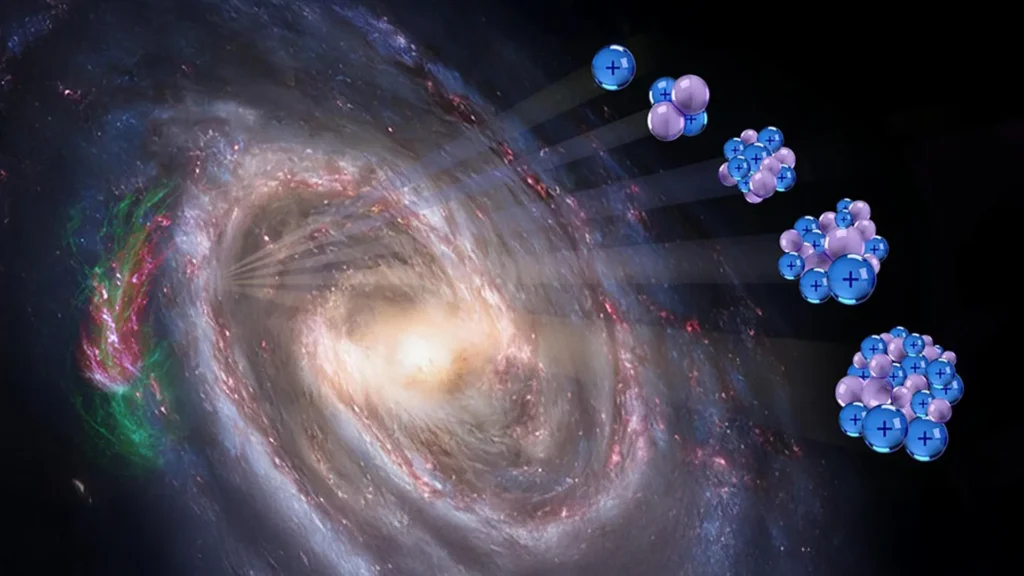
For over a century, the universe has presented scientists with one of its most profound puzzles: cosmic rays. These incredibly powerful particles traverse the cosmos at energies far exceeding anything achievable in terrestrial laboratories, yet their exact origins and the mechanisms behind their acceleration have remained largely elusive. Despite decades of dedicated research, spanning numerous ground-based observatories and space missions, many fundamental questions persisted. Now, a groundbreaking discovery by researchers utilizing data from the Dark Matter Particle Explorer (DAMPE) space telescope has provided a critical new clue. Their findings, meticulously detailed in a recent publication in the prestigious journal Nature, unveil a common, unifying feature across various cosmic ray nuclei, offering unprecedented insight into how these enigmatic particles are energized and propagate through the galaxy.
The Enduring Enigma of Cosmic Rays: A Century-Long Quest
The story of cosmic rays began in 1912 when Austrian physicist Victor Hess made a daring balloon ascent, demonstrating that ionizing radiation increased with altitude, originating from space. His discovery opened a new frontier in physics, revealing a constant bombardment of Earth by high-energy particles. Since then, scientists have determined that cosmic rays are primarily composed of atomic nuclei—mostly protons (hydrogen nuclei), but also helium, carbon, oxygen, and much heavier elements like iron—along with a smaller fraction of electrons and positrons. These particles possess energies that dwarf those produced by the Large Hadron Collider (LHC), the most powerful particle accelerator on Earth, by orders of magnitude. While the LHC can accelerate protons to several teraelectron-volts (TeV), cosmic rays routinely arrive with energies up to petaelectron-volts (PeV) and, in rare instances, even exaelectron-volts (EeV), representing macroscopic amounts of energy concentrated in a single subatomic particle.
The prevailing scientific consensus is that cosmic rays are born from some of the universe’s most violent and energetic phenomena. These "cosmic accelerators" are thought to include supernova remnants—the expanding shells of gas and dust left after a star explodes—which create powerful shockwaves capable of accelerating particles. Other candidates include relativistic jets emanating from supermassive black holes at the centers of active galaxies (Active Galactic Nuclei, or AGNs), and rapidly rotating, highly magnetized neutron stars known as pulsars. However, identifying the dominant sources for different energy ranges and understanding the precise acceleration mechanisms (e.g., diffusive shock acceleration) has been a formidable challenge. The interstellar medium, permeated by complex and turbulent magnetic fields, further complicates the picture, bending the paths of charged cosmic rays and obscuring their point of origin.
The DAMPE Mission: An Eye on the High-Energy Sky
Launched on December 17, 2015, from China’s Jiuquan Satellite Launch Center, the DAMPE mission, also known as "Wukong" (after the mythical Monkey King), was specifically designed to tackle these profound questions. The satellite carries a state-of-the-art detector array intended to measure the precise energy spectra and arrival directions of high-energy electrons, photons, and cosmic ray nuclei. Its primary scientific objectives include:
- Searching for signatures of dark matter annihilation or decay in the cosmic ray electron and positron spectra.
- Studying the origin and propagation of high-energy cosmic rays by accurately measuring their energy spectra and composition.
- Conducting gamma-ray astronomy in the very high-energy range.
The DAMPE instrument is a sophisticated stack of detectors, including a Plastic Scintillator Detector (PSD) for charge measurement, a Silicon-Tungsten Tracker (STK) for precise particle tracking, a Bismuth Germanate (BGO) calorimeter for energy measurement, and a Neutron Detector (NUD) for electron/hadron separation. The mission involves significant international collaboration, with major contributions from various institutions, notably the astrophysics group at the Department of Nuclear and Particle Physics (DPNC) at the University of Geneva (UNIGE), which played a crucial role in the development and analysis aspects of the mission.
Unveiling a Universal "Spectral Softening" Threshold
The core of the DAMPE discovery lies in its highly precise measurements of the energy spectra of primary cosmic ray nuclei. For the first time, researchers observed a universal pattern in how the number of particles changes with increasing energy for various types of nuclei, from the lightest protons to much heavier iron nuclei.
"Cosmic rays are primarily composed of protons, but also of helium, carbon, oxygen, and iron nuclei," explains Andrii Tykhonov, associate professor at the DPNC in the Faculty of Science at UNIGE, and a co-author of the study. "These particles are also categorised according to their energy: low, up to a few billion electron-volts; intermediate, from a few billion to several hundred billion electron-volts; and high, from 1,000 billion electron-volts and beyond."
The study revealed a consistent phenomenon: for every type of nucleus investigated, the number of particles, which generally decreases as energy increases, begins to drop much more rapidly after reaching a specific threshold. This effect is termed "spectral softening." While it is expected for higher-energy cosmic rays to be less common, DAMPE’s observations showed that this decline becomes dramatically steeper beyond a rigidity of approximately 15 teravolts (TV).
Rigidity vs. Energy per Nucleon: A Decades-Long Debate Settled
This finding is particularly significant because it addresses a long-standing debate in cosmic ray astrophysics concerning the mechanisms of particle acceleration and propagation. Two main theoretical frameworks have historically competed:
- Rigidity-dependent models: These theories propose that the acceleration and propagation of cosmic rays are primarily governed by their "rigidity." Rigidity is a measure of a particle’s resistance to being bent by magnetic fields and is defined as the particle’s momentum divided by its charge. In simpler terms, for a given magnetic field, particles with higher rigidity will follow straighter paths. This implies that particles with the same rigidity, regardless of their mass or individual energy, would experience similar acceleration and transport processes.
- Energy-per-nucleon-dependent models: These alternative theories suggest that the relevant parameter is the particle’s energy divided by its number of nucleons (protons and neutrons). This would mean that particles with the same energy per nucleon would behave similarly, regardless of their total charge.
The DAMPE data definitively tilted the scales. Because the observed spectral softening occurred consistently at a rigidity of 15 TV across many different types of nuclei (protons, helium, carbon, oxygen, iron), the findings provide extremely strong support for theories where cosmic ray acceleration and movement through space are controlled by rigidity. Conversely, the data largely rules out competing explanations based on energy per nucleon. According to the researchers, the confidence level against these alternative models reached an astounding 99.999%, effectively closing the door on this aspect of the debate.
This breakthrough implies that the galactic magnetic fields, which permeate the interstellar medium, play a dominant role in shaping the cosmic ray spectrum. Particles are likely accelerated to a maximum rigidity, rather than a maximum energy, by astrophysical sources, and their subsequent escape from these sources or their transport through the turbulent galactic magnetic fields are also rigidity-dependent processes.
Geneva’s Pivotal Role in the Breakthrough
The University of Geneva (UNIGE) played a particularly significant role in achieving this discovery. Researchers from the DPNC astrophysics group were instrumental in several key aspects of the mission and data analysis:
- Advanced AI Methods: The Geneva team developed sophisticated artificial intelligence and machine learning algorithms to reconstruct particle events detected by the telescope. Given the immense volume of data collected by DAMPE, accurately identifying and characterizing each cosmic ray event—distinguishing between different particle types, determining their energy, and tracing their paths—requires highly advanced computational techniques. These AI methods were critical for sifting through background noise and enhancing the precision of the measurements.
- Flux Measurements: The UNIGE group made crucial contributions to important measurements involving proton and helium fluxes, which are the most abundant cosmic ray species. Their expertise also extended to the analysis of carbon nuclei data, further validating the universal nature of the spectral softening.
- Silicon-Tungsten Tracker (STK) Development: Perhaps most notably, the Geneva group led the development of one of DAMPE’s key instruments: the Silicon-Tungsten Tracker (STK). This detector is essential for two primary functions:
- Accurate Particle Path Tracing: The STK provides precise information about the trajectory of incoming cosmic rays, allowing scientists to reconstruct their paths through the detector.
- Electrical Charge Determination: By measuring how strongly a particle interacts with the detector material, the STK enables accurate determination of the electrical charge of the incoming cosmic rays. This is vital for classifying different nuclei and, critically, for calculating their rigidity.
Dr. Laura M. Popa, a senior researcher at UNIGE involved in the STK development, remarked, "The STK’s precision was paramount. Without its ability to meticulously track particle paths and determine charge, we would not have been able to calculate rigidity with the accuracy needed to observe this subtle, yet universal, spectral break. It’s a testament to years of meticulous engineering and calibration."
Broader Astrophysical Impact and Future Outlook
The DAMPE findings mark a monumental advance in understanding how cosmic rays are created, accelerated, and how they travel through the vast expanse of the Milky Way. By confirming the rigidity-dependent nature of cosmic ray phenomena, the new results place tighter limits on existing theoretical models of particle acceleration in astrophysical sources. This significantly refines our understanding of the extreme physics at play in environments like supernova remnants and pulsars.
"This discovery provides a much-needed anchor point for theoretical models," stated Dr. Chen Li, a spokesperson for the DAMPE collaboration. "For decades, we’ve had various models, but this clear observational evidence of rigidity-dependent softening allows us to discard many alternatives and focus on refining those that align with our findings. It’s a huge step forward in the ‘cosmic ray problem’."
Moreover, the improved understanding of how high-energy particles move through interstellar space has implications for other areas of astrophysics. Cosmic rays interact with interstellar gas and magnetic fields, producing secondary particles and diffuse gamma-ray emission, which are observed by other telescopes. More accurate models of cosmic ray propagation will enhance the interpretation of these observations, improving our understanding of galactic magnetic fields, the distribution of interstellar matter, and even star formation processes.
While DAMPE’s discovery has provided a crucial piece of the puzzle, many questions still remain. Scientists will now focus on refining models that explain why the spectral softening occurs at precisely 15 TV rigidity. Is it due to a limit in the acceleration capabilities of typical galactic sources, or does it reflect the efficiency of particle escape from these sources or their transport through the galaxy? Future missions and observatories, such as the Cherenkov Telescope Array (CTA) and potentially even next-generation radio telescopes like the Square Kilometre Array (SKA), will build upon these findings, aiming to pinpoint individual cosmic ray sources and probe the highest energy particles with even greater precision. The ongoing search for dark matter, another key DAMPE objective, also stands to benefit indirectly, as a clearer understanding of conventional cosmic ray backgrounds is essential for isolating any potential dark matter signals. The journey to fully unravel the mysteries of cosmic rays continues, now with a clearer roadmap thanks to the illuminating data from DAMPE.