On August 12, 2026, as a breathtaking total solar eclipse captivated millions across parts of Europe, a unique celestial ballet unfolded 60,000 kilometers above Earth. Hours before the Moon’s shadow began its sweeping passage across the planet, the European Space Agency’s (ESA) Proba-3 mission, a sophisticated pair of satellites, achieved its 65th artificial eclipse, demonstrating a remarkable feat of orbital engineering without any lunar assistance. This groundbreaking achievement provided an unprecedented opportunity to study the Sun’s elusive corona, offering insights that complement the awe-inspiring natural event witnessed on the ground.
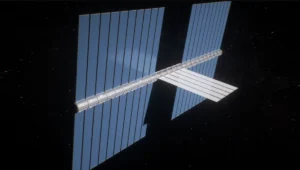
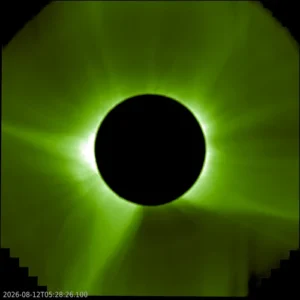
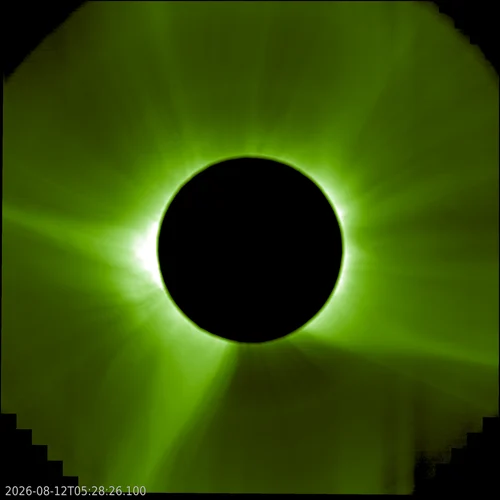
The Proba-3 mission, designed to meticulously study the Sun’s outer atmosphere, utilizes a clever formation-flying technique. The mission comprises two spacecraft, the "Occulter" and the "Coronagraph." The Occulter, positioned in front, functions as an artificial Moon, precisely blocking the Sun’s blindingly bright disk. This carefully orchestrated maneuver creates a stable and extended period of darkness, allowing the Coronagraph spacecraft, positioned behind the Occulter and separated by approximately 150 meters, to obtain an uninterrupted view of the Sun’s corona. The ASPIICS (Association de Spectrométrie Solaire, Imagerie et Investigation de la Couronne Interne) instrument aboard the Coronagraph spacecraft captured a stunning image of the Sun’s inner corona on the morning of August 12, 2026. This image, rendered in a vibrant greenish hue, closely resembles how observers on Earth would perceive the corona through a green filter during a natural eclipse.
A Cosmic Coincidence: The Double Eclipse
Adding a layer of cosmic serendipity to the day’s events, the Moon itself decided to participate in Proba-3’s celestial performance. Shortly after the artificial eclipse was created and observed, the Moon, Earth’s closest celestial neighbor, traversed Proba-3’s field of view. This opportune alignment resulted in a "double eclipse," where the Moon temporarily obscured the Sun as seen by the Proba-3 spacecraft, creating a unique and rare observational moment that further enhanced the mission’s scientific value. This event was documented and shared by ESA, highlighting the serendipitous nature of space observation.
Predictive Power of Proba-3
The Proba-3 mission’s capabilities extended beyond mere observation; they provided a remarkable predictive tool. Approximately two weeks prior to the August 12th eclipse, Proba-3 had been positioned to observe the Sun from the opposite side of its orbit. Given that the Sun completes roughly half a rotation on its axis in two weeks, the images captured by Proba-3’s coronagraph during that earlier period served as an exceptionally accurate forecast of what the Sun’s corona would look like on August 12th. This predictive power was valuable not only for the Proba-3 mission itself, allowing for optimized observation planning, but also for ground-based observers, offering a preview of the natural eclipse’s visual characteristics. ESA highlighted this predictive aspect, showcasing an image that accurately mimicked the views expected during the 2026 total solar eclipse.
The Science Behind the Artificial Eclipse
The Proba-3 mission’s primary objective is to unlock the secrets of the Sun’s corona, the Sun’s outermost atmosphere, which is notoriously difficult to study due to the overwhelming glare of the Sun’s photosphere. The corona is a region of immense scientific interest, playing a crucial role in solar flares, coronal mass ejections (CMEs), and the solar wind – phenomena that significantly impact Earth’s space environment, including satellite operations, communication systems, and even power grids.
By artificially eclipsing the Sun, Proba-3 creates a stable environment that mimics the conditions experienced during a total solar eclipse on Earth, but with a significant advantage: duration. While a natural total solar eclipse typically lasts only a few minutes, Proba-3 can maintain its artificial eclipse for hours at a time. This extended observation window allows scientists to gather far more detailed and continuous data on the corona’s structure, dynamics, and evolution.
The ASPIICS instrument, a state-of-the-art coronagraph, is designed to capture high-resolution images of the corona across a range of wavelengths. The greenish hue observed in the August 12th image is indicative of specific emission lines from ionized elements within the corona, providing clues about its temperature, density, and composition. By analyzing these spectral signatures, scientists can piece together a more comprehensive understanding of the physical processes driving coronal activity.
Supporting Data and Mission Milestones
Proba-3 was launched in 2023, and its operational phase began shortly thereafter. The mission’s success relies on the precise coordination of its two spacecraft, which maintain their formation with centimeter-level accuracy. This formation flying is achieved through sophisticated onboard propulsion systems and advanced guidance, navigation, and control algorithms.
- Orbital Altitude: Approximately 60,000 kilometers above Earth.
- Spacecraft Separation: 150 meters.
- Number of Artificial Eclipses Achieved (as of August 12, 2026): 65.
- Duration of Artificial Eclipse: Can extend for several hours.
- Key Instrument: ASPIICS (Association de Spectrométrie Solaire, Imagerie et Investigation de la Couronne Interne) coronagraph.
- Scientific Objectives: Study the Sun’s corona, understand solar flares and CMEs, investigate the solar wind, and improve space weather forecasting.
The achievement of 65 artificial eclipses signifies the mission’s maturity and the reliability of its complex systems. Each successful eclipse represents a valuable data collection opportunity, contributing to a growing body of knowledge about our Sun.
Broader Impact and Implications
The Proba-3 mission’s artificial eclipses have significant implications for our understanding of solar physics and space weather. By providing prolonged and detailed observations of the corona, the mission contributes to:
- Improved Space Weather Forecasting: A deeper understanding of CMEs and solar flares, which are driven by events in the corona, can lead to more accurate predictions of their arrival times and potential impacts on Earth. This is crucial for protecting critical infrastructure, such as satellites, power grids, and communication networks.
- Fundamental Solar Physics Research: The data gathered by Proba-3 helps scientists to test and refine theoretical models of solar atmospheric processes, leading to a more profound understanding of the Sun’s behavior and its influence on the heliosphere.
- Technological Advancement: The mission pushes the boundaries of satellite formation flying and precision maneuvering, paving the way for future complex space missions.
- Complementary Science: The ability to create artificial eclipses provides a unique opportunity to study phenomena that are only briefly visible during natural eclipses. This allows for a more comprehensive and continuous scientific investigation.
Official Reactions and Future Prospects
ESA officials have consistently expressed enthusiasm for the Proba-3 mission’s achievements. The successful creation of artificial eclipses, particularly the alignment with the natural eclipse on August 12, 2026, has been lauded as a testament to European space engineering prowess.
"Proba-3 is a game-changer in our quest to understand the Sun," stated a senior ESA scientist involved in the mission. "The ability to create our own eclipses for extended periods allows us to probe the Sun’s corona in ways that were previously unimaginable. The synergy with natural eclipses, as we saw on August 12th, provides an invaluable opportunity for cross-validation and a deeper appreciation of our Sun’s dynamic nature."
Looking ahead, Proba-3 is expected to continue its observations for several more years, accumulating a wealth of data that will fuel scientific discovery for decades to come. The mission’s success serves as a powerful reminder of humanity’s ingenuity and our relentless pursuit of knowledge about the cosmos, even as we marvel at the natural wonders unfolding above us. The artificial eclipses generated by Proba-3 are not just scientific endeavors; they are a testament to our ability to replicate and understand the universe’s most spectacular phenomena, offering a unique perspective on our star and its profound influence on our solar system.