A groundbreaking advancement from Washington State University (WSU) has leveraged artificial intelligence to fundamentally transform the 3D printing of a critical high-performance metal alloy, effectively circumventing the arduous and often prohibitive task of manually evaluating over 100 million potential printing configurations. This innovation promises to democratize access to an alloy vital for aerospace and other demanding industries, making its production feasible on more commonly available commercial 3D printing equipment. Beyond its immediate impact on additive manufacturing, the AI-driven strategy pioneered by the WSU team demonstrates profound potential for accelerating discovery in other scientific domains grappling with similarly immense experimental search spaces, including pharmaceutical development and novel material design.
The pioneering research, a collaborative effort between WSU’s School of Electrical Engineering and Computer Science and the School of Mechanical and Materials Engineering, was recently published in the prestigious Proceedings of the AAAI Conference on Artificial Intelligence. The project’s significance was further underscored by its receipt of the Innovative Deployed Application Award at the organization’s annual conference, a testament to its practical applicability and innovative methodology.
Dr. Jana Doppa, the Huie-Rogers Endowed Chair Professor of Computer Science and Berry Distinguished Professor in Engineering, who spearheaded the research, articulated the profound implications of this breakthrough. "Ninety percent of commercial printers cannot print this metal alloy. The fact that we were able to identify these feasible process parameters allows us to utilize those commercial printers, essentially democratizing the printing of this alloy," Doppa explained, highlighting the significant expansion of accessibility for GRCop-42.
The Critical Need for GRCop-42 in Extreme Environments
At the heart of this innovation lies GRCop-42, a specialized metal alloy composed of copper, chromium, and niobium. This material was originally developed by NASA to withstand the extraordinarily demanding conditions encountered in advanced aerospace systems, particularly where both exceptional heat resistance and highly efficient heat transfer are paramount. Its unique properties make it an indispensable component in critical applications such as liquid rocket engine combustion chambers, where it must endure extreme temperatures and pressures while maintaining structural integrity and facilitating rapid heat dissipation.
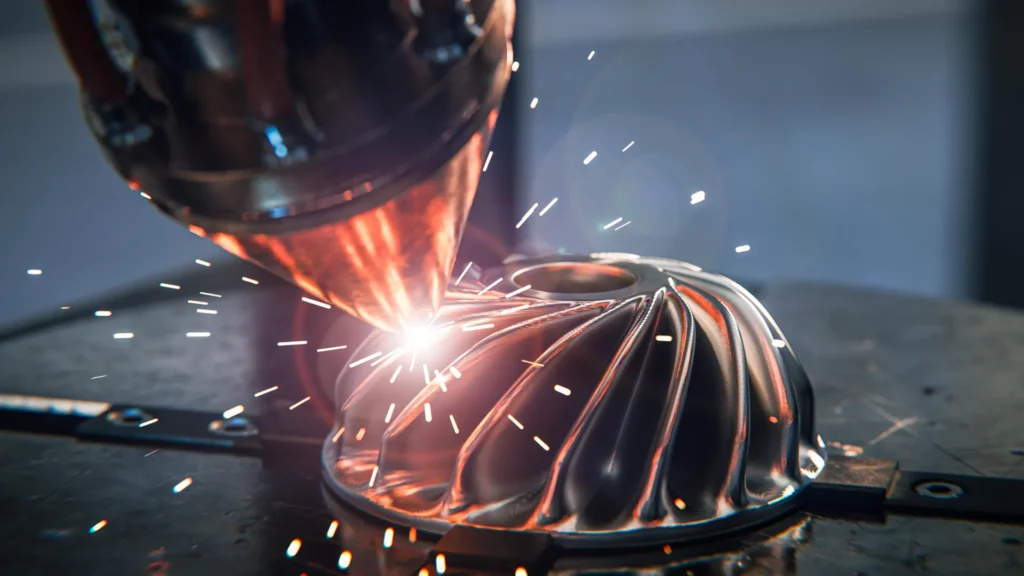
The allure of GRCop-42 stems from its remarkable combination of high thermal conductivity and robust strength retention at elevated temperatures—qualities rarely found together in engineering materials. While its desirable attributes and broader potential applications across various industrial sectors are widely recognized, the alloy has historically presented significant challenges for 3D printing. The conventional additive manufacturing processes typically necessitate substantial laser power and energy, pushing beyond the capabilities of most standard commercial 3D printing equipment. This limitation has historically confined the production of GRCop-42 to highly specialized facilities with access to ultra-high-power laser systems, contributing to its high cost and restricted availability.
Previous attempts to 3D print GRCop-42 using the lower wattages available on more common commercial machines had met with consistent failure. The sheer complexity of additive manufacturing, involving a multitude of interacting parameters such as laser power, scan speed, layer thickness, and hatch spacing, creates an astronomically vast parameter space. Manually testing each possible printing setting to find a successful configuration is not merely impractical; it is economically unfeasible and physically exhaustive. Each experimental print consumes expensive raw material, demands specialized equipment operation, and requires considerable human effort for setup and execution. Furthermore, a single print can incur costs reaching hundreds of dollars, and the thorough post-processing and analysis of a finished sample—to assess its structural integrity, density, and mechanical properties—can easily extend over several days.
Azza Fadhel, the first author of the research paper and a PhD student in computer science, vividly described the frustrations of the traditional approach. "Sometimes they printed a certain configuration, and the product just melted. It wasn’t really printable, and even with time and money, they wouldn’t be able to try all 100 million options," Fadhel noted. "What we were doing in our collaboration is to apply the AI so that we efficiently choose candidates from this very large search space." This "needle in a haystack" problem underscores the critical need for a more intelligent, targeted approach to materials discovery and process optimization.
The AI-Driven Solution: Navigating a Labyrinth of Possibilities
The WSU team’s innovative approach began by leveraging existing, albeit unsuccessful, data. They initiated their AI model training with information derived from 37 previously failed printing configurations, experiments that had been conducted within the School of Mechanical and Materials Engineering. These initial failures, rather than being dead ends, provided invaluable data points for the AI to learn from.
Building upon this foundational dataset, the researchers developed a sophisticated machine learning method capable of estimating the likelihood that an untested combination of printing settings would yield a successful print. This AI model was then tasked with recommending small, optimized groups of new configurations for physical testing. The genius of the AI’s selection process lay in its balanced approach to two critical priorities: exploitation and exploration. Some recommended experiments focused on configurations that appeared especially promising based on the model’s current understanding, aiming for quick successes. Concurrently, other recommendations strategically explored less certain or previously unexamined regions of the vast search space. These exploratory experiments, even if they resulted in failure, were crucial for gathering new information, refining the AI model’s predictive capabilities, and ultimately guiding it towards more optimal solutions.
The multidisciplinary collaboration was vital to the project’s success. Nathaniel Zuckschwerdt, Susmita Bose, and Amit Bandyopadhyay from the School of Mechanical and Materials Engineering worked closely with the AI team. Their role involved meticulously printing GRCop-42 using the configurations precisely chosen by the AI model and subsequently evaluating the finished samples for quality and performance. Aryan Deshwal from the University of Minnesota also contributed to this significant project.
Fadhel emphasized the iterative and learning nature of the process: "They would give me back the results, and I liked all of them — even if they failed — because every result improved our AI model." This feedback loop, where real-world experimental outcomes continuously refine the AI’s understanding, is a hallmark of effective AI-guided scientific discovery.
A Breakthrough in Accessibility: Lower Power, Broader Access
The successful demonstration of printing GRCop-42 with significantly less laser power than previously thought possible carries several transformative advantages. Firstly, it promises to substantially reduce energy consumption during the printing process, contributing to more sustainable manufacturing practices. Secondly, it could significantly decrease the wear and tear on expensive printing equipment, extending the lifespan of machinery and reducing maintenance costs. Thirdly, and perhaps most importantly, it lowers the overall costs associated with post-processing and quality control of printed samples.
Crucially, this breakthrough has the potential to make GRCop-42 accessible to a much broader range of institutions and organizations. Universities, smaller research laboratories, and companies that do not possess the capital or infrastructure for specialized high-power printing systems can now realistically consider working with this advanced alloy. This "democratization" means more researchers and innovators can experiment with and develop new applications for GRCop-42, fostering a new wave of innovation.
The inherent difficulty of this challenge cannot be overstated. Researchers had long understood that successful printing settings would be exceedingly rare, a minute fraction among the more than 100 million possible configurations. Dr. Doppa underscored the unique complexities for AI: "It’s a very challenging case for AI. Every time you try, you basically get a binary success or failure signal, and you are trying to minimize the number of tries that you have so that you get to those successful needles very quickly."
Despite these formidable odds, the WSU team achieved remarkable success. Over a period of just three months, and limiting the total number of physical experiments to a mere 40, they successfully identified six distinct configurations that yielded successful GRCop-42 prints. This represents an extraordinary efficiency gain compared to traditional trial-and-error methods. Critically, for the first time, they successfully printed GRCop-42 using only 500 watts of laser power, a threshold well within the capabilities of many commercial 3D printers, opening the door for widespread adoption.
Broader Implications for Scientific Discovery and Industrial Innovation
The impact of this WSU innovation extends far beyond the specific case of GRCop-42. The researchers firmly believe that the same AI-guided approach can be readily adapted and applied to identify workable processing conditions for a vast array of other metal alloys and additive manufacturing systems. This methodology represents a paradigm shift in materials science, moving away from time-consuming and expensive empirical experimentation towards an intelligent, data-driven discovery process.
More broadly, this AI-driven method holds immense promise for tackling scientific problems characterized by rare successful outcomes, enormous experimental search spaces, and prohibitively expensive individual tests. The researchers envision potential applications far beyond manufacturing, encompassing diverse areas of scientific discovery where each experiment incurs significant material, financial, or temporal costs. Examples include the accelerated discovery of new drug compounds, the optimization of catalysts for chemical reactions, or the development of novel energy storage materials.
The potential economic impact of such AI-accelerated discovery is substantial. According to recent market analyses, the global additive manufacturing market is projected to grow significantly, reaching well over $50 billion by the end of the decade, with aerospace and defense being major drivers. Within this growth, the segment of AI in materials science and discovery is emerging as a critical accelerator, promising to shorten material development timelines from decades to mere years. This WSU breakthrough positions itself squarely at the nexus of these two burgeoning fields, offering a blueprint for more efficient and cost-effective innovation.
Dr. Doppa reflected on the inherent risks and rewards of such cutting-edge research: "There’s always uncertainty when you are deploying something where real people, materials, and physical costs are involved. We didn’t know whether we would succeed or not, and there is always that risk. There are real stakes. I was very surprised that we were able to do this so well." This sentiment encapsulates the pioneering spirit of scientific inquiry, where calculated risks, guided by intelligent systems, can lead to breakthroughs that redefine the boundaries of what is possible.
Industry experts anticipate that such advancements will significantly accelerate the development cycles for critical components, not only for space exploration but also for terrestrial applications requiring high-performance materials in extreme environments, such as advanced power generation, high-performance computing cooling, and specialized industrial tooling. The ability to rapidly iterate and optimize manufacturing processes for complex alloys like GRCop-42 will undoubtedly foster greater innovation and provide a competitive edge to industries capable of integrating AI into their research and development pipelines. The WSU team’s work is a powerful demonstration of how artificial intelligence can unlock new frontiers in engineering and scientific discovery, making advanced technologies more accessible and paving the way for a new era of material innovation.