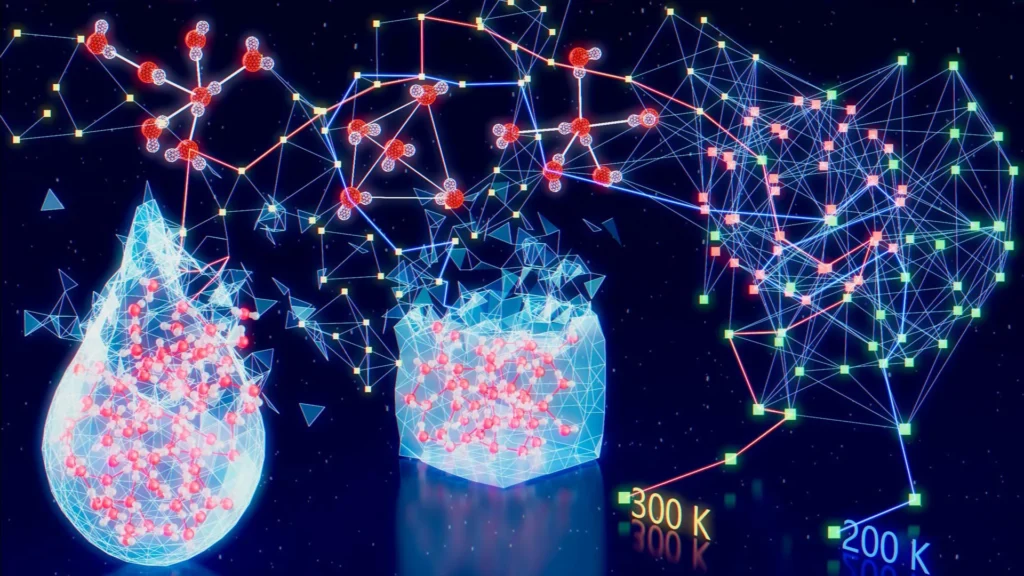
Water, the ubiquitous solvent covering over 70% of Earth’s surface, continues to present scientists with a paradox: despite its apparent simplicity, it defies numerous physical laws observed in nearly all other liquids. Among its most striking peculiarities is its counterintuitive expansion upon freezing, a property vital for life on Earth. For decades, researchers have attributed these unusual characteristics to subtle shifts in water’s microscopic molecular arrangement as temperature and pressure fluctuate, yet they have grappled with the absence of a standardized, consistent methodology to characterize and compare these intricate structural transformations. This long-standing scientific challenge has taken a significant step towards resolution with the advent of artificial intelligence.
Researchers at the University of Osaka have leveraged the advanced capabilities of AI to address this fundamental problem. Their innovative AI system now offers a harmonized approach to evaluate various methods used to describe the complex structure of supercooled water, effectively pinpointing which descriptors most accurately capture the essential molecular features. This groundbreaking research, published recently in the esteemed journal Communications Chemistry, promises to revolutionize our understanding of water’s most enigmatic states and properties.
The Enduring Mystery of Water’s Anomalies
Water is an extraordinary substance, exhibiting more than 70 known anomalies compared to other liquids. Beyond its expansion upon freezing—a phenomenon crucial for aquatic life, allowing ice to float and insulate water bodies below—water also boasts an unusually high specific heat capacity, meaning it requires a significant amount of energy to change its temperature. This property helps moderate global temperatures and stabilize climates. It also possesses exceptionally high latent heats of fusion and vaporization, high surface tension, and a density maximum at 4°C, rather than at its freezing point. These seemingly disparate properties are not mere curiosities; they are foundational to the planet’s climate systems, geological processes, and biological functions. Scientists believe these anomalies stem from the unique hydrogen bonding network that water molecules form and constantly reconfigure.
At the heart of many of these anomalies, particularly in extreme conditions, lies the peculiar state known as supercooled water. For liquid water to transition into its solid, crystalline ice form, its molecules must organize themselves into a highly ordered lattice. This process typically initiates at a "nucleation site," which can be a microscopic impurity within the water, a dust particle, or even a tiny scratch on the surface of a container. These sites act as templates upon which ice crystals can begin to form and grow.
However, in the pristine absence of such nucleation sites, water can defy its conventional freezing point, remaining in a liquid state even when cooled significantly below 0°C. This metastable condition is known as supercooled water. It can persist down to approximately -48°C, a point known as the homogeneous nucleation limit, where it spontaneously and rapidly freezes regardless of the absence of impurities. Under these supercooled conditions, water’s already unusual properties become even more pronounced and perplexing, magnifying the scientific challenge of understanding its behavior.
The Two-State Hypothesis: A Molecular Tug-of-War
A leading theoretical framework to explain water’s anomalous behavior, particularly in its supercooled state, posits the existence of a delicate balance between two competing forms of liquid water at the molecular level. These are often referred to as a high-density liquid (HDL) and a low-density liquid (LDL). In essence, water molecules are constantly forming, breaking, and reforming networks of hydrogen bonds, the weak electrostatic interactions between hydrogen atoms on one molecule and oxygen atoms on another.
The low-density liquid (LDL) structure is characterized by a more open, tetrahedral arrangement of hydrogen bonds, reminiscent of the structure of ice, where each water molecule is hydrogen-bonded to four neighbors. This open structure contributes to lower density. Conversely, the high-density liquid (HDL) structure is more compact and disordered, with molecules packed closer together, leading to a higher density. As the temperature of water rises, or as pressure increases, the more compact HDL structures become increasingly dominant, displacing the more open LDL arrangements. The precise interplay and equilibrium between these two hypothetical liquid forms are believed to underpin many of water’s macroscopic anomalies. However, directly observing and quantifying these transient molecular structures has remained a formidable hurdle.
A History of Descriptors: A Babel of Scientific Languages
Over many decades, researchers have developed a multitude of computational and theoretical approaches to describe the local arrangement of water molecules. These "structural descriptors" aim to quantify specific aspects of the molecular environment, such as the degree of tetrahedral ordering (how ice-like the local structure is) or the local density around a given molecule. Examples include metrics like tetrahedral bond order parameters, local density measurements, coordination numbers, and various angular distribution functions.
The inherent problem with this rich array of descriptors is that they were often developed independently by different research groups, each focusing on specific aspects of water’s structure or particular phenomena. Consequently, these descriptors frequently employ different mathematical scales, incorporate varying dimensions of information, and rely on distinct underlying assumptions. This lack of standardization has created a significant barrier to scientific progress, making it exceedingly difficult to directly compare the findings of different studies, reconcile conflicting results, or definitively determine which descriptors are the most robust and useful for capturing the essential structural information relevant to water’s macroscopic behavior. It was, in effect, a scientific "Babel," with each research group speaking a slightly different language to describe the same fundamental phenomenon.
AI as a Unifying Translator: The Osaka Breakthrough
Recognizing this critical need for a unified approach, the team at the University of Osaka turned to artificial intelligence, specifically neural networks, to act as a translator and evaluator for these disparate structural descriptors. Their objective was to develop an AI system capable of identifying the most effective ways to characterize the molecular structure of supercooled water, thereby providing a consistent framework for future research.
"Past studies have shown that using machine learning to classify and understand structural data is effective," explains corresponding author Kang Kim, highlighting the growing utility of AI in complex scientific endeavors. "We specifically wanted to incorporate a neural network model into this study to evaluate how accurate the descriptors were at capturing key structural information, in a way that is like human cognition." This analogy to human cognition underscores the AI’s ability to learn and discern complex patterns that might be difficult for traditional analytical methods to uncover.
To train this sophisticated AI system, the researchers meticulously fed the neural network vast datasets of structural information. This data was not obtained through direct experimental observation—which is incredibly challenging for the transient, picosecond-scale changes in water’s molecular network—but rather generated from cutting-edge molecular dynamics (MD) simulations of supercooled water. MD simulations are powerful computational techniques that model the physical movements of atoms and molecules over time, based on fundamental laws of physics. By tracking the interactions of thousands of water molecules under various temperature and pressure conditions, these simulations provide a rich, detailed, atomistic view of water’s dynamic structure. Through repeated cycles of trial and error, pattern recognition, and optimization, the neural network progressively learned to identify and interpret meaningful structural patterns within this complex simulated data, essentially developing an intrinsic understanding of water’s microscopic organization.
Identifying the "Most Efficient" Descriptors
The culmination of this training process was an AI system capable of performing a crucial comparative analysis. "The network used what it had learned to compare how 16 descriptors differentiated between LDL and HDL structures at different temperatures," reports Nobuyuki Matubayasi, a senior author of the study. This systematic evaluation allowed the AI to assess the efficacy of each descriptor in distinguishing between the two hypothesized liquid forms that are believed to govern water’s behavior. By analyzing the network’s performance, the researchers were able to quantify the discriminatory power and informational content of each descriptor. "In this way, we determined the most efficient descriptors," Matubayasi concluded, emphasizing the AI’s role in streamlining and validating the tools used by chemists and physicists.
This identification of "most efficient descriptors" is not merely an academic exercise. It provides the scientific community with a rigorously vetted, data-driven foundation for describing water’s structure. Researchers can now confidently select and apply descriptors that are known to accurately capture the essential features of water’s molecular arrangements, facilitating more precise and comparable studies across different laboratories and methodologies.
Broader Implications and Future Horizons
The framework developed by the Osaka University team carries profound implications across multiple scientific disciplines.
Firstly, at the most fundamental level, it significantly improves scientists’ understanding of how microscopic structural changes are intimately connected to the macroscopic thermodynamic behavior of water. By providing a clearer, unified picture of water’s molecular dance, this research could lead to a refined, or even a paradigm shift in, the "two-state" model of water, potentially resolving long-standing debates about its very nature. A more accurate molecular understanding could also help pinpoint the precise origins of water’s numerous anomalies.
Secondly, in climate science, a deeper understanding of water’s phase transitions and behavior in supercooled states is critical. Water in clouds can exist in supercooled liquid form at temperatures well below freezing, influencing precipitation patterns, cloud formation dynamics, and atmospheric energy transfer. Improved models of supercooled water could enhance the accuracy of climate simulations, leading to better predictions of weather patterns, ice formation, and global climate change impacts.
Thirdly, in biology and biochemistry, water is not merely a passive solvent; it is an active participant in virtually all biological processes. Its unique properties are essential for protein folding, enzyme activity, membrane structure, and cellular function. For instance, the behavior of water around biomolecules dictates their stability and interactions. This research could shed new light on how water influences these critical biological processes, potentially leading to advancements in fields like drug discovery and understanding disease mechanisms. A specific application lies in cryopreservation, where the ability to cool biological tissues and organs to very low temperatures without forming damaging ice crystals is paramount. A better grasp of supercooled water’s structure could guide the development of more effective cryoprotectants and preservation techniques, revolutionizing organ transplantation and fertility treatments.
Fourthly, the insights gained could impact materials science and engineering. Understanding how water interacts with various surfaces and materials at a molecular level is crucial for designing new materials with specific functionalities. This could include developing more efficient anti-icing coatings for aircraft and infrastructure, advanced filtration membranes for water purification, or novel catalysts that operate in aqueous environments.
Finally, this study serves as a powerful testament to the transformative potential of artificial intelligence and machine learning in scientific discovery. By demonstrating how AI can identify patterns, unify disparate data, and validate theoretical constructs in complex systems like water, it sets a precedent for future interdisciplinary research. This approach can be extended to other challenging scientific problems involving complex molecular interactions and structural characterization in chemistry, physics, and materials science, accelerating the pace of innovation.
The findings from the University of Osaka team not only offer new clues to water’s hidden structure but also lay a robust foundation for developing even better computational tools and experimental techniques for studying this complex and indispensable molecule. As humanity continues to grapple with challenges related to water resources, climate change, and biological mysteries, a deeper, unified understanding of water’s fundamental nature, aided by the intelligent insights of AI, promises to be an invaluable asset in the ongoing quest for scientific advancement. The journey to fully comprehend one of the most common, yet least understood, substances on Earth continues, now with a powerful new ally in artificial intelligence.