Researchers at the Korea Advanced Institute of Science and Technology (KAIST) have announced a breakthrough in materials science that could fundamentally alter the efficiency of global energy production and water desalination systems. A joint research team, led by Professor Youngsuk Nam from the Department of Mechanical Engineering and Professor Sung Gap Im from the Department of Chemical and Biomolecular Engineering, has successfully developed an ultrathin polymer coating that enhances condensation heat transfer performance by as much as 5.5 times compared to traditional copper surfaces. By engineering the surface at the nanoscale to facilitate both the rapid formation and the swift detachment of water droplets, the team has overcome a long-standing "trade-off" in thermal engineering that has limited industrial efficiency for decades.
The study, which was published in the prestigious international journal Nature Communications, details a methodology that leverages initiated chemical vapor deposition (iCVD) to create a surface that promotes "dropwise condensation." This process is critical for any industrial application involving steam-to-liquid conversion, including thermal power plants, semiconductor cooling systems, and atmospheric water harvesting.
The Fundamental Challenge of Condensation Heat Transfer
To understand the magnitude of this breakthrough, one must look at the physics of condensation in industrial environments. Condensation occurs when a gas, such as steam, loses energy and transitions into a liquid state upon contact with a cooler surface. In power plants, this process is used to recycle water back into boilers; in desalination, it is used to capture fresh water from evaporated brine.
However, a persistent problem in these systems is the formation of a "liquid film." On conventional metal surfaces, such as the copper or stainless steel used in industrial heat exchangers, water droplets tend to merge quickly, forming a continuous sheet of liquid. This film acts as a thermal insulator, creating a barrier that prevents the heat from the steam from reaching the cooling surface effectively. Scientists often compare this to wearing multiple layers of clothing in winter; the layers trap heat, which is desirable for a human body but catastrophic for a heat exchanger designed to move heat away.
The ideal alternative is "dropwise condensation," where water forms discrete droplets that roll off the surface as soon as they reach a certain size. This leaves the surface "clean" and ready to receive more heat. While scientists have known about the benefits of dropwise condensation for years, creating a surface that can sustain this behavior while being durable enough for industrial use has remained an elusive goal.
Engineering "Defects" into Functional Assets
The KAIST team’s innovation lies in their unconventional approach to polymer structures. Traditionally, when applying thin-film coatings, researchers strive for a perfectly smooth, uniform surface. Any irregularities or small clumps of molecules, known as polymer aggregates, were viewed as "defects" that could compromise the integrity of the coating.
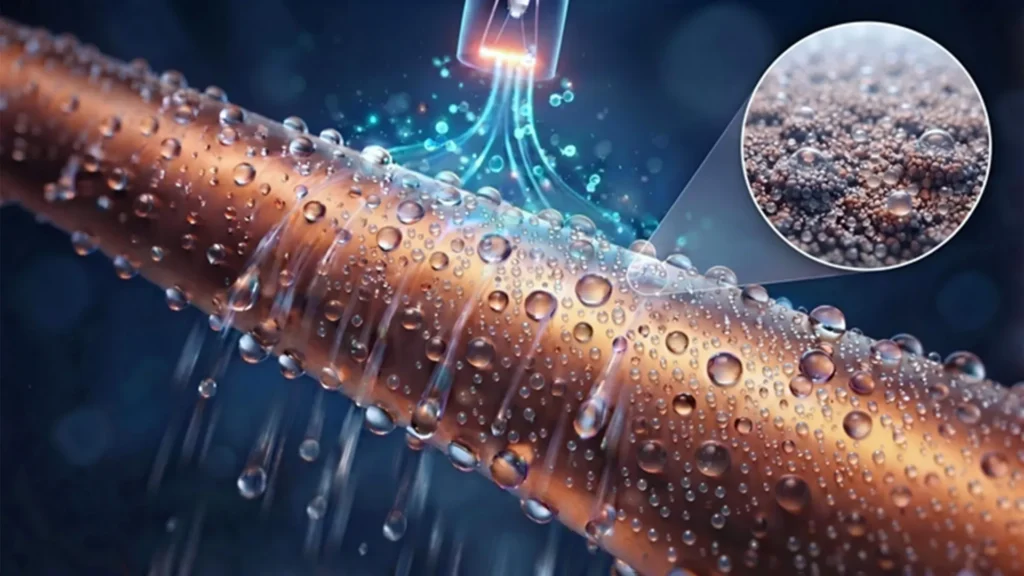
The joint research team flipped this perspective. Using initiated chemical vapor deposition (iCVD)—a process that uses gas-phase precursors to grow polymer chains directly on a substrate—they discovered that by precisely controlling the thickness of the film, they could induce the formation of nanoscale polymer aggregates.
When the researchers reduced the polymer film to an "ultrathin" state, these aggregates became more prominent. Instead of smoothing them over, the team utilized these structures as "nucleation sites." These sites act like tiny anchors that encourage water vapor to begin the transition into liquid droplets. The team found that their thin polymer films produced approximately three times as many initial droplets as thicker, smoother films. This effectively solved the first half of the condensation puzzle: how to make droplets form faster and more frequently.
Solving the Mobility Trade-off
Increasing the number of droplets is only beneficial if those droplets can be removed quickly. Historically, surfaces with many nucleation sites—often achieved through intentional roughness—tended to "pin" the droplets in place. The rougher the surface, the more the water would stick to it, eventually leading back to the problematic film formation.
To address this, the KAIST researchers introduced a secondary process: a specialized thermal treatment. This heat treatment was designed to modify the molecular energy of the polymer surface, reducing the "pinning force" that holds water droplets in place. By weakening this bond, the researchers ensured that even though more droplets were forming, they were also detaching at much smaller sizes.
The result is a highly dynamic surface where droplets are constantly appearing and "jumping" or rolling off, creating a perpetual state of renewal. The researchers likened the process to a crowded room where seats are filled as soon as they are vacated; the higher the turnover, the more people (or in this case, heat units) can move through the system.
Performance Data and Empirical Results
The research team subjected their new coating to rigorous testing to determine its efficacy in real-world scenarios. They applied the iCVD polymer coating to copper tubes, which are the industry standard for heat exchangers in condensers.
The results were statistically significant. The maximum condensation heat transfer coefficient—the metric used to quantify how efficiently a surface transfers heat—reached approximately 88 kW·m⁻²·K⁻¹. This figure represents a 5.5-fold increase over conventional copper surfaces that operate under filmwise condensation conditions.
Furthermore, the KAIST coating outperformed existing high-end hydrophobic (water-repellent) coatings by more than 50%. Most hydrophobic coatings rely on chemical treatments that can degrade over time or require perfectly flat surfaces to function. The iCVD method, by contrast, creates a robust, uniform layer that can conform to complex 3D shapes, such as the curved interior and exterior of industrial piping.
Chronology of Development and Publication
The development of this technology is the culmination of years of interdisciplinary collaboration between KAIST’s mechanical and chemical engineering departments.
- Initial Discovery: Several years ago, the team began experimenting with iCVD to create moisture-resistant coatings for electronics. During this period, they noticed the "defect" aggregates and began theorizing their potential for phase-change heat transfer.
- Experimental Phase: Throughout 2022 and 2023, researchers Jun Soo Kim and Minjeong Kang (the study’s first authors) conducted hundreds of iterations to find the "Goldilocks zone" for film thickness—thin enough to promote nucleation but thick enough to remain durable.
- Refinement: In early 2024, the thermal treatment protocol was perfected, allowing the team to decouple the droplet formation rate from the droplet detachment rate.
- Peer Review and Publication: The findings were submitted to Nature Communications and underwent rigorous peer review before being published online on July 16, 2024.
- Official Announcement: On August 23, 2024, KAIST President Choongsik Bae officially announced the results to the public, highlighting the technology’s potential for national and international industrial application.
Broader Industrial Impact and Implications
The implications of a 5.5-fold increase in heat transfer efficiency are far-reaching, touching on energy, water security, and the future of computing.
1. Energy Efficiency in Power Plants:
Most thermal power plants, whether fueled by coal, gas, or nuclear energy, rely on steam turbines. After the steam passes through the turbine, it must be condensed back into water to repeat the cycle. If the condensers in these plants are 5.5 times more efficient, the entire plant’s thermodynamic efficiency improves. This could lead to a significant reduction in fuel consumption and carbon emissions for the same amount of electricity generated.
2. Desalination and Global Water Security:
In many parts of the world, particularly the Middle East and North Africa, fresh water is produced through Multi-Stage Flash (MSF) or Multi-Effect Distillation (MED) processes. Both rely heavily on condensation. Improving heat transfer efficiency directly lowers the cost of producing fresh water, making desalination more accessible for developing nations facing water scarcity.
3. Next-Generation Electronics Cooling:
As artificial intelligence and high-performance computing continue to advance, the heat generated by semiconductor chips is reaching the limits of traditional air and liquid cooling. "Two-phase cooling," which uses evaporation and condensation to move heat, is the next frontier. The KAIST coating’s ability to be applied to complex, tiny structures makes it a prime candidate for cooling the data centers of the future.
Statements from the Lead Researchers
Professor Youngsuk Nam emphasized the paradigm shift his team achieved by embracing what others ignored. "This research is meaningful because it uses nanostructures previously regarded as defects as features that help droplets form," Nam stated. "We have presented a new method for improving heat transfer efficiency by separately controlling droplet formation and removal."
Professor Sung Gap Im added that the versatility of the iCVD process is a key factor in the technology’s commercial potential. "Because this technology can form extremely thin, uniform coatings even on surfaces with complex shapes, we expect it to be used in various energy and environmental applications, including industrial heat exchangers," Im said.
The research was a collaborative effort supported by several South Korean government initiatives, including the Mid-Career Researcher Program (Ministry of Science and ICT), the SME Technology Innovation Development Program, and the Deep-Tech Startup Activation Support Program. This level of institutional support suggests a strong push toward the commercialization of the coating in the near future.
As the global community seeks ways to meet net-zero carbon goals and manage dwindling resources, innovations that squeeze more efficiency out of fundamental physical processes like condensation will be vital. The KAIST team’s ability to turn a "defect" into a breakthrough serves as a testament to the power of reimagining established scientific norms.