The rapid integration of artificial intelligence into the field of materials science has ushered in an era of unprecedented generative potential, where algorithms can propose millions of novel material designs in a matter of minutes. However, a significant "translation gap" persists between these theoretical computational designs and their practical application in critical industries such as semiconductor manufacturing, aerospace engineering, and renewable energy. While AI models have become adept at imagining new structures, they frequently fail to account for the fundamental chemical stability required for these materials to exist in the physical world. This discrepancy has necessitated a massive computational overhead, as industries and researchers must spend weeks or months screening out thousands of unstable candidates. To address this bottleneck, a multidisciplinary team of researchers at the Massachusetts Institute of Technology (MIT) has developed a new framework known as Crystal Generator with Valence-Constrained Design, or CrysVCD. This system integrates the fundamental rules of chemistry directly into the generative process, ensuring that the materials produced are not only novel but also physically viable.
The Challenge of Theoretical Abundance and Physical Scarcity
In recent years, the materials science community has shifted from traditional trial-and-error experimentation to high-throughput computational screening. The advent of generative AI, particularly diffusion models and large language models (LLMs), promised to accelerate this further by allowing researchers to specify a desired property—such as hardness, conductivity, or transparency—and letting the AI work backward to suggest a molecular or atomic structure. However, the primary obstacle has been the "unstable material" problem.
Current generative models often treat atoms like pixels in an image or words in a sentence, lacking an inherent understanding of the laws of physics and chemistry. Consequently, many generated designs are "unstable," meaning they would decompose or fail to maintain their structure under real-world conditions. For industrial players, the cost of filtering these designs is astronomical. Estimates suggest that validation and stability testing can account for up to 90 percent of the total computational budget in material discovery. For a small research lab or a startup, this cost is often prohibitive, effectively gatekeeping the most advanced materials science research behind a wall of expensive supercomputing resources.
The MIT researchers identified that the root cause of this inefficiency lies in the timing of the stability check. By treating stability as a post-generation filter rather than a pre-generation constraint, current workflows waste immense energy on non-viable candidates. CrysVCD flips this script by applying valence shell rules—the fundamental principles governing how electrons occupy the outermost shells of atoms—at the very beginning of the design process.
CrysVCD: A Two-Stage Generative Architecture
The CrysVCD framework, detailed in a study published in Nature Computational Science, represents a departure from monolithic AI models. Instead, it utilizes a modular, two-stage approach that combines the linguistic logic of LLMs with the structural precision of diffusion models.
In the first stage, the framework utilizes a language model to generate chemically valid formulas. This stage is governed by "valence-constrained design," which ensures that the suggested combination of elements follows the octet rule and other electronic stability criteria. By ensuring that the stoichiometry of the material is sound before a single atom is placed in a 3D lattice, the model eliminates millions of impossible combinations at the outset.
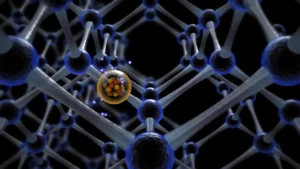
The second stage involves a diffusion model, an AI technique popularized by image generators like DALL-E. This model takes the chemically valid formula from the first stage and determines the specific spatial arrangement of the atoms—the crystal lattice. Because the input formula is already grounded in chemical reality, the diffusion model can focus on optimizing the lattice structure for specific properties without the risk of creating a physically impossible substance.
The researchers compared the efficiency of this process to existing methods. Traditional diffusion models for material generation often require approximately 1,000 steps of iterative refinement to produce a single design. In contrast, by using the CrysVCD framework as a front-end constraint, the process is streamlined to roughly five steps. This 200-fold increase in procedural efficiency allows for higher quality output with a fraction of the energy consumption.
Empirical Results and Performance Metrics
The effectiveness of CrysVCD was tested against several industry-standard benchmarks for material stability. One of the most rigorous tests is "lattice-dynamics stability," which measures how a material’s atoms vibrate and whether those vibrations lead to a collapse of the structure. In testing, CrysVCD-generated materials achieved a high lattice-dynamics stability rate in nearly 70 percent of cases. This is a staggering improvement over traditional generative models, which often yield stable results in only the single-digit percentage range.
Furthermore, the framework demonstrated a metastability rate of 85 percent. Metastability refers to a material’s ability to remain in a stable state for an extended period even if it is not in its absolute lowest energy state—a crucial characteristic for materials used in electronics and structural components.
Beyond mere stability, the MIT team proved that CrysVCD could be "fine-tuned" to target specific industrial needs. The researchers successfully used the system to generate material candidates with two highly sought-after properties: high thermal conductivity and a high dielectric constant. These properties are the "holy grail" for the next generation of computing hardware.
Strategic Implications for the Semiconductor and Data Center Industries
The practical applications of CrysVCD are particularly relevant to the burgeoning field of artificial intelligence itself—specifically the infrastructure required to run it. As data centers expand to meet the demands of global AI processing, energy consumption has become a critical concern. Currently, roughly 30 percent of the total energy used by data centers is dedicated solely to cooling the hardware.
Ju Li, the Carl Richard Soderberg Professor in Power Engineering at MIT and a co-author of the study, emphasized that the industry is in desperate need of materials that can move heat more efficiently. High thermal conductivity materials generated by CrysVCD could lead to the development of new heat sinks and substrate materials that allow chips to run cooler and more efficiently.
Additionally, for the semiconductor industry, the ability to rapidly design materials with high dielectric constants is essential for the continued miniaturization of transistors. As traditional silicon-based designs reach their physical limits, the "plug-and-play" nature of CrysVCD allows engineers to explore exotic crystalline structures that were previously too computationally expensive to simulate reliably.
The "DVD Player" Model: Democratizing Material Science
One of the most significant aspects of CrysVCD is its versatility. Mingda Li, an associate professor of nuclear science and engineering at MIT, described the framework using a consumer electronics analogy: "If material-generating models are like DVDs, we are like the DVD player."
This means that CrysVCD is not a replacement for existing AI models but rather an enhancement layer that can be wrapped around them. Whether a research group is using a current diffusion model or a future, more advanced architecture, CrysVCD can be integrated to provide the necessary chemical constraints. This "democratization" of material design is a key goal for the MIT team. By reducing the computational cost of finding stable materials by an order of magnitude, the framework allows smaller academic labs and startups—who lack the massive server farms of Big Tech—to compete in the discovery of next-generation materials.
A Chronology of Progress in Computational Discovery
The development of CrysVCD is the latest milestone in a decades-long timeline of computational materials science:
- 1960s-1980s: The foundation of Density Functional Theory (DFT) allows researchers to calculate the properties of materials based on quantum mechanics, though it remains extremely slow and limited to small systems.
- 2000s: The rise of high-throughput screening allows supercomputers to run DFT calculations on thousands of known or slightly modified materials.
- 2010s: The "Materials Genome Initiative" and the creation of large databases like the Materials Project provide the training data necessary for machine learning.
- 2020-2023: Generative AI models (Diffusion and Transformers) begin to "hallucinate" new materials, leading to a surplus of designs but a deficit of stable, usable ones.
- 2024: The introduction of CrysVCD by MIT researchers provides the first robust, valence-constrained framework to ensure "stability by design."
Expert Perspectives and Collaborative Research
The development of CrysVCD was a highly collaborative effort involving experts from MIT’s departments of Materials Science and Engineering, Chemistry, Chemical Engineering, Physics, and Nuclear Science and Engineering, along with researchers from Michigan State University and Oak Ridge National Laboratory.
Heather Kulik, the Lammot du Pont Professor of Chemical Engineering at MIT, noted that the traditional "generate then select" model is fundamentally inefficient. "In academia, where we have fewer resources, I think we can still achieve strong performance with smarter designs," Kulik explained. She highlighted that by placing the language model at the beginning of the pipeline to constrain the generation, the ratio of stable materials increases so significantly that the downstream "selection" phase becomes almost trivial.
The research was supported by a broad coalition of government and academic institutions, including the U.S. Department of Energy, the National Science Foundation, and the U.S. Defense Threat Reduction Agency, underscoring the national security and economic importance of maintaining a lead in material discovery.
Limitations and Future Directions
While CrysVCD represents a landmark achievement, the researchers acknowledge its current limitations. The framework is currently optimized for crystalline solids—materials with highly ordered internal arrangements. It is less effective for amorphous materials (like glass) or complex biological polymers, where the rules of stability are governed by different structural dynamics.
However, the team is already looking toward expanding the framework’s capabilities. Future iterations may include constraints for environmental stability—ensuring materials don’t degrade when exposed to moisture or oxygen—and "synthesizability" constraints, which would predict not just if a material is stable, but how easy it is to actually manufacture in a lab.
As AI continues to evolve, the CrysVCD framework stands as a critical bridge between the digital and physical worlds. By embedding the ancient laws of chemistry into the cutting-edge algorithms of tomorrow, MIT researchers have provided a roadmap for a more efficient, accessible, and productive era of material innovation. The transition from millions of "theoretical" designs to thousands of "usable" products is no longer just a possibility; it is a computationally viable reality.