H. Moser & Cie. has long distinguished itself in the world of haute horlogerie by embracing a philosophy of understated complexity. In an industry where intricate timepieces often boast dials crowded with sub-dials, apertures, and multiple hands, the independent Swiss brand consistently opts for a minimalist aesthetic that prioritizes clarity and visual harmony. This commitment to refined design is powerfully exemplified by their latest creation, the Endeavour Flyback Chronograph Dual Time Date. This ambitious watch masterfully integrates three significant complications – a flyback chronograph, a dual time zone indicator, and a date function – onto a remarkably uncluttered dial, a testament to Moser’s signature design ethos.
A Symphony of Complications, Subtly Orchestrated
The Endeavour Flyback Chronograph Dual Time Date is not merely a watch; it’s a statement on how mechanical ingenuity can be presented with unparalleled grace. At first glance, the 42mm stainless steel case, housing a mesmerizing turquoise fumé dial, offers an immediate visual appeal. However, it’s the thoughtful integration of its complex functions that truly sets this timepiece apart. Unlike conventional chronographs that scatter elapsed time indicators across the dial in subsidiary registers, Moser has opted for a revolutionary central display. A vibrant red hand tracks elapsed seconds, while a sophisticated rhodium-plated hand meticulously indicates elapsed minutes. This innovative approach preserves the expansive beauty of the fumé dial, allowing the intricate gradient of color to remain the primary focus.
The dial’s perimeter is marked by a crisp white minute track, providing a clear scale for reading both the chronograph and the time itself. A tachymeter scale, subtly positioned on the flange, further enhances the chronograph’s utility for measuring speed over distance. This ingenious arrangement allows the watch to perform as a fully functional flyback chronograph without compromising the visual serenity that has become a hallmark of H. Moser & Cie. The flyback mechanism itself is a significant engineering feat, enabling the instantaneous reset and restart of timing operations for both seconds and minutes without the need to first stop the chronograph. This functionality is crucial for rapid sequential timing, a feature highly valued by those who rely on precise timekeeping for dynamic events.

The Art of Discretion: Dual Time and Date Integration
Moser’s commitment to subtlety extends to the watch’s Dual Time complication. Eschewing the common practice of introducing a separate GMT hand or another sub-dial, the brand has ingeniously woven the second time zone indicator into the very heart of the dial. A deep Blackor fumé central disc, visually receding into the dial’s depths, features a small, white arrow tipped with Super-LumiNova. This discreet pointer offers a clear, at-a-glance reading of the second time zone, elegantly integrating itself into the overall design when not actively being consulted. This characteristic Moser solution ensures that the watch’s travel-centric functionality is readily available without overwhelming the primary time-telling function.
The date complication, often a prominent aperture on many watches, is also handled with characteristic restraint. While the exact method of integration is not detailed in initial reports beyond its presence, it is implied to be seamlessly incorporated without disrupting the dial’s clean lines. This careful orchestration of complications makes the Endeavour Flyback Chronograph Dual Time Date an exceptionally practical companion for the modern globetrotter. Local time, a second time zone, chronograph capabilities, and the date are all at the wearer’s disposal, yet none of these functions demand undue attention, allowing the fundamental elegance of the timepiece to shine through.
The Ingenious HMC 730 Caliber: The Heart of Simplicity
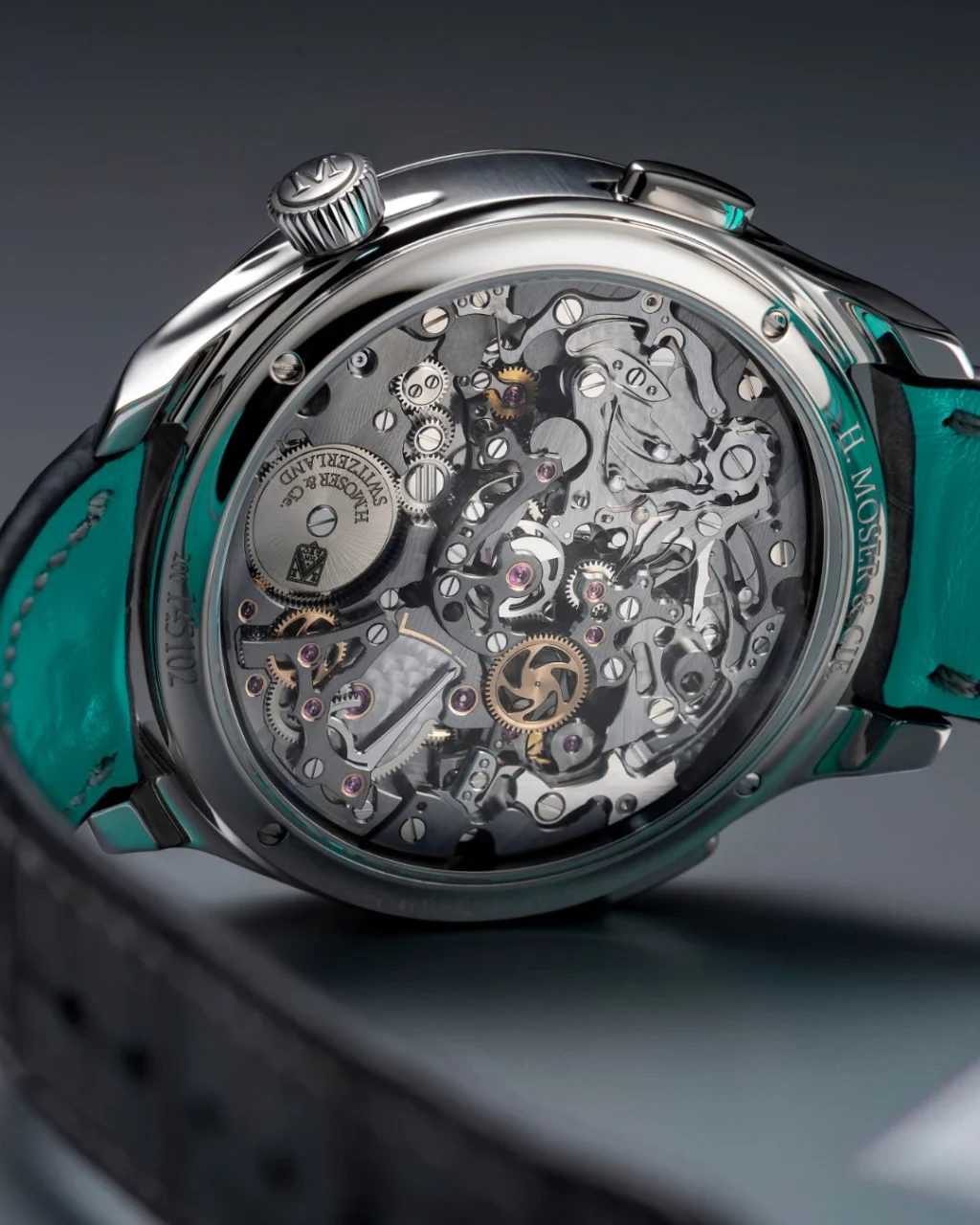
Beneath the dial’s minimalist façade lies the new, manually wound HMC 730 caliber, a sophisticated movement developed in collaboration with the esteemed movement specialist Agenhor. This caliber represents a significant evolution, building upon the architectural foundations of the automatic HMC 902 movement. For the HMC 730, Agenhor strategically removed the automatic winding system and oscillating weight. This crucial modification not only frees up valuable space for the seamless integration of the Dual Time and date mechanisms but also imbues the watch with the more traditional and engaging interaction of a manually wound caliber, a choice often favored by purists.
The HMC 730 retains several of the HMC 902’s most technically impressive features. Central to its chronograph function is a column-wheel mechanism, renowned for its smooth and precise operation. Furthermore, it incorporates Agenhor’s innovative micro-tooth system for the horizontal clutch. This unique design utilizes a friction wheel with micro-teeth engineered to significantly reduce the often-unpleasant "jump" that can occur when conventional chronograph gears engage, ensuring a more fluid start and stop to the timing process.

The elapsed minutes are managed through a retrograde mechanism, a particularly elegant solution for displaying time intervals. Energy is meticulously accumulated and then released via a snail cam. This system allows the central elapsed-minute hand to jump instantaneously to its next designated position, rather than gradually sweeping across the dial. This immediate jump enhances readability, making it easier for the wearer to ascertain the precise elapsed minute at any given moment.
Operating at a frequency of 21,600 vibrations per hour, the HMC 730 is comprised of 383 individual components and 49 jewels. Twin barrels work in concert to provide a robust minimum power reserve of 72 hours, ensuring ample autonomy for the watch. In another thoughtful nod to the brand’s design philosophy, the power reserve indicator is discreetly positioned on the movement side, visible only through the sapphire crystal caseback. This clever placement ensures that the dial remains unburdened by additional information, preserving its clean aesthetic.
A Traveler’s Best Friend: Practicality and Design
The HMC 730 caliber is housed within a 42mm stainless steel Endeavour case, measuring a comfortable 13.2mm in thickness. Moser has also reimagined the conventional layout of the watch’s controls. Instead of the typical placement of chronograph pushers along the right side of the case, they are strategically positioned at 10 and 2 o’clock. The screw-down crown, bearing the engraved "M" insignia, is located at 4 o’clock, offering a balanced and ergonomic arrangement. The case is rated for water resistance up to 3 ATM, suitable for everyday wear and protection against splashes.
The sapphire display caseback offers a captivating view of the HMC 730’s intricate workings. The movement is adorned with an anthracite finish, complemented by Moser’s signature double stripes and partially skeletonized bridges, showcasing the brand’s meticulous attention to detail in both form and function. The striking turquoise fumé dial, with its darker Blackor fumé central disc, is punctuated by strategically placed red, rhodium-plated, and white indications. This interplay of colors and finishes creates a sophisticated contrast that enhances legibility without sacrificing the overall visual harmony. Despite the wealth of complications, the architectural design of the dial effectively avoids the visual clutter often associated with multi-complication timepieces.

The watch is completed by a refined grey alligator leather strap, featuring a soft nubuck finish, secured by a stainless steel pin buckle elegantly engraved with the Moser logo. This thoughtful combination of materials and design elements underscores the watch’s blend of sporty functionality and luxurious appeal.
The Moser Philosophy Embodied
The H. Moser & Cie. Endeavour Flyback Chronograph Dual Time Date Ref. 1730-1200 represents a profound philosophical statement in watchmaking. It challenges the prevailing notion that complexity must be overtly displayed. The mechanical architecture of the HMC 730 caliber is undeniably elaborate, yet the wearer is not subjected to a constant barrage of information. Instead, the flyback chronograph, dual time zone, date, and power reserve are artfully organized around the fundamental simplicity and clarity of the Endeavour design. For H. Moser & Cie., the complications are present and functional when needed, but largely recede into the background when not, allowing the wearer to appreciate the time with effortless grace.
This approach is particularly relevant in an era where watch enthusiasts increasingly value intelligent design and functional elegance over ostentatious displays of technical prowess. The Endeavour Flyback Chronograph Dual Time Date is a perfect embodiment of this trend, offering a sophisticated blend of cutting-edge horology and timeless aesthetic appeal.
Pricing and Availability
The H. Moser & Cie. Endeavour Flyback Chronograph Dual Time Date Ref. 1730-1200 is priced at CHF 59,000 (excluding taxes), which approximates to approximately $72,800 USD at the time of reporting. This pricing reflects the meticulous craftsmanship, innovative engineering, and exclusive nature of H. Moser & Cie. timepieces. Further details and purchasing information can be found on the brand’s official website.

Broader Implications for the Watch Industry
The introduction of the Endeavour Flyback Chronograph Dual Time Date by H. Moser & Cie. has significant implications for the broader watch industry. It serves as a powerful counterpoint to the trend of increasingly complex and often visually overwhelming dial designs. By demonstrating that multiple complications can be integrated without sacrificing legibility or aesthetic appeal, Moser sets a new benchmark for sophisticated watchmaking. This approach encourages other brands to reconsider their design strategies, potentially leading to a greater emphasis on user-centric design and understated elegance across the high-end watch market. The success of such a technically advanced yet visually minimalist timepiece suggests a growing consumer appreciation for watches that offer substance without sacrificing style, a trend that is likely to shape future product development in the sector. The collaboration with Agenhor also highlights the importance of strategic partnerships in pushing the boundaries of horological innovation, especially in the realm of complex movements.