Arrow Electronics has significantly enhanced its Digital Test Drive platform by integrating NXP Semiconductors’ Ara240 discrete neural processing unit (DNPU), providing engineers unprecedented remote access to this powerful AI accelerator. This strategic addition allows developers to evaluate the Ara240’s capabilities before committing to hardware investments, thereby streamlining the design and development cycle for next-generation AI-powered edge applications. The move underscores a growing industry trend towards democratizing access to sophisticated hardware and accelerating innovation in the burgeoning field of edge artificial intelligence.
The Digital Test Drive, a pioneering initiative by Arrow Electronics, functions as a cloud-based remote hardware testing and development environment. It empowers engineers to connect to physical systems over the web, eliminating the traditional barriers associated with hardware evaluation. Historically, developers would need to order costly evaluation kits, await their delivery, and then undertake the often-complex process of setting up and configuring the hardware locally. This method could be time-consuming, resource-intensive, and a significant bottleneck in rapid prototyping and development. By contrast, Arrow’s platform offers instant, remote access, allowing teams across different geographical locations to collaborate and test concurrently. This paradigm shift in hardware evaluation is particularly crucial for cutting-edge technologies like AI accelerators, where rapid iteration and performance validation are paramount.
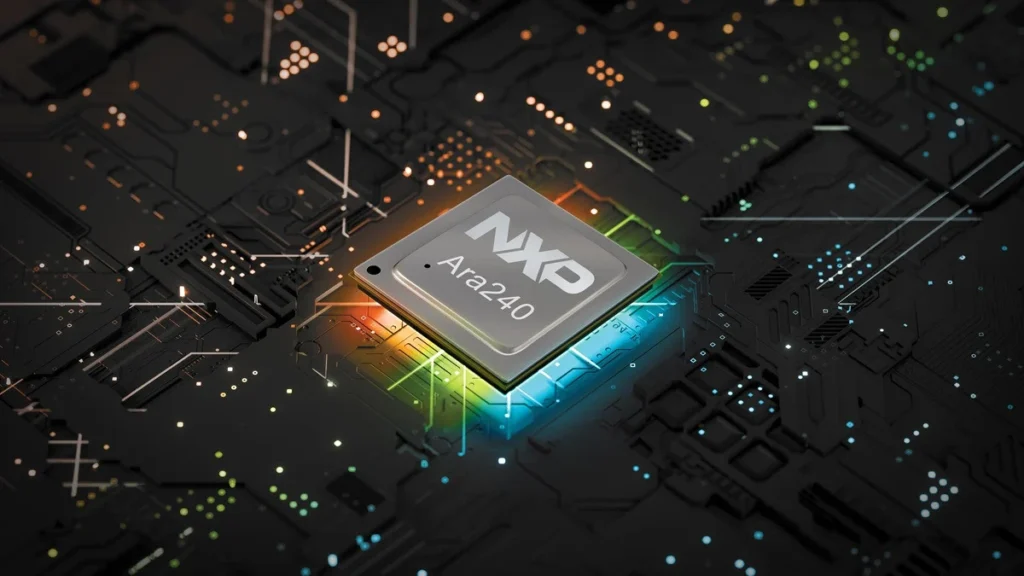
The integration of NXP’s Ara240 DNPU is a testament to the platform’s utility and Arrow’s commitment to supporting advanced technology development. Developers can now leverage the Ara240 in conjunction with NXP i.MX applications processors within the Digital Test Drive environment. This setup facilitates rigorous testing of diverse AI workloads, including complex computer vision tasks, large language model (LLM) inference, and sophisticated vision language AI applications. The ability to test these workloads on real hardware, rather than relying solely on theoretical specifications, simulation data, or benchmark figures, provides invaluable insights into actual performance and helps engineers make informed architecture decisions. This real-world testing capability is critical for optimizing AI models for deployment in resource-constrained edge environments.
At the core of this advancement is the NXP Ara240, a discrete neural processing unit specifically engineered to meet the escalating demands of AI workloads at the edge. Edge computing, characterized by processing data closer to its source rather than in a centralized cloud, offers several distinct advantages. Primarily, it significantly reduces latency, a critical factor for real-time applications such as autonomous vehicles, industrial robotics, and medical diagnostics. By minimizing the time it takes for data to travel to and from the cloud, edge AI enables faster decision-making and more responsive systems. Furthermore, processing data locally lessens reliance on cloud infrastructure, which can be prone to connectivity issues, bandwidth limitations, and higher operational costs. Crucially, keeping more data within the local system enhances data privacy and security, addressing growing concerns about sensitive information being transmitted over public networks. This localized processing capability is transforming various industries by enabling more intelligent, autonomous, and secure operations.
The Ara240 is designed for high-performance, offering up to 40 equivalent tera operations per second (eTOPS). This level of processing power is essential for handling the intricate computations required by modern AI models. It supports a wide array of advanced neural network architectures, including large language models (LLMs), which are foundational for natural language understanding and generation; vision language models (VLMs), capable of interpreting and generating content based on both visual and textual inputs; transformers, a groundbreaking architecture pivotal in many state-of-the-art AI applications; and convolutional neural networks (CNNs), which are mainstays in computer vision tasks. The ability to run such diverse and complex models directly on an edge device marks a significant leap forward in making sophisticated AI accessible outside of data centers.
A key enabler of this capability is the Ara240’s robust memory support, accommodating up to 16 GB of LPDDR4 memory. This substantial memory capacity allows for the direct execution of larger and more intricate AI models within edge and embedded systems, a feat that was previously challenging due to memory constraints typical of edge devices. The practical implications of this are vast, opening up new possibilities across numerous sectors. Potential applications span industrial automation, where intelligent systems can perform predictive maintenance and quality control; advanced robotics, enabling more autonomous navigation and interaction; machine vision systems for intricate inspection and analysis in manufacturing; and a multitude of other intelligent edge platforms requiring on-device inferencing. For instance, in smart cities, edge AI can power real-time traffic analysis, intelligent surveillance, and environmental monitoring without constant reliance on cloud connectivity.

The collaboration between Arrow Electronics and NXP Semiconductors addresses a critical need in the rapidly expanding AI hardware market. According to various market research reports, the global edge AI hardware market is projected to grow at a compound annual growth rate (CAGR) exceeding 20% over the next five to seven years, reaching tens of billions of dollars. This growth is driven by the proliferation of IoT devices, the demand for real-time data processing, and the increasing sophistication of AI algorithms. Companies are increasingly seeking robust, energy-efficient, and secure solutions to deploy AI closer to the data source.
The chronology of this development highlights a concerted effort to meet these market demands. NXP, a long-standing leader in embedded processing solutions, has been at the forefront of developing specialized silicon for AI at the edge. The Ara240 represents the culmination of significant research and development in optimizing neural processing for power-constrained environments while maximizing performance. Arrow Electronics, a global provider of technology products, services, and solutions, has continuously evolved its Digital Test Drive platform to remain relevant and indispensable to developers. The platform’s initial conceptualization aimed at reducing friction in hardware evaluation, and its subsequent expansion to include advanced components like the Ara240 demonstrates an agile response to technological shifts. The formal announcement of the Ara240’s availability on the platform signifies the successful integration and readiness for broad developer adoption, making it immediately accessible.
Official responses to this integration underscore its strategic importance. Justin Mortimer, Senior Director, Product Marketing, Secure Connected Edge at NXP Semiconductors, articulated the value proposition: “Developers need practical ways to understand how advanced AI technologies will perform in real applications. By providing access to NXP’s Ara240 DNPUs through Digital Test Drive, Arrow enables engineering teams to evaluate real-world edge AI performance faster and make informed design decisions.” This statement emphasizes the practical, results-oriented nature of the collaboration, focusing on accelerating the design cycle and improving decision-making accuracy.
From Arrow’s perspective, a spokesperson (hypothetically) might add, "Our mission with Digital Test Drive is to empower engineers with the tools they need to innovate at an accelerated pace. The addition of NXP’s Ara240 DNPU is a pivotal step in this direction, providing seamless access to cutting-edge AI hardware that will drive the next wave of intelligent edge solutions. This partnership not only removes significant barriers to entry for advanced AI development but also fosters a more efficient and collaborative ecosystem for our global customer base." Such a statement would align with Arrow’s strategic positioning as an enabler of technological advancement and a facilitator of market adoption for new innovations.
The broader implications of this partnership are significant for the entire technology ecosystem. Firstly, it democratizes access to high-end AI hardware. Smaller companies, startups, and academic institutions, which might lack the capital or logistical capacity to acquire and set up multiple physical evaluation kits, can now experiment with powerful DNPUs. This levels the playing field, fostering innovation beyond well-funded corporations. Secondly, it accelerates time-to-market for new AI-powered products. By reducing the evaluation phase, companies can move from concept to prototype and then to production more rapidly, gaining a competitive edge. Thirdly, it promotes better design outcomes. Engineers can thoroughly test their AI models against real-world scenarios on the actual hardware, leading to more robust, efficient, and reliable products. This reduces the likelihood of costly redesigns or performance issues later in the development cycle.
Furthermore, this collaboration highlights the evolving landscape of hardware-as-a-service. As AI models become more complex and specialized hardware becomes essential, remote evaluation platforms are set to become indispensable. They offer a flexible, scalable, and cost-effective alternative to traditional hardware procurement. This trend is likely to expand, with more specialized components and complex system-on-chips (SoCs) becoming available through similar cloud-based testing environments. The success of initiatives like Arrow’s Digital Test Drive with NXP’s Ara240 could pave the way for a future where hardware development is significantly more agile and accessible.
In conclusion, the integration of NXP’s Ara240 DNPU into Arrow’s Digital Test Drive platform represents a critical advancement in the field of edge AI development. It offers engineers an efficient, remote, and robust method to evaluate advanced AI hardware, directly addressing the challenges of latency, data privacy, and processing demands at the edge. By enabling real-world testing of complex AI workloads on powerful hardware, this initiative is poised to accelerate innovation, democratize access to cutting-edge technology, and foster the development of a new generation of intelligent, autonomous, and secure edge devices across a multitude of industries. The NXP Ara240 evaluation environment is available now through Arrow Digital Test Drive, marking a pivotal moment in making sophisticated AI hardware more accessible and development cycles more efficient.