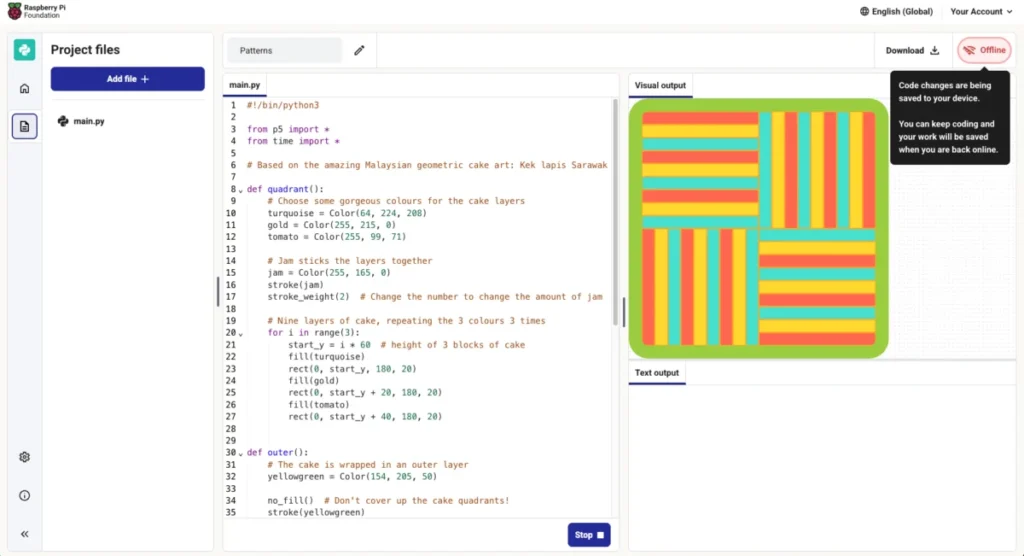
The Raspberry Pi Foundation has announced a significant technical update to its free, browser-based Code Editor, introducing robust offline support designed to mitigate the impact of unstable internet connectivity on global learners. This development ensures that students and educators can continue writing, executing, and managing code even when a network connection is lost or interrupted. By utilizing advanced web technologies, the Foundation aims to bridge the "digital divide" that often hinders computer science education in regions with inconsistent infrastructure. The update allows the editor to remain functional during mid-session disconnections, even if a user reloads the browser page, effectively removing one of the primary barriers to entry for digital literacy in underserved communities.
Responding to Global Connectivity Challenges
The impetus for this update stems from extensive field research conducted by the Raspberry Pi Foundation in diverse geographical contexts, including India, Kenya, and South Africa. While internet penetration has grown significantly over the last decade, the quality and reliability of that access remain highly variable. In many rural areas, high-speed broadband is non-existent, and users often rely on expensive or "patchy" mobile data. However, the Foundation’s research highlighted a more complex reality: even in metropolitan centers, connectivity is frequently compromised by external factors such as electricity load-shedding—planned rolling blackouts used to manage power grids—and brownouts.
When a student is twenty minutes into a complex programming task, a momentary loss of signal can lead to more than just a minor annoyance. Previously, a browser refresh during a connection drop could result in the loss of unsaved work, a blank screen, or a generic browser error. For a learner just beginning to grasp the logic of Python or HTML, such technical failures can be demoralizing and disruptive to the "flow state" necessary for effective learning. By making the Code Editor resilient to these interruptions, the Foundation is directly addressing the physical and economic realities of its global user base.
Technical Implementation: The Role of Service Workers
The seamless transition between online and offline states is facilitated by the implementation of "service workers." A service worker is a specialized script that a web browser runs in the background, separate from the main web page. This technology acts as a programmable network proxy, allowing the application to intercept network requests and take appropriate action based on the availability of the internet.

When a user first navigates to the Code Editor while online, the service worker automatically downloads and stores the essential files—such as the editor’s interface, the code execution engine, and necessary libraries—into the browser’s local cache. If the network connection subsequently fails, the service worker detects the outage and serves the required files directly from the local cache rather than attempting to fetch them from a remote server.
Crucially, the Raspberry Pi Code Editor was designed from its inception with a decentralized architecture. Unlike many traditional online Integrated Development Environments (IDEs) that rely on server-side execution, the Raspberry Pi Editor runs code locally within the user’s browser. This architectural choice, combined with the new caching mechanism, means that the core functionality of the tool—writing code and seeing the output—is entirely independent of a live server once the initial load is complete. When the user eventually returns to an area with connectivity, the service worker automatically updates the cached files to ensure the user has the latest version of the software.
Supporting Data: The State of Global Internet Access
The necessity of this update is underscored by data from the International Telecommunication Union (ITU). As of 2023, while approximately 67% of the world’s population is online, the quality of that connection varies wildly. In many developing nations, the "usage gap"—where people live within range of a signal but cannot afford or reliably maintain a connection—is a significant hurdle.
In South Africa, for instance, the practice of load-shedding reached record levels in 2023, with some regions experiencing over 10 hours of power outages per day. This directly affects the uptime of local WiFi routers and cellular towers. Similarly, in India, while the digital infrastructure is expanding rapidly, rural schools often contend with bandwidth congestion. In a typical classroom setting where 30 or more students attempt to access a single WiFi access point simultaneously, the available bandwidth per student can drop to levels that mimic a total connection failure. The Raspberry Pi Foundation’s offline-first approach mitigates these "local" connectivity crises, ensuring that the educational process is not dictated by the limitations of the local router.
Strategic Alignment with EdTech Principles
This technical update is not merely a feature addition but a practical application of the Raspberry Pi Foundation’s "Draft Principles for Safe and Responsible Education Technology." These principles emphasize the importance of designing for diverse needs and contexts, explicitly stating that developers should not assume constant, high-speed internet connectivity.

By prioritizing resilience, the Foundation is advocating for a shift in how educational tools are built. Most modern "Software as a Service" (SaaS) products are designed for an "always-on" environment, which inadvertently excludes millions of potential users. The Code Editor’s new capabilities represent a commitment to "inclusive by design" engineering, where the software adapts to the user’s environment rather than requiring the user to adapt to the software’s requirements.
The project was made possible through funding from Cisco, highlighting a growing corporate interest in supporting sustainable and accessible educational infrastructure. This partnership reflects a broader industry recognition that digital literacy is a global necessity that requires robust, low-barrier tools.
Operational Impact for Educators and Students
For teachers in a classroom setting, the update provides a layer of insurance against technical disruptions. In the past, a sudden internet drop could derail a 45-minute lesson, forcing teachers to pivot to "unplugged" activities or spend valuable time troubleshooting connection issues. With the updated Code Editor, the lesson can continue. Students can still run their Python scripts or preview their web pages, and their progress is saved locally to their device’s storage.
However, the Foundation has clarified the current limitations of this browser-based approach. While the editor is resilient to disconnections, it is not yet a "full offline app" in the sense of a downloadable desktop application. Users still need an initial internet connection to load the editor for the first time. Furthermore, features that require server-side interaction—such as logging into a Raspberry Pi account to sync projects to the cloud or sharing projects via a URL—still require an active connection. Once the connection is restored, these cloud-based features become available again, and any locally saved changes can be synchronized.
Chronology of Development and Future Outlook
The development of the Code Editor’s offline capabilities followed a structured timeline:
- Initial Research Phase (2022-2023): Field studies in Kenya, South Africa, and India to identify the specific environmental factors affecting learners.
- Architectural Design: Selection of a browser-side execution model to minimize server dependency.
- Beta Testing of Service Workers: Implementation of caching strategies to handle page reloads during offline states.
- Integration of Local Storage: Refining how code is saved to the browser’s IndexedDB or LocalStorage to prevent data loss.
- Official Launch (Late 2023): Deployment of the update to the live web editor.
Looking forward, the Raspberry Pi Foundation has expressed its intention to further expand the offline capabilities of the Editor. Potential future updates may include more sophisticated local project management and the ability to "install" the editor as a Progressive Web App (PWA) on mobile devices and tablets, which would allow users to launch the tool directly from their home screen without navigating to a URL.
Conclusion: A Step Toward Digital Sovereignty
The Raspberry Pi Foundation’s update to its Code Editor is a significant milestone in the movement toward more resilient and inclusive educational technology. By acknowledging and engineering for the reality of unstable internet, the Foundation is providing a vital tool for the next generation of programmers, regardless of their geographic or economic circumstances.
In a world where digital skills are increasingly synonymous with economic opportunity, the ability to learn without the constant fear of a "Connection Lost" message is a form of digital sovereignty. This update ensures that the spark of curiosity in a student—whether they are in a high-tech lab in London, a community center in Nairobi, or a rural school in Bihar—is not extinguished by a faulty router or a scheduled power cut. Through this initiative, the Raspberry Pi Foundation continues to uphold its mission to put the power of computing and digital making into the hands of people all over the world.