In a landmark achievement for the field of quantum electrodynamics, an international coalition of researchers has uncovered what appears to be the first observational evidence of vacuum birefringence, a phenomenon first theorized by physicist Werner Heisenberg nearly nine decades ago. By utilizing a suite of sophisticated space-based and ground-based telescopes to observe a highly magnetized neutron star known as a magnetar, the team has identified signals that suggest the vacuum of space is not a void, but a medium that can alter the path and polarization of light when subjected to extreme magnetic forces. The study, led by Rachael E. Stewart of George Washington University and published in the journal Nature, represents a significant leap forward in our understanding of the fundamental laws of physics under conditions that are impossible to replicate within any terrestrial laboratory.
The Quantum Foundations of Vacuum Birefringence
The concept of vacuum birefringence (VB) dates back to 1936, when Werner Heisenberg and Hans Heinrich Euler published a paper describing the non-linear properties of the vacuum in the presence of strong electromagnetic fields. According to the principles of quantum electrodynamics (QED), the "vacuum" is not truly empty. Instead, it is a roiling sea of "virtual particles"—pairs of electrons and positrons—that constantly pop into and out of existence. Under normal circumstances, these fluctuations are imperceptible. However, Heisenberg and Euler predicted that in the presence of an incredibly intense magnetic field, these virtual particles would become polarized, effectively turning the vacuum into a prism.
This process creates a "birefringent" effect, meaning the vacuum develops a refractive index that depends on the polarization and direction of light passing through it. Essentially, light waves oscillating in different directions would travel at slightly different speeds. While this theory has been a cornerstone of QED for decades, the magnetic field strength required to trigger a detectable level of birefringence is staggering—far exceeding the capabilities of human engineering. On Earth, even the most powerful superconducting magnets can only produce fields of about 45 to 100 Tesla. To observe vacuum birefringence, scientists require a field roughly 100 million times stronger.
The Cosmic Laboratory: Magnetar 1E 1547.0-5408
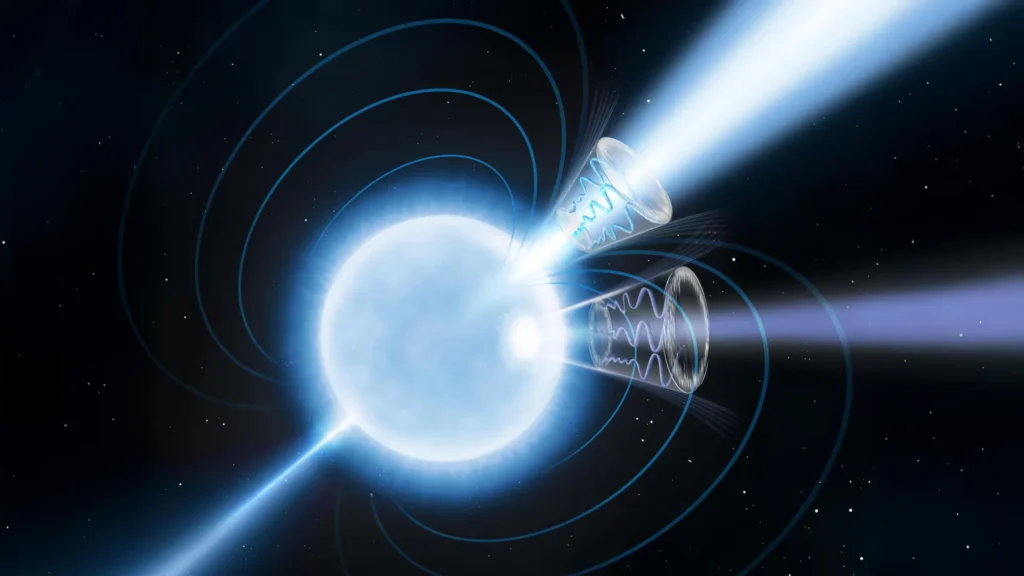
The search for such extreme conditions led researchers to the far reaches of the Milky Way, specifically to a class of celestial objects known as magnetars. These are a rare type of neutron star—the collapsed core of a massive star—possessing magnetic fields that are the strongest known in the universe, often reaching quadrillions of Gauss (or hundreds of millions of Tesla).
The focus of the recent study was the magnetar 1E 1547.0-5408 (often abbreviated as 1E1547), located approximately 13,000 light-years from Earth. Magnetars are ideal "cosmic laboratories" because the environment surrounding them is so extreme that the laws of classical physics break down, allowing quantum effects like VB to manifest on a scale that can be measured by modern instrumentation. Dr. Marcus Lower, an Australian Research Council DECRA Fellow at the Swinburne University of Technology and a key lead in the observations, noted that nature provides the only viable setting for this research. "Detecting vacuum birefringence requires a magnetic field that is over 100 million times stronger than any we’ve ever made on Earth," Lower stated. "Thankfully, nature has provided us with magnetars, which are the perfect cosmic laboratories to go looking for this effect."
A Multi-Instrumental Approach to Deep Space Observation
The investigation required a sophisticated coordination of data from multiple high-tech sources. The primary radio observations were conducted using the CSIRO’s Murriyang radio telescope, also known as the Parkes telescope, located in New South Wales, Australia. This 64-meter dish is world-renowned for its sensitivity and its history in pulsar and magnetar research. The massive volume of data captured by Murriyang was processed using the Ngarrgu Tindebeek supercomputer at Swinburne University, which allowed the team to analyze the complex radio pulse profiles with unprecedented precision.
To complement the radio data, the researchers integrated X-ray measurements from two critical NASA missions. The first was the Imaging X-ray Polarimetry Explorer (IXPE), a specialized satellite launched in late 2021 designed specifically to measure the polarization of X-rays from exotic sources like black holes and neutron stars. The second was the Neutron star Interior Composition Explorer (NICER), an instrument mounted on the International Space Station (ISS) that provides high-precision timing of X-ray emissions.
By monitoring 1E 1547.0-5408 across different wavelengths, the researchers tracked the "polarization state" of the emissions—the orientation in which the light waves oscillate—as the magnetar rotated on its axis. The geometry of 1E 1547.0-5408 proved to be particularly fortuitous; the data revealed that the object’s magnetic axis and its rotational axis are nearly aligned, and from Earth’s vantage point, we are looking almost directly down at one of its poles. This "pole-on" perspective minimizes many of the geometric distortions that usually complicate the analysis of neutron star emissions, providing a clear window into the quantum effects occurring in the surrounding vacuum.
Analyzing the Signature of Quantum Fluctuations
The results of the analysis were striking. The X-rays detected by IXPE showed an exceptionally high degree of linear polarization. More importantly, the direction of this polarization remained strictly aligned with the magnetar’s magnetic field. Similarly, the radio waves observed by the Parkes telescope maintained a consistent alignment with the magnetic field as the star rotated.
In a standard vacuum, according to classical physics, the polarization of light would not be influenced by a magnetic field in this specific way. However, the alignment observed in 1E 1547.0-5408 is a hallmark signature of vacuum birefringence. As light travels through the ultra-strong magnetic field surrounding the magnetar, the polarized virtual particles of the vacuum interact with the photons, forcing their polarization to stay "locked" to the magnetic field lines.
Dr. Lower explained the mechanism: "Because of the magnetic field’s strength, Heisenberg’s virtual particles become aligned with the direction the field is pointing. By carefully tracking the direction the radio waves and X-rays oscillate as the magnetar rotates, the team found that the alignment of 1E1547’s magnetic and rotational poles was ideal for detecting vacuum birefringence."
Chronology of the Quest for Vacuum Birefringence
The journey to this discovery has spanned nearly a century of theoretical and experimental physics:
- 1936: Werner Heisenberg and Hans Euler publish the first theoretical framework for vacuum birefringence, suggesting that the vacuum can act like a medium.
- 1940s-1950s: The development of Quantum Electrodynamics (QED) by Richard Feynman, Julian Schwinger, and Shin’ichirō Tomonaga provides a more robust mathematical basis for these predictions.
- 1990s-2000s: Advances in laser technology lead to terrestrial experiments (such as PVLAS in Italy) attempting to measure VB in the lab, though the fields generated remain too weak for a definitive confirmation.
- 2016: Observations of the neutron star RX J1856.5-3754 using the Very Large Telescope (VLT) show the first hints of vacuum birefringence, but the results are considered statistically suggestive rather than conclusive.
- 2021: NASA launches the IXPE mission, providing the first dedicated tool for measuring X-ray polarization in space.
- 2023-2024: The collaborative team led by Stewart and Lower analyzes data from IXPE, NICER, and Murriyang, focusing on magnetar 1E 1547.0-5408, leading to the current findings.
Institutional Collaboration and Official Responses
The study was a massive undertaking involving a diverse group of institutions, including the Center for Space Sciences and Technology, the South African Radio Astronomy Observatory (SARAO), Los Alamos National Laboratory, NASA’s Marshall Space Flight Center, and the Astrophysics Science Division at NASA’s Goddard Space Flight Center.
While the scientific community has reacted with cautious optimism, the findings are being hailed as a major milestone. Representatives from NASA have noted that the success of the IXPE mission in providing this data justifies the investment in specialized polarimetry hardware. "This is exactly why we sent IXPE into orbit," said a spokesperson associated with the mission. "To test the limits of physics where the laboratory of Earth ends and the laboratory of the universe begins."
Rachael E. Stewart, the lead author and a graduate student at George Washington University, emphasized the collaborative nature of the discovery. The integration of radio and X-ray data was essential, as the two different types of radiation provided independent confirmation of the same physical phenomenon.
Broader Implications and Future Research
If confirmed by subsequent observations and more refined computer simulations, the detection of vacuum birefringence will have profound implications for modern physics. First, it would provide a definitive validation of one of the last remaining unproven predictions of the Heisenberg-Euler Lagrangian, reinforcing the standard model of particle physics and QED.
Furthermore, this research opens a new "window" into the study of the strong-field regime. Most of our current understanding of physics is based on "weak-field" observations. By proving that we can measure quantum effects around magnetars, scientists can begin to use these stars as probes for other exotic theories, such as the search for axions—hypothetical particles that are candidates for dark matter. Some theories suggest that axions could also cause light to change its polarization in strong magnetic fields, and being able to account for vacuum birefringence is a necessary step in isolating those potential signals.
However, the team remains disciplined about the need for more data. "Additional observations and more advanced computer simulations could help researchers determine whether the signals really come from vacuum birefringence or whether other physical processes could produce similar effects," the researchers noted in their report. Potential "noise" could come from the plasma environment surrounding the magnetar, which can also affect polarization. Distinguishing between plasma effects and true quantum vacuum effects is the next hurdle for the team.
The study of 1E 1547.0-5408 has set a new benchmark for multi-messenger astronomy. As telescopes become more sensitive and supercomputers more powerful, the quest that Heisenberg started 88 years ago is nearing its conclusion, potentially turning the "empty" vacuum of space into one of the most productive areas of study in the 21st century.