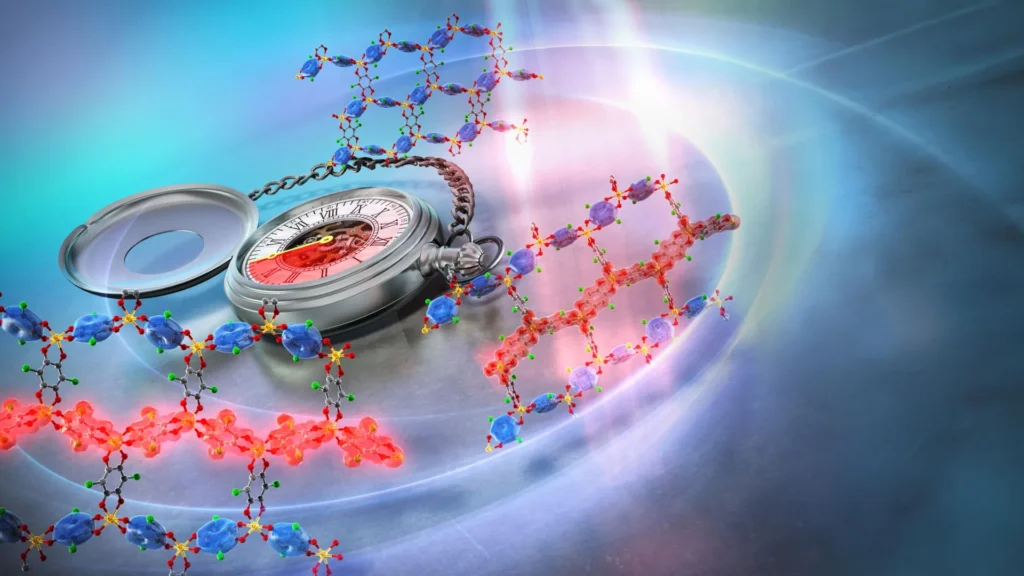
A collaborative research effort led by scientists from the Institute of Science Tokyo (Science Tokyo), Tohoku University, and the Nagoya Institute of Technology has achieved a significant breakthrough in the field of condensed matter physics. By utilizing advanced ultrafast laser spectroscopy, the team captured the precise moment a metal-organic framework (MOF) undergoes a dramatic electronic transformation, revealing a previously "hidden" intermediate state that exists for a mere 30 femtoseconds. This discovery, published in the prestigious journal Physical Review Letters, provides a foundational understanding of how light interacts with complex materials at the sub-atomic level, potentially paving the way for a new generation of light-controlled electronics and high-speed optoelectronic devices.
The study centered on the observation of photoinduced states—transient phases of matter that occur when a material absorbs photons. Unlike conventional states of matter, which are dictated by temperature, pressure, or chemical composition, photoinduced states allow materials to exhibit properties that are fundamentally different from their equilibrium conditions. The ability to manipulate these states has long been a "holy grail" for researchers seeking to develop materials that can be switched on or off with the speed of light. However, because these transformations occur on the femtosecond timescale—one quadrillionth of a second—observing the exact sequence of events has remained an immense technical challenge until now.
The Architecture of Metal-Organic Frameworks
Metal-organic frameworks, or MOFs, represent a unique class of porous crystalline materials composed of metal ions or clusters coordinated to organic ligands. Known for their high surface area and tunable structures, MOFs have traditionally been utilized for applications in gas storage, carbon capture, and catalysis. However, in recent years, their potential as "designer materials" for electronics has come to the forefront.
Because the properties of a MOF can be finely tuned by swapping different metal ions or organic molecules, they provide an ideal playground for investigating light-matter interactions. In this specific study, the researchers focused on a MOF characterized by its sensitive electronic structure. When light hits this material, it doesn’t just warm it up; it rearranges the electrons and the atomic lattice itself, creating a "hidden" state that does not exist under normal thermal conditions. Understanding the "pathway" to this state is critical for engineering materials that can utilize these transformations efficiently.
Achieving Sub-Decadal Femtosecond Resolution
To witness a process that completes in just 30 femtoseconds, the research team employed time-resolved reflectance spectroscopy. This technique involves hitting a sample with an "ultrashort" laser pulse (the pump) to trigger a change and then hitting it with a second pulse (the probe) to measure how the material’s light-reflecting properties have evolved.
The laser pulses used in this experiment were exceptionally brief, lasting only six femtoseconds. For context, a femtosecond is to a second what a second is to about 31.7 million years. This level of resolution allowed the team to essentially "film" the electronic movement within the MOF. Assistant Professor Tadahiko Ishikawa of Science Tokyo’s Department of Chemistry, alongside then-doctoral student Samiran Banu (now at RIKEN), observed that almost immediately after the laser pulse, the material’s reflectance spectrum shifted, signaling the emergence of a new optical absorption band. This was the signature of the photoinduced hidden state.
The Discovery of the Bond-Order Wave State
The most significant finding of the study was not just the final hidden state, but the discovery of a fleeting intermediate state that facilitates the transformation. By combining their experimental observations with sophisticated theoretical calculations provided by collaborators at Tohoku University and the Nagoya Institute of Technology, the team reconstructed the 30-femtosecond window of change.
The analysis revealed that before the material settles into its final photoinduced state, it briefly enters an intermediate electronic configuration known as a "bond-order wave" (BOW) state. In this phase, the electronic bonds between neighboring sites in the material’s lattice begin to alternate between stronger and weaker configurations in a repeating pattern. This BOW state represents a high-energy "stepping stone" that the electrons occupy before the atomic nuclei have time to move into their new positions.
"We found that the photoinduced hidden state forms within 30 fs through a previously unknown intermediate electronic state," Assistant Professor Ishikawa noted. "By revealing these intermediate states, our method could help design materials that can be efficiently controlled using light."
The Role of Atomic Movement and Polarity
While the initial change is purely electronic, the research showed that the transformation is completed by subtle structural shifts. Following the 30-femtosecond electronic pulse, the atoms within the MOF began to shift slightly in response to the new electronic environment. This lattice relaxation is what stabilizes the "hidden" state, making it last long enough to be utilized in a technological context.
Furthermore, the theoretical models suggested a property of immense interest to the semiconductor industry: the final photoinduced state may be polar. In a polar state, the distribution of positive and negative electrical charges is uneven across the material, creating a dipole moment. If researchers can reliably induce and control polarity using light pulses, it could lead to the development of ultrafast ferroelectric memory or light-driven transistors that operate at frequencies far beyond current silicon-based technology.
Collaborative Synergy and Theoretical Validation
The success of the project relied heavily on the synergy between experimental physics and theoretical chemistry. While the ultrafast lasers at Science Tokyo provided the raw data, the interpretation of that data required complex quantum mechanical simulations. Researchers at Tohoku University and the Nagoya Institute of Technology were instrumental in modeling the electron-phonon coupling—the interaction between electronic states and lattice vibrations—that governs how the MOF reacts to light.
This multi-institutional approach allowed the team to confirm that the observed spectral changes were indeed due to the bond-order wave state and not merely noise or secondary thermal effects. The alignment between the 6-femtosecond pulse data and the theoretical predictions provided a high degree of confidence in the existence of the intermediate phase.
Chronology of an Ultrafast Transformation
To understand the scale of the discovery, it is helpful to look at the timeline of the transformation as established by the research:
- 0 to 6 Femtoseconds: The MOF is struck by the initial "pump" laser pulse. The organic-metallic bonds absorb the energy, exciting the electrons.
- 6 to 15 Femtoseconds: The material enters the "Bond-Order Wave" state. Electrons reorganize into an alternating strength pattern across the lattice, but the atoms themselves have not yet moved.
- 15 to 30 Femtoseconds: The electronic shift forces the atomic nuclei to begin repositioning. This is the transition from a purely electronic state to a structural one.
- 30 Femtoseconds and Beyond: The "hidden" photoinduced state is fully formed. The material now exhibits new optical and potentially polar properties, distinct from its original state.
Implications for Future Technology and Material Science
The ability to observe and eventually control these fleeting moments has profound implications for the future of technology. As the demand for faster data processing grows, traditional electronic switching—which relies on the physical movement of electrons through a semiconductor—is reaching its physical limits. Light-driven switching, however, operates on a much faster scale.
The discovery of the intermediate BOW state provides a roadmap for "tuning" materials. If scientists know the specific intermediate steps required to reach a hidden state, they can modify the organic ligands or metal ions in a MOF to lower the energy barrier for that transition. This would make the light-induced switching more efficient, requiring less power and generating less heat.
Potential applications include:
- Optoelectronic Switching: Creating transistors that switch at petahertz (PHz) speeds, millions of times faster than current gigahertz (GHz) processors.
- Ultrafast Data Storage: Using light to flip the polarity of a material to store bits of data in femtoseconds.
- Quantum Computing: Manipulating quantum states in materials with precise laser pulses to maintain coherence.
- Energy-Efficient Sensors: Developing sensors that respond instantaneously to specific wavelengths of light by changing their electrical conductivity.
Conclusion and Next Steps
The work of the Japanese research team represents a landmark in the study of non-equilibrium dynamics. By capturing a 30-femtosecond transformation, they have pushed the boundaries of what is visible in the realm of material science. The identification of the bond-order wave state as a precursor to a hidden photoinduced state settles long-standing questions about the mechanism of light-induced phase transitions in metal-organic frameworks.
Moving forward, the researchers plan to apply this same experimental-theoretical framework to other classes of materials, including two-dimensional van der Waals materials and high-temperature superconductors. The goal is to build a comprehensive library of "intermediate states," allowing future engineers to design materials with the same precision that architects design buildings—only at the scale of atoms and the speed of light. As Assistant Professor Ishikawa concluded, exposing these previously invisible steps brings the scientific community one step closer to a future where light is the primary tool for controlling the behavior of the physical world.