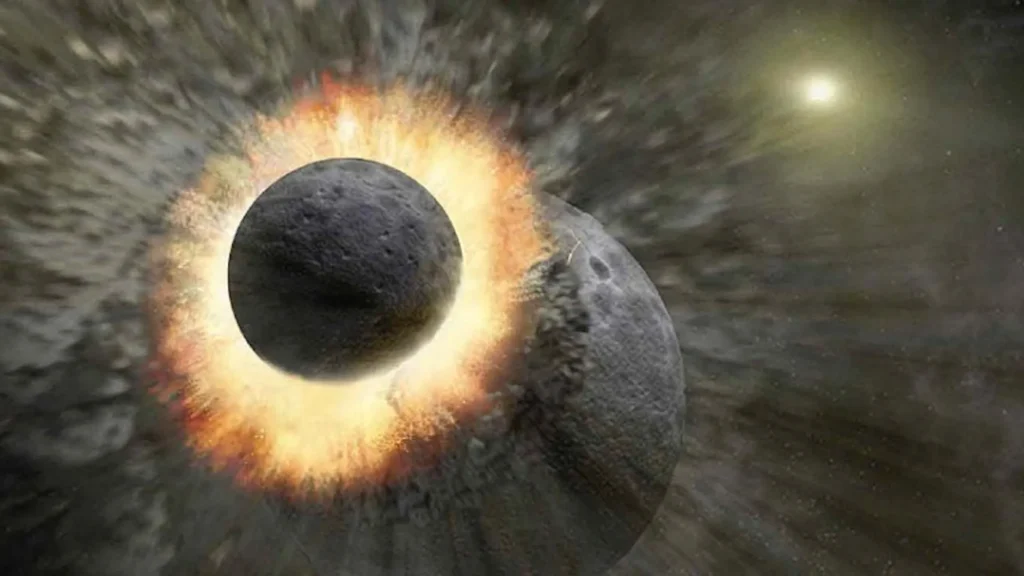
Earth boasts a moon of exceptional size relative to its host planet, a celestial anomaly within our solar system’s rocky planets. For decades, the precise mechanisms behind its formation have remained a profound enigma, a puzzle that scientists have tackled with increasingly sophisticated tools and theories. Now, a groundbreaking new study, spearheaded by researchers from the Southwest Research Institute (SwRI) and the University of Arizona, offers a compelling perspective: the physical strength and internal state of the colliding bodies may have been a far more significant factor than previously understood. This research, published in the esteemed journal The Astrophysical Journal Letters, introduces a critical element – material strength – into the simulations of the colossal impact event believed to have birthed our Moon, potentially reshaping our understanding of this pivotal moment in cosmic history.
For years, the prevailing scientific consensus has leaned towards the "Giant Impact Theory," a scenario positing a cataclysmic collision between the nascent Earth and a Mars-sized protoplanet, often referred to as Theia, approximately 4.5 billion years ago. This cataclysmic event, according to the theory, would have vaporized and ejected vast quantities of material from both celestial bodies, forming a swirling disk of debris around Earth. Over time, this debris coalesced under gravity to forge the Moon. Early simulations, including seminal work by Robin Canup, a renowned expert in planetary formation and vice president at SwRI’s Solar System Science and Exploration Division, and Erik Asphaug, a professor at the University of Arizona and co-author of the new study, provided a robust framework for this theory. However, these models operated under a crucial simplification: they treated the colliding rocky bodies as essentially fluid-like entities, assuming the sheer force of the impact would render their solid structures irrelevant.
The new research, however, challenges this long-held assumption by incorporating the concept of material strength, specifically the temperature-dependent geologic properties of the colliding protoplanets. Adeene Denton, a former postdoctoral researcher at the Lunar and Planetary Laboratory and now a scientist at SwRI, led the computational modeling effort. "We discovered that the preexisting geology of the Mars-sized proto-moon matters," Denton stated. "When you simulate the Earth and the Moon as colliding bodies with geologic properties, it changes how the Moon forms out of that impact – that’s something we considered unnecessary before." This paradigm shift is significant, as it suggests that the internal composition and structural integrity of Theia and early Earth were not merely passive participants but active agents in the Moon’s formation.
Revisiting the Giant Impact Theory with Enhanced Realism
The "Giant Impact Theory" has been the cornerstone of lunar formation hypotheses for several decades. The narrative paints a picture of a violent cosmic dance where Earth, still in its formative stages, was struck by a rogue celestial body roughly the size of Mars. This impact, estimated to have occurred around 4.5 billion years ago, during the Hadean Eon of Earth’s history, was not just a glancing blow but a world-shattering event. Theia, the impactor, is theorized to have been completely obliterated, its molten and vaporized remnants flung into orbit around Earth. These ejected materials, a chaotic soup of rock and metal, then began to clump together, gradually accreting into the Moon we observe today.
Early simulations, while instrumental in establishing the plausibility of this scenario, often simplified the complex physics involved. The immense energies unleashed during such a collision led scientists to assume that the rocky nature of the impacting bodies could be approximated as fluids. This simplification allowed for computationally tractable models but might have overlooked crucial nuances. The foundational research in 2001 by Canup and Asphaug, which laid much of the groundwork for the Giant Impact Theory, relied on these fluid dynamics approximations.
Denton and her colleagues, leveraging advancements in computational power and simulation techniques, decided to rigorously test the validity of this fluid approximation. They employed a sophisticated version of smoothed particle hydrodynamics (SPH) simulations, a method capable of modeling complex astrophysical phenomena. Crucially, their SPH model was enhanced to account for the material strength of the colliding bodies, allowing simulated planetary material to resist deformation in a manner more akin to real geological substances – the rocks and metals that would have constituted Theia and proto-Earth. "Because the collision was considered violent enough to melt and vaporize large portions of Earth and Theia, those previous papers assumed that it is okay to approximate them as fluids," explained Asphaug. "Based on our new results, however, we think that it is time to reconsider that."
The Critical Influence of Temperature and Material Strength
The inclusion of material strength proved to be a game-changer, revealing that the temperature of the colliding protoplanets played a pivotal role in determining the outcome of the impact. Hotter planetary bodies, the simulations demonstrated, are inherently weaker and more susceptible to deformation. This difference in mechanical strength between a hotter impactor and a potentially cooler Earth, or vice versa, could dramatically alter the trajectory of lunar formation.
The simulations yielded two striking scenarios. In one, the impact effectively shattered Theia, producing a diffuse, broad protolunar disk of debris surrounding Earth. This disk then, over extended periods, gravitationally assembled into the Moon. This outcome aligns with some interpretations of the Giant Impact Theory.
However, a more dramatic and unexpected result emerged under different simulated conditions. In these instances, the simulations depicted the formation of a substantial, seemingly intact Moon within a remarkably short timeframe – a matter of mere hours. This rapid formation of a nearly complete lunar body, rather than gradual accretion from debris, presents a compelling new perspective.
The implications of this rapid formation are profound, particularly concerning the timing of the Moon-forming event. Young protoplanets, including early Earth and Theia, are generally understood to have been significantly hotter than their more evolved counterparts. As they aged, they would have gradually cooled. The discovery that the initial temperature of the colliding bodies could dictate whether the Moon formed rapidly or slowly from debris provides a potential link between the Moon’s current properties and the thermal state of the early solar system.
"Depending on how hot the Earth and Moon are prior to the collision, the impact can destroy Theia and produce this massive disk of debris that eventually forms the Moon," Denton elaborated. "But when we used the same parameters as original impact modeling – down to the equal temperature structures inside both bodies – within around five hours, an intact moon emerged." This finding is particularly significant because previous simulations had also produced intact moons, but this new work is the first to demonstrably link this rapid formation to the interplay of material strength and temperature. It suggests that the geological conditions at the moment of impact could be the deciding factor in whether the Moon coalesces gradually from a disk or is born in a more singular, rapid event.
New Avenues for Understanding the Moon’s Birth and Evolution
The implications of these findings extend beyond simply refining the mechanics of the Giant Impact Theory. They open up new avenues for scientists to connect the Moon’s present-day characteristics with the specific physical conditions that prevailed in our solar system billions of years ago. Robin Canup, while not directly involved in this specific study, recognized the significance of the research. "These surprising and exciting new results imply a potential connection between the physical properties of the Moon today, including perhaps its volatile content, and the thermal state of the Earth and Theia at the time of the giant impact," Canup commented. "This in turn might help scientists better constrain when the moon-forming event occurred."
The timing of the Moon’s formation is a critical parameter for understanding the evolution of both the Earth-Moon system and the broader solar system. If the Moon formed rapidly, it suggests a specific set of thermal conditions existed at that time, potentially narrowing down the window for the impact event. Conversely, a slower formation from debris would point to a different set of initial conditions.
However, the new research, like its predecessors, does not definitively resolve one of the most persistent enigmas surrounding the Moon’s origin: its remarkably similar isotopic composition to Earth. The Giant Impact Theory, in its various iterations, has struggled to fully explain this isotopic parity. While Theia’s origin is still debated, it is generally thought to have formed in a different region of the solar system than Earth, which would suggest compositional differences.
Denton offered an analogy to illustrate this point: "Because Earth and Mars formed in the same neighborhood of the solar system, they are like siblings. The Moon and Earth are more like fraternal twins." This "fraternal twin" characteristic suggests a complex interplay of material mixing. One hypothesis is that both Earth and Theia accreted material from a similar region of the early solar system, leading to their compositional similarities. Mars, on the other hand, may have formed further afield, resulting in its distinct elemental makeup. The new simulations, by emphasizing the physical properties of the impactors, may indirectly shed light on this compositional puzzle by influencing the degree of mixing between Earth and Theia’s material.
A New Window into Planetary Science’s Greatest Mysteries
The study’s emphasis on the geophysical state of the colliding bodies offers a novel approach to tackling one of planetary science’s most enduring questions. By demonstrating that the internal conditions of Earth and Theia could profoundly influence the aftermath of their collision, researchers are provided with a more nuanced toolkit for investigating the Moon’s genesis.
Namya Baijal, a doctoral student in Erik Asphaug’s group and a co-author of the study, articulated this forward-looking perspective. "We now know that the geophysical state of Earth and Theia play a fundamental role in shaping the outcome of the collision," Baijal stated. "This gives us a new way to explore the conditions of the impact and what they might reveal about the Moon’s origin."
This research underscores the dynamic and complex nature of planetary formation. It highlights that even the most established theories may benefit from re-examination as our computational capabilities and theoretical understanding evolve. The incorporation of material strength into lunar formation models is not just an incremental improvement; it represents a significant conceptual leap that could unlock further insights into the chaotic and formative epochs of our solar system, ultimately bringing us closer to understanding our own celestial companion. The Moon, a constant presence in our night sky, continues to hold secrets, and this latest scientific endeavor has illuminated a previously overlooked pathway to unraveling its ancient origins.