A groundbreaking new study suggests that the shape of the universe may not be uniformly symmetric in every direction, but rather lopsided or asymmetric. This finding, published by a team of researchers, directly challenges the foundational assumptions of the standard cosmological model, which has served as the bedrock of our understanding of the cosmos for decades. The implications of an intrinsically asymmetric universe could necessitate a fundamental rethinking of cosmic dynamics and structure, potentially heralding a new era in astrophysics and theoretical physics.
The Standard Cosmological Model and Its Foundational Pillars
For much of the 20th and 21st centuries, the scientific community has operated under the "standard cosmological model," officially known as the Lambda-CDM (Lambda-Cold Dark Matter) model. This model provides a comprehensive framework for describing the universe’s evolution, its large-scale structure, and its dynamics, from the Big Bang to the present day. Central to the Lambda-CDM model are two fundamental assumptions, collectively known as the "cosmological principle": isotropy and homogeneity.
Isotropy posits that the universe looks the same in all directions when observed from any point. Homogeneity, on the other hand, suggests that the universe is uniform in composition and structure when averaged over sufficiently large scales. These assumptions are not merely theoretical conveniences; they are supported by compelling observational evidence, primarily from the Cosmic Microwave Background (CMB). The CMB is the relic radiation left over from the Big Bang, a faint glow pervading the entire universe, and it appears remarkably uniform across the sky to an astonishing precision of one part in a hundred thousand.
This observed uniformity of the CMB allowed cosmologists to model the universe using a "maximally symmetric" description of spacetime within Albert Einstein’s theory of general relativity. This symmetric vision, where the universe appears identical everywhere and in all directions, is encapsulated in the Friedmann-Lemaître-Robertson-Walker (FLRW) metric. The FLRW metric vastly simplifies the complex solutions of Einstein’s field equations, making the Lambda-CDM model mathematically tractable and observationally testable. Without the FLRW framework, deriving and testing cosmological theories would be immensely more complex, if not impossible with current mathematical tools.
Emerging Tensions and Anomalies in the Cosmic Fabric
Despite the elegance and success of the Lambda-CDM model, recent decades have seen the emergence of several "tensions" or disagreements in cosmological data that pose significant challenges to its completeness and underlying assumptions. These discrepancies hint at potential flaws or missing pieces in our current understanding of the universe.
One of the most widely debated of these issues is the Hubble Tension. Named after Edwin Hubble, who in 1929 famously discovered that the universe is expanding, this tension refers to a significant discrepancy in the measured rate of cosmic expansion. Measurements of the Hubble constant (H₀), which quantifies the expansion rate, yield different values depending on the method used. Early universe measurements, derived from the analysis of CMB anisotropies by missions like the Planck satellite, predict a lower expansion rate (around 67.4 km/s/Mpc). In contrast, local universe measurements, obtained from observing Type Ia supernovae and other cosmic distance ladders using telescopes like the Hubble Space Telescope (HST) and data from the Gaia satellite, consistently point to a higher expansion rate (around 73-74 km/s/Mpc). This persistent 8-10% difference has puzzled cosmologists for years, leading to extensive research into potential systematic errors or new physics beyond the standard model. While the Hubble tension challenges the precise parameters of the Lambda-CDM model, it doesn’t necessarily invalidate its fundamental assumptions of isotropy and homogeneity.
However, a more fundamental challenge, which has received comparatively less attention than the Hubble tension, is the cosmic dipole anomaly. This anomaly directly questions the very assumption of an isotropic universe.
Unpacking the Cosmic Dipole Anomaly: The Ellis-Baldwin Test
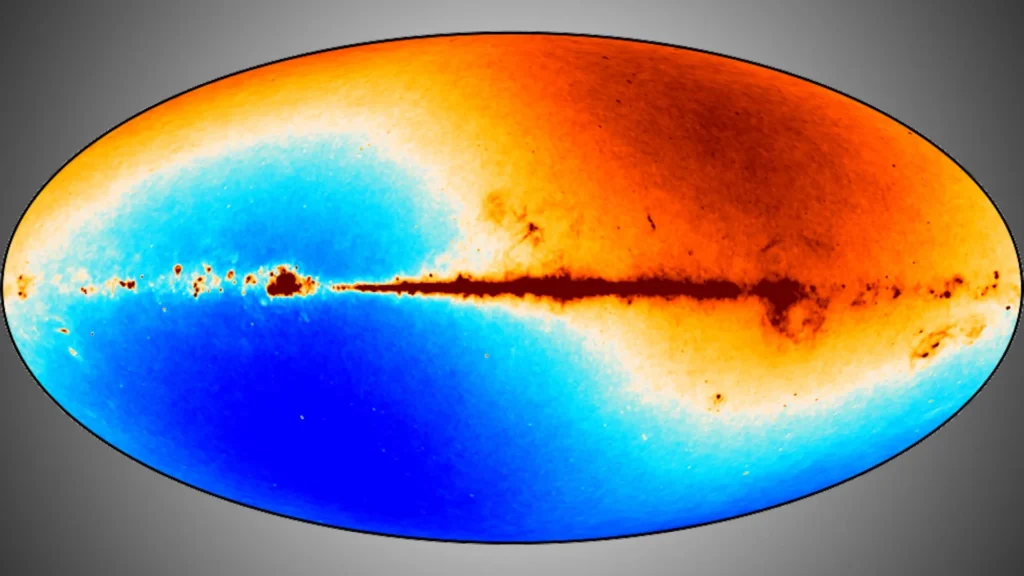
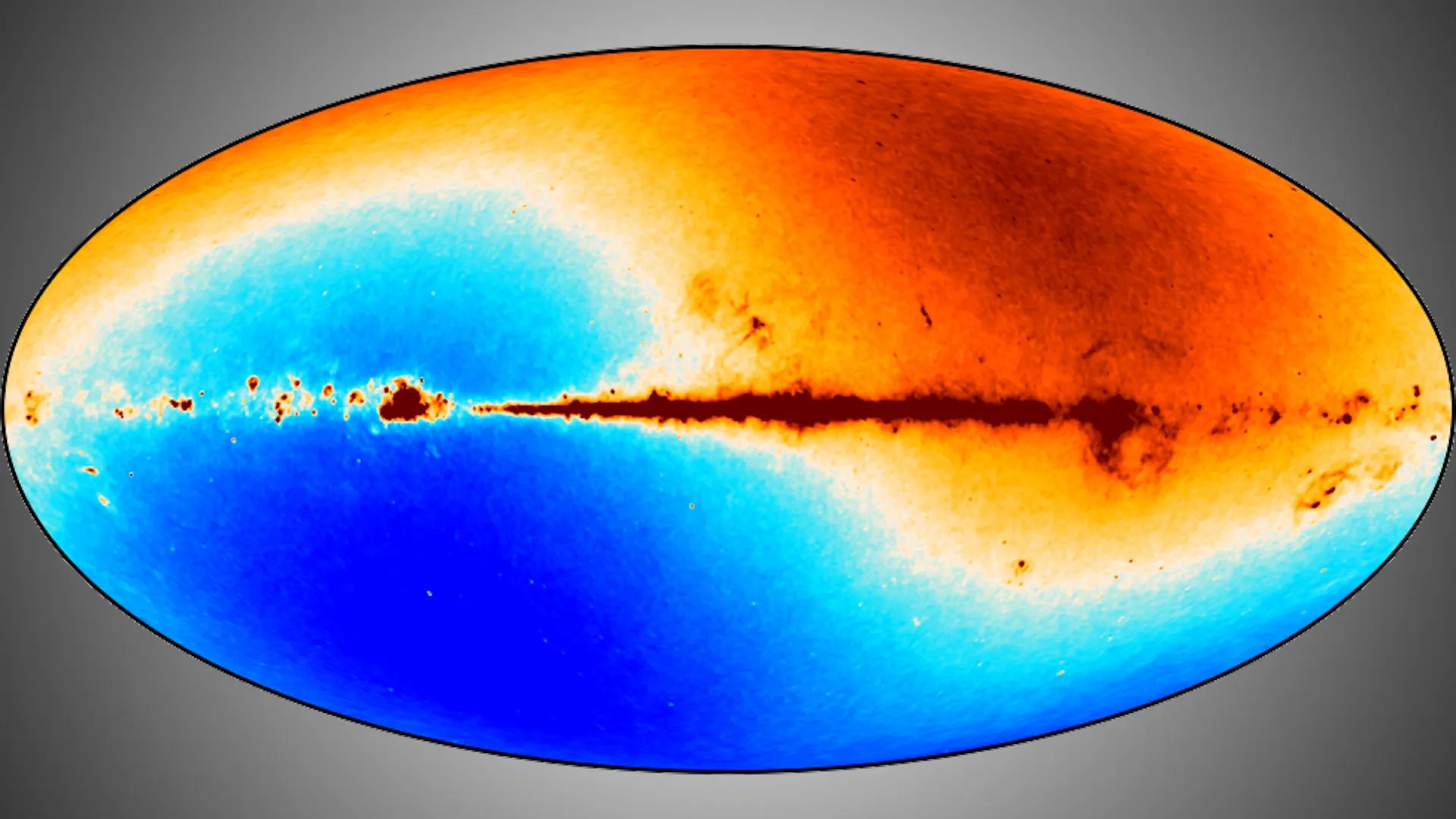
To understand the cosmic dipole anomaly, one must first revisit the CMB. While the CMB is overwhelmingly uniform, it does exhibit small variations. The most significant of these is the CMB dipole anisotropy. This phenomenon manifests as a slight temperature difference across the sky: one side appears marginally hotter, and the opposite side slightly cooler, by about one part in a thousand. This observed dipole is conventionally attributed to the peculiar motion of our Solar System relative to the CMB rest frame. As our galaxy, the Milky Way, and indeed our entire local group of galaxies, moves through space, we observe a Doppler shift in the CMB radiation, making it appear warmer in the direction of our motion and cooler in the opposite direction. Crucially, this kinematic explanation for the CMB dipole does not, in itself, challenge the Lambda-CDM model or the FLRW description, as it is understood to be a local effect rather than an intrinsic property of the universe’s large-scale structure.
However, the critical question arises: if this CMB dipole is purely due to our motion, then other astronomical observations of distant sources should exhibit a corresponding dipole anisotropy. This is where the concept of the Ellis-Baldwin test comes into play. In 1984, cosmologists George Ellis and John Baldwin posed the crucial question of whether a similar "dipole anisotropy" exists in the sky distribution of very distant astronomical sources, such as radio galaxies and quasars. The emphasis on "very distant" is paramount because nearby sources could create a spurious "clustering dipole" due to local gravitational inhomogeneities, which would not reflect the large-scale structure of the universe.
The premise of the Ellis-Baldwin test is straightforward: if the FLRW assumption of a symmetrical universe is correct, and the CMB dipole is indeed a kinematic effect caused by our motion, then the observed distribution of distant matter sources in the universe should exhibit a corresponding dipole, aligned with and quantitatively consistent with the CMB dipole. This means that if we are moving towards a "hotter" region of the CMB, we should also observe a slightly higher density of distant galaxies and quasars in that same direction, and a lower density in the opposite direction, due to relativistic effects on observed source counts and fluxes.
For decades, performing the Ellis-Baldwin test with sufficient precision was challenging due to the lack of comprehensive, all-sky catalogues of distant astronomical sources. The test demands extremely precise data across vast cosmic scales to distinguish genuine cosmological anisotropies from local fluctuations or observational biases.
The Universe Fails the Test: A Dire Challenge
The recent advent of advanced astronomical surveys and satellite missions has finally provided the necessary data catalogues to execute the Ellis-Baldwin test with unprecedented accuracy. The outcome, as highlighted by the new study, is profoundly significant: the universe appears to fail the Ellis-Baldwin test.
The variations observed in the distribution of distant matter sources do not match those predicted by the CMB dipole, under the assumption of a purely kinematic origin within an FLRW universe. Specifically, the magnitude and/or direction of the dipole observed in the distribution of radio galaxies, quasars, and other distant objects deviate significantly from what would be expected if our motion alone explained the CMB dipole. This discord is not a subtle hint but a direct challenge to the consistency of the standard model.
The robustness of this finding is bolstered by its reproducibility across different observational platforms and wavelengths. The same anomalous results have been obtained using terrestrial radio telescopes observing at radio wavelengths and satellites observing at mid-infrared wavelengths. This consistency across diverse instruments, which are susceptible to different types of systematic errors, significantly strengthens the confidence in the anomaly’s reality.
Implications: Rewriting the Cosmic Narrative
The cosmic dipole anomaly, therefore, stands as a major and perhaps the most fundamental challenge to the standard cosmological model. Unlike the Hubble tension, which might be resolved by tweaking parameters or introducing new, relatively minor physics (like early dark energy), the cosmic dipole anomaly directly questions the very foundation of the FLRW metric – the assumption of large-scale isotropy.
If the universe is indeed intrinsically asymmetric, meaning it does not look the same in all directions, then the entire mathematical framework of the FLRW metric becomes inadequate. This would imply that Einstein’s equations, as applied to the cosmos, require a more complex, anisotropic solution. Such a shift would necessitate abandoning not just the Lambda-CDM model as we know it, but potentially the FLRW description itself, effectively sending cosmologists "back to square one" in constructing a comprehensive model of the universe.
The scientific community’s response to this anomaly, as noted in the research, has been one of cautious observation, perhaps even a degree of reluctance to fully embrace its implications. This is understandable, given the monumental success and explanatory power of the Lambda-CDM model over several decades. Overturning such an established paradigm, especially one that underpins so much of modern physics, is not a decision taken lightly. It would require compelling, irrefutable evidence and a viable alternative framework.
The philosophical implications are equally profound. An anisotropic universe would challenge our intuitive understanding of cosmic homogeneity and potentially open doors to concepts previously considered speculative, such as preferred directions in space or a cosmic "axis." It would force a re-evaluation of the "cosmological principle," a cornerstone of modern cosmology that posits our location in the universe is not special.
The Road Ahead: A New Era of Discovery
Despite the daunting nature of this challenge, the future of cosmology is vibrant with potential. An avalanche of new data is anticipated from a new generation of observational facilities. Upcoming satellites like the European Space Agency’s Euclid mission, designed to map the large-scale structure of the universe, and NASA’s Spectro-Photometer for the History of the Universe, Epoch of Reionization, and Ices Explorer (SPHEREx), which will map the entire sky in near-infrared light, are set to provide unprecedented insights into cosmic evolution and distribution. Ground-based telescopes such as the Vera C. Rubin Observatory, with its Legacy Survey of Space and Time (LSST) producing a colossal dataset of the southern sky, and the Square Kilometre Array (SKA), the world’s largest radio telescope, will generate vast amounts of precise data on distant galaxies and quasars.
This unprecedented influx of information could be instrumental in either confirming the cosmic dipole anomaly with even greater certainty or revealing new physics that resolves it. Furthermore, the sheer volume and complexity of this data make it an ideal candidate for analysis using advanced computational techniques. Recent advances in artificial intelligence (AI), particularly machine learning algorithms, are poised to play a crucial role in sifting through these massive datasets, identifying subtle patterns, and potentially even aiding in the construction of new cosmological models that can accommodate such anomalies.
The impact of confirming an intrinsically asymmetric universe would be truly colossal, not only for fundamental physics but for humanity’s entire understanding of its place in the cosmos. It would compel a complete paradigm shift, potentially leading to a richer, albeit more complex, model of the universe – a universe that might be far more interesting and intricate than we have dared to imagine.