Spacecraft developers have long been constrained by the physical limitations of rocket fairings, forcing them to meticulously fold and package complex hardware in an origami-like fashion for launch. Once in orbit, these components undergo a delicate and intricate choreography of unfolding to reach their operational state. However, a pioneering startup based in Warsaw, Poland, is actively challenging these established paradigms. Orbital Matter is spearheading a groundbreaking approach by testing the feasibility of 3D-printing solar arrays and other critical components directly in space, a development that could fundamentally reshape the future of space infrastructure.
Replicator 2: A New Era of In-Orbit Manufacturing
In a significant stride towards this ambitious vision, Orbital Matter launched its Replicator 2 satellite in early July. This experimental spacecraft is equipped with four advanced 3D printers, a testament to the company’s commitment to in-space manufacturing. Two of these printers are currently engaged in generating 1-meter-long beams designed to support a small solar array. The successful execution of this demonstration is anticipated to validate the viability of 3D printing for fabricating substantially larger structures in orbit. Orbital Matter’s ultimate objective is to scale this technology to print beams capable of supporting expansive solar arrays measuring up to 100 meters in length and generating 100 kilowatts of power.
The company identifies its potential clientele as any entity requiring large-scale structural components for the deployment of solar arrays and other essential hardware in orbit. Jakub Stojek, CEO and co-founder of Orbital Matter, emphasized that this includes developers of orbital data centers, a rapidly growing sector that frequently envisions the deployment of solar arrays exceeding 100 meters in diameter. The demand for robust and scalable power generation in space is a critical driver for such innovations.
Early Successes and Technical Adjustments
As of early August, the Replicator 2 satellite had already achieved a significant milestone: one of its 3D printers successfully produced a rope-like strip of polymer. Robert Ihnatisin, Orbital Matter’s co-founder and chief technology officer, reported that this initial print yielded approximately enough material to form a 1-centimeter diameter cylinder. The engineering team is now meticulously analyzing this test print to identify necessary adjustments to the printer’s settings. For instance, they have already concluded that the printer head "over-extruded," meaning it dispensed more liquid polymer than optimal for a precise and robust print.
Before uploading any revised settings to Replicator 2’s onboard software, engineers conducted rigorous testing on a "flatsat" model at the company’s facility in Warsaw. This ground-based simulation allows for the validation of parameters in a controlled environment before committing to on-orbit adjustments. Plans are in place to resume on-orbit printing operations during the week of September 14th, Ihnatisin confirmed.
"By taking the printer into microgravity, there were some variables that we had to adjust for, which we expected, and that’s why we have four of them on board," Ihnatisin explained. The redundancy of having multiple printers is a strategic decision, allowing for parallel testing and the ability to adapt to unforeseen challenges in the unique conditions of space.
Expanding Capabilities and Future Demonstrations
Two of the four printers are specifically allocated for fine-tuning the printing parameters to accommodate the microgravity and vacuum conditions prevalent in space. By the end of September, one of these printers is slated to fabricate a 1-meter-long cylindrical beam. This component is intended to extend an antenna, representing a separate, yet equally important, test for a space services company. This demonstrates the versatility of Orbital Matter’s technology for diverse applications beyond just solar array support.
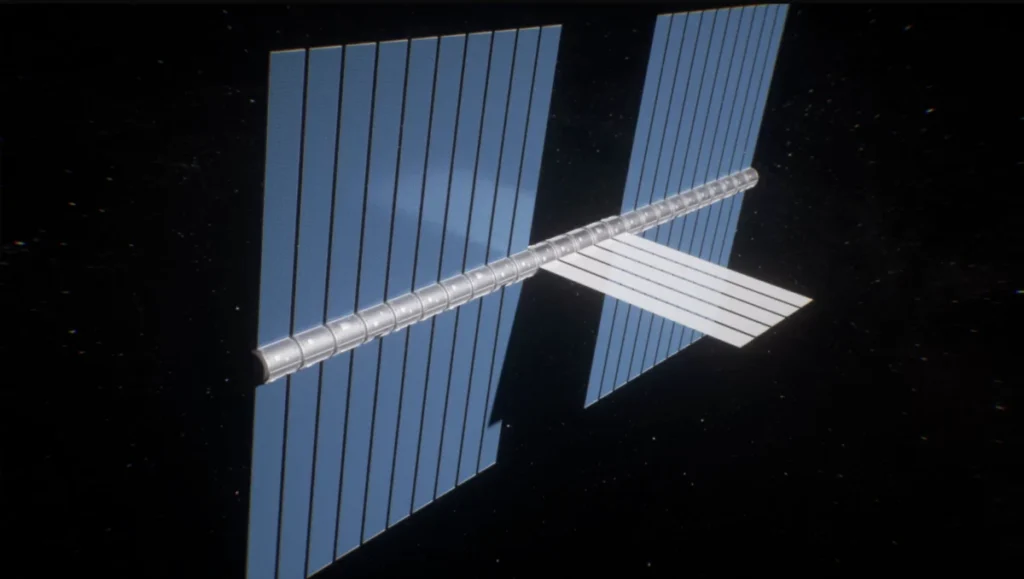
The company’s primary demonstration, involving the simultaneous printing of larger structural elements, is scheduled to resume by mid-October. During this phase, the remaining two printers will work in tandem to generate 1-meter-long beams. The printing process involves extruding a liquid polymer resin, which is then hardened by ultraviolet light. This material is deposited in a layered, coiled-rope-like fashion, gradually building a lengthening cylindrical structure.
Positioned strategically between these two printers are folded solar panels. As the beams are progressively printed and extended, these panels are designed to unfold in an accordion-like manner, ultimately forming a flat, functional solar array. This integrated approach showcases the potential for self-assembling and self-powering structures in orbit.
Rigorous Testing and Performance Analysis

Following the completion of the beam printing and solar array deployment, engineers will conduct extensive performance analysis. Onboard cameras will meticulously observe the twin beams, monitoring their expansion and contraction as they experience fluctuating temperatures from direct sunlight and Earth’s shadow. A critical aspect of this testing will be to assess the beams’ resilience to solar radiation over the satellite’s expected three-year lifespan.
"It’s basically how well the beam holds together," Ihnatisin stated, highlighting the focus on structural integrity and durability. In addition to structural assessments, engineers will also measure the power output of the solar panels over time. These panels, crucially, are constructed using readily available, off-the-shelf solar cells, further underscoring the practical and cost-effective nature of the proposed solution.
Orbital Matter is not resting on its current achievements. The company is already preparing a follow-up demonstration that envisions a satellite printing two 3-meter-long beams to deploy a 1-kilowatt solar array. The launch for this more ambitious demonstration is tentatively targeted for before the end of 2027, signaling a continuous progression in their technological development.
A Landmark Achievement in Space Manufacturing
If successful, the Replicator 2 demonstration will represent a significant milestone, marking the first publicly acknowledged instance of a 3D-printed structure being generated on orbit independently of a space station or capsule. Advenit Makaya, an advanced manufacturing engineer with the European Space Agency (ESA) in the Netherlands, commented on the potential impact of such a breakthrough. He noted that the future development of large-scale space structures will likely necessitate a synergistic combination of 3D printing and advanced robotic assembly techniques.
Makaya elaborated on the limitations of current deployment methods, describing the "deployable" approach, where structures unfold origami-style, as the long-standing workhorse for solar arrays, antennas, and telescopes. However, he cautioned that this method has inherent limitations: "Deployables will hit a certain ceiling. The limitation you have when you want to make large structures in space is the size of your rocket fairing." This is precisely the bottleneck that Orbital Matter’s in-space 3D printing technology aims to overcome.
Addressing the Demand for Larger Space Structures
Orbital Matter has indicated that it has a number of prospective customers, although the company has chosen not to disclose their identities at this stage. A particularly strong area of interest, according to Ihnatisin, lies in the capability to print beams capable of supporting solar panel structures exceeding 100 kilowatts. However, he stressed the prerequisite: "we need to demonstrate it first."
The company’s proactive approach in launching its own demonstration mission underscores a strategic response to industry skepticism. "The blocker has always been: ‘It sounds like a great technology, but we want to see it working first.’ That was the motivation behind doing our own launch," Ihnatisin articulated. This initiative aims to provide tangible proof of concept, paving the way for broader adoption and investment in in-space manufacturing technologies.
The implications of Orbital Matter’s work extend beyond just power generation. The ability to fabricate large, custom structures in orbit opens up possibilities for a wide range of applications, including the construction of orbital habitats, in-space servicing platforms, and even large scientific instruments that are currently too cumbersome to launch. The development represents a critical step towards a more self-sufficient and expansive presence in space, reducing reliance on Earth-based manufacturing and launch constraints.
The Broader Impact on Space Exploration and Commerce
The successful demonstration of in-space 3D printing by Orbital Matter could usher in a new era of space infrastructure development. By enabling the construction of larger and more complex structures directly in orbit, the technology could significantly reduce launch costs and timelines. This is particularly relevant for ambitious projects like lunar bases, Mars missions, and extensive satellite constellations.
Furthermore, the ability to manufacture components on demand in space could revolutionize space logistics and maintenance. Instead of relying on expensive and lengthy resupply missions, astronauts and robotic systems could potentially print replacement parts or even entirely new modules as needed. This capability would enhance the autonomy and sustainability of long-duration space missions.
The commercial implications are also profound. The growing space economy, encompassing satellite services, space tourism, and resource utilization, will increasingly demand robust and scalable infrastructure. Orbital Matter’s technology positions itself as a key enabler for these burgeoning industries, offering a pathway to overcome current limitations and unlock new opportunities for innovation and growth in Earth orbit and beyond. The ongoing testing and validation of Replicator 2 are being closely watched by industry experts and space agencies worldwide, as they hold the potential to redefine the boundaries of what is achievable in space.