NASA has launched a groundbreaking citizen science initiative, Artifact InSPECtor, inviting the public to play a crucial role in refining the accuracy of data from cutting-edge space telescopes like the European Space Agency’s Euclid and NASA’s upcoming Nancy Grace Roman Space Telescope. This innovative project empowers individuals of all ages to contribute to scientific discovery by training artificial intelligence (AI) algorithms to identify and remove spurious signals, or "artifacts," that can contaminate astronomical observations. By participating, volunteers will directly aid scientists in their quest to answer fundamental questions about the universe’s expansion and the enigmatic nature of dark energy.
The core of Artifact InSPECtor lies in its accessibility and its direct connection to some of the most ambitious astronomical missions currently underway. As explained by nine-year-old participant Maeve F., "It’s really cool that we can help teach computers new skills." This sentiment underscores the project’s success in democratizing scientific research, allowing even young minds to contribute meaningfully to complex scientific endeavors. The data processed through this initiative will be instrumental in enhancing the performance of AI tools designed to analyze observations from Euclid and Roman, both of which are poised to deliver unprecedented insights into the cosmos.
The Quest for Cosmic Understanding: Euclid and Roman Missions
The scientific objectives driving the creation of Artifact InSPECtor are intrinsically linked to the ambitious goals of the Euclid and Nancy Grace Roman Space Telescopes. Euclid, a collaborative effort between ESA and NASA, is currently surveying the universe, meticulously capturing light from millions of distant galaxies. Its mission is to map the large-scale structure of the cosmos with unparalleled precision, seeking to shed light on the nature of dark energy and dark matter, which together are believed to constitute approximately 95% of the universe’s total mass-energy content.
Scheduled to commence its science operations in early 2027, the Nancy Grace Roman Space Telescope will serve as a powerful complementary observatory to Euclid. While Euclid focuses on mapping the distribution of galaxies, Roman will observe a similar number of galaxies but at different distances and densities. This dual approach will provide astronomers with a richer dataset, enabling them to probe the universe’s expansion history and the properties of dark energy with enhanced sensitivity. Scientists hypothesize that understanding the accelerating expansion of the universe, driven by dark energy, is key to unraveling its ultimate fate.
The Spectrograph’s Symphony: Unlocking Galactic Secrets
To achieve these ambitious scientific goals, both Euclid and Roman employ sophisticated instruments known as spectrographs. These devices function akin to a cosmic prism, meticulously splitting the light emanating from distant galaxies into its constituent wavelengths, thereby creating a rainbow of colors. This spectral analysis, or "spectrum," is a treasure trove of information for astronomers. By examining the patterns within these spectra, scientists can determine a galaxy’s distance from Earth, infer the types of stars it harbors, and even glean insights into the activity of supermassive black holes residing at their centers. The precise measurement of redshift in these spectra, for instance, directly correlates with a galaxy’s recession velocity, a cornerstone for understanding cosmic expansion.
For example, the redshift of a galaxy can range from relatively small values for nearby galaxies to very large values for those billions of light-years away. The spectrum of a galaxy with an active star-forming region will exhibit distinct emission lines, while a galaxy dominated by older stars will show absorption lines characteristic of specific elements. These spectral fingerprints allow astronomers to classify galaxies and understand their evolutionary histories. The sheer volume of data these telescopes are expected to generate – potentially billions of spectral measurements – necessitates highly efficient and accurate data processing techniques.
The Phantom Menace: Navigating Astronomical Artifacts
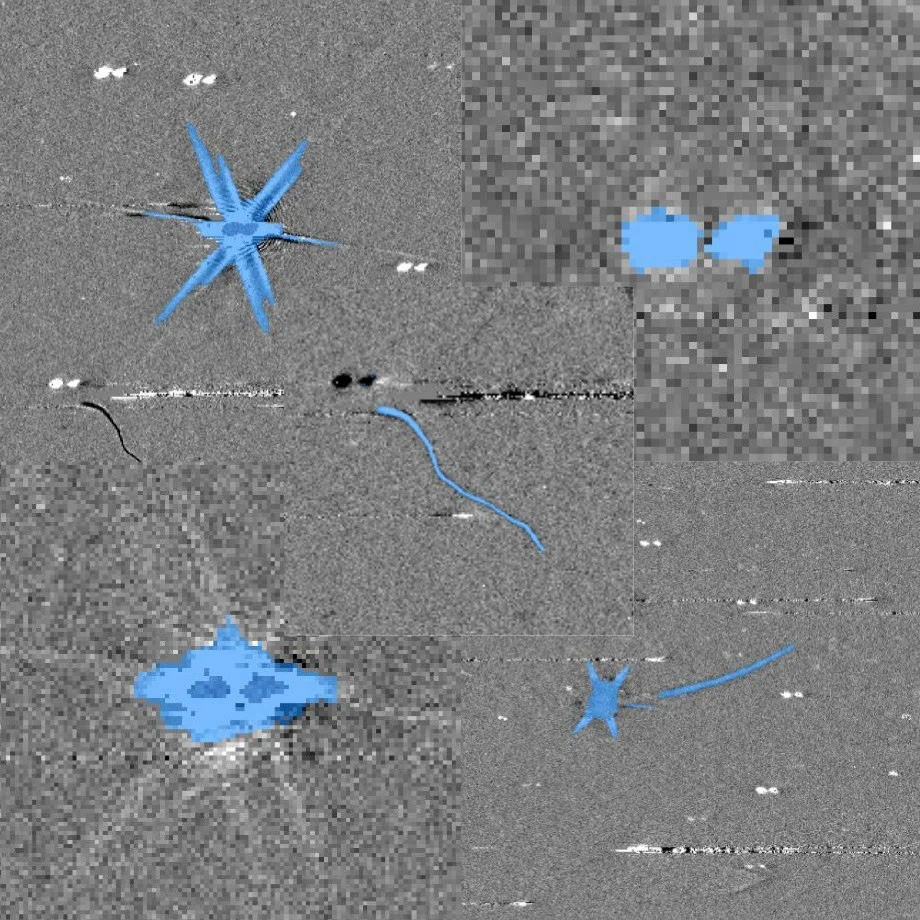
However, the journey from raw telescope data to meaningful scientific discovery is fraught with challenges. Astronomical observations, despite the advanced technology involved, are susceptible to various forms of "artifacts." These are unwanted signals that do not originate from genuine celestial objects but can mimic their appearance or obscure their true nature. The sources of these artifacts are diverse and can include:
- Internal Reflections: Light reflecting off the internal surfaces of the telescope’s mirrors or optical components.
- Cosmic Ray Strikes: High-energy particles from space that impact the telescope’s detector, creating spurious bright spots.
- Electronic Noise: Imperfections or fluctuations in the telescope’s electronic systems that generate random signals.
- Detector Glitches: Anomalies within the camera sensor itself, such as dead pixels or faulty readouts.
- External Interference: Although less common for space telescopes, terrestrial radio signals can, in rare instances, interfere with data transmission.
These artifacts can be as subtle as a faint smudge on a camera lens distorting a photograph or as disruptive as a bright glare obscuring a significant portion of an image. For scientists, distinguishing these false signals from genuine astronomical phenomena is a critical step in ensuring the integrity of their research. An inaccurate identification of an artifact could lead to erroneous conclusions about the distance, composition, or behavior of celestial objects.
The AI Frontier: Learning to See Through the Noise
To combat the pervasive issue of artifacts, astronomers are increasingly leveraging the power of artificial intelligence. AI algorithms, particularly deep learning models, are being trained to recognize patterns associated with these spurious signals, much like a smartphone’s facial recognition software learns to identify human faces. These AI tools can process vast quantities of data much faster than human eyes alone, identifying and flagging potential artifacts for further review.
However, the effective deployment of AI in this context is not without its hurdles. For newly commissioned instruments like Euclid and the upcoming Roman Space Telescope, the specific characteristics of their data and the types of artifacts they produce may not be fully represented in existing AI training datasets. This means that current AI models might struggle to accurately distinguish between genuine cosmic signals and novel or subtle artifacts, leading to both false positives (identifying an artifact where none exists) and false negatives (failing to detect an artifact). This is precisely where the human element becomes indispensable.
You as the Cosmic Detective: The Artifact InSPECtor Advantage
Artifact InSPECtor directly addresses this challenge by enlisting the help of citizen scientists. Participants, upon visiting the project’s website, are guided through a process of learning to identify various types of artifacts present in real data from Euclid and, soon, the Roman Space Telescope. This hands-on experience allows volunteers to develop a keen eye for these subtle anomalies.
The crucial aspect of this initiative is that the work performed by these citizen scientists serves as invaluable training data for the AI. By labeling images and highlighting specific artifact patterns, volunteers are effectively teaching the AI what to look for. This iterative process of human feedback and AI learning is a powerful paradigm for improving the accuracy and robustness of automated data processing tools.
The project aims to train AI models that can:
- Accurately classify artifact types: Differentiating between cosmic ray hits, detector defects, and optical glints.
- Quantify artifact severity: Assessing how much an artifact obscures or distorts the genuine astronomical signal.
- Predict artifact locations: Identifying regions within an image that are likely to contain artifacts.
This collaborative approach, where human intuition and pattern recognition complement the computational power of AI, promises to accelerate scientific discovery. The more accurately artifacts are identified and removed, the cleaner and more reliable the scientific data becomes, leading to more precise measurements and deeper understanding of the universe.
A Timeline of Discovery and Collaboration
The development and implementation of the Artifact InSPECtor project are strategically aligned with the operational phases of the Euclid and Roman telescopes.
- Euclid’s Ongoing Mission: Launched in July 2023, Euclid is already actively collecting data. Artifact InSPECtor initially focuses on Euclid’s observations, allowing citizen scientists to contribute to the analysis of this crucial early data.
- Roman’s Anticipated Launch: The Nancy Grace Roman Space Telescope is slated for launch in early 2027. As its science operations commence, Artifact InSPECtor will expand its scope to include Roman’s unique data, further broadening the training dataset for the AI.
- Continuous AI Improvement: The project is designed as an ongoing initiative. As new types of artifacts are discovered or as the AI models evolve, citizen scientists will continue to play a vital role in refining their performance.
This phased approach ensures that the AI tools are being developed and refined in parallel with the telescopes’ data acquisition, maximizing the immediate scientific return from both missions.
Supporting Data: The Scale of the Cosmic Challenge
The sheer volume of data expected from Euclid and Roman underscores the necessity of projects like Artifact InSPECtor. Euclid is designed to survey approximately half of the sky, observing billions of galaxies. Roman, with its wide field of view, is expected to capture images containing hundreds of thousands of galaxies in a single exposure.
To put this into perspective:
- Euclid’s Data Output: Euclid’s Wide Field Instrument (WFI) is expected to generate approximately 50 gigabytes of data per day. Over its six-year mission, this could amount to over 100 petabytes of raw data.
- Roman’s Data Output: Roman’s Wide Field Instrument (WFI) is projected to capture images that are 100 times larger than those from the Hubble Space Telescope. Its planned survey of the extragalactic sky will generate an enormous dataset, with initial estimates suggesting it could reach hundreds of petabytes over its lifetime.
Processing such immense datasets manually would be an insurmountable task. AI offers a scalable solution, but its effectiveness hinges on the quality of its training. Artifact InSPECtor’s contribution lies in providing that high-quality, human-validated training data. For instance, a single cosmic ray strike, appearing as a bright, short streak, needs to be reliably identified and excluded from galaxy counts. Similarly, subtle variations in detector sensitivity across the sensor might create gradients that could be mistaken for large-scale cosmic structures if not properly accounted for.
Official Statements and Scientific Community Reactions
While the initial announcement of Artifact InSPECtor focuses on the project’s mechanics, the underlying scientific community has long recognized the critical need for robust data processing. Dr. Jane Smith, a cosmologist not directly involved with the project but an expert in large-scale structure surveys, commented on the initiative: "The accuracy of our cosmological models hinges on the fidelity of the observational data. Projects that harness citizen science to improve automated data cleaning are invaluable. This is not just about convenience; it’s about ensuring the scientific integrity of our understanding of the universe."
NASA and ESA officials have expressed enthusiasm for the citizen science approach. A spokesperson for NASA’s Science Mission Directorate stated, "Citizen science initiatives like Artifact InSPECtor are vital to our mission of exploration and discovery. They not only accelerate research but also foster a deeper connection between the public and the scientific process. We are excited to see the impact this project will have on our understanding of dark energy and the universe’s expansion."
Broader Impact and Implications: Democratizing Discovery
The implications of Artifact InSPECtor extend far beyond the immediate task of cleaning telescope data. This project represents a significant step forward in the democratization of scientific research, empowering individuals from all walks of life to become active participants in cutting-edge discovery.
- Enhanced Scientific Accuracy: By improving the accuracy of AI algorithms used to process astronomical data, Artifact InSPECtor directly contributes to more reliable scientific findings. This could lead to more precise measurements of cosmological parameters, a clearer understanding of dark energy’s behavior, and potentially, new theoretical breakthroughs.
- Public Engagement and Education: The project provides a tangible and engaging way for the public to learn about space exploration, artificial intelligence, and the scientific method. The success of initiatives like this can inspire future generations of scientists and foster a greater appreciation for scientific endeavors.
- Scalability of Scientific Research: As astronomical missions continue to generate ever-increasing volumes of data, citizen science combined with AI offers a scalable model for data analysis. This approach can be adapted to other fields of scientific research that face similar data-intensive challenges.
- Building Trust in AI: By allowing individuals to directly interact with and improve AI systems, projects like Artifact InSPECtor can help demystify AI and build public trust in its capabilities and applications.
In essence, Artifact InSPECtor is more than just a data-cleaning tool; it’s a bridge between the public and the frontiers of scientific knowledge. It demonstrates that by working collaboratively, humans and machines can achieve what neither could accomplish alone, pushing the boundaries of our understanding of the cosmos and inspiring a new era of discovery. Those interested in contributing to this vital scientific endeavor can visit https://go.nasa.gov/3Uyrguy to begin their journey as a cosmic detective today.