American Rheinmetall, the United States-based subsidiary of the formidable German defense industrial group Rheinmetall AG, has been awarded a significant $7.28 million contract to furnish the U.S. Marine Corps with a fleet of cutting-edge autonomous ground vehicles. This strategic procurement marks a pivotal step in the Marine Corps’ ongoing modernization efforts, particularly in advancing its capabilities for autonomous logistics and expeditionary mobility in complex operational environments.
The comprehensive contract mandates the manufacturing and delivery of 12 Mission Master SP Autonomous Unmanned Ground Vehicles (A-UGVs), alongside five specialized amphibious kits, associated Marine Kits, and an array of essential supporting equipment. These sophisticated systems are poised to play a crucial role in the Marine Corps’ intensive testing and evaluation programs, designed to rigorously assess the efficacy and integration of autonomous technologies within its operational framework. The Defense Logistics Agency (DLA) is overseeing the procurement process, with ADS Inc., a prominent military equipment supplier, serving as the prime contractor. The deployed equipment will directly bolster the U.S. Marine Corps Warfighting Laboratory’s operational evaluations and broader capability development initiatives, which are central to shaping the future of Marine expeditionary forces.
The Mission Master SP: An Advanced Autonomous Platform
The Mission Master SP A-UGVs represent the zenith of Rheinmetall’s autonomous ground vehicle development to date, incorporating the most advanced configuration the company has engineered. At the heart of each Mission Master SP is Rheinmetall’s proprietary PATH autonomy system, a sophisticated technological core that empowers military vehicles to execute complex tasks with minimal human intervention. This advanced system facilitates autonomous navigation, obstacle avoidance, and mission execution, significantly reducing the cognitive and physical load on human operators while enhancing operational efficiency.
The latest iteration of the Mission Master SP benefits from over four years of iterative development and rigorous testing conducted in close collaboration with the U.S. Marine Corps. This extensive partnership has allowed Rheinmetall to integrate invaluable real-world feedback directly into the vehicle’s design and functionality, ensuring it meets the stringent demands of Marine operations. Key enhancements in this configuration include improved vehicle capabilities, a robust architecture supporting the seamless integration of diverse mission payloads, and, critically, specialized amphibious kits.
Amphibious Capabilities: A Game Changer for Littoral Operations
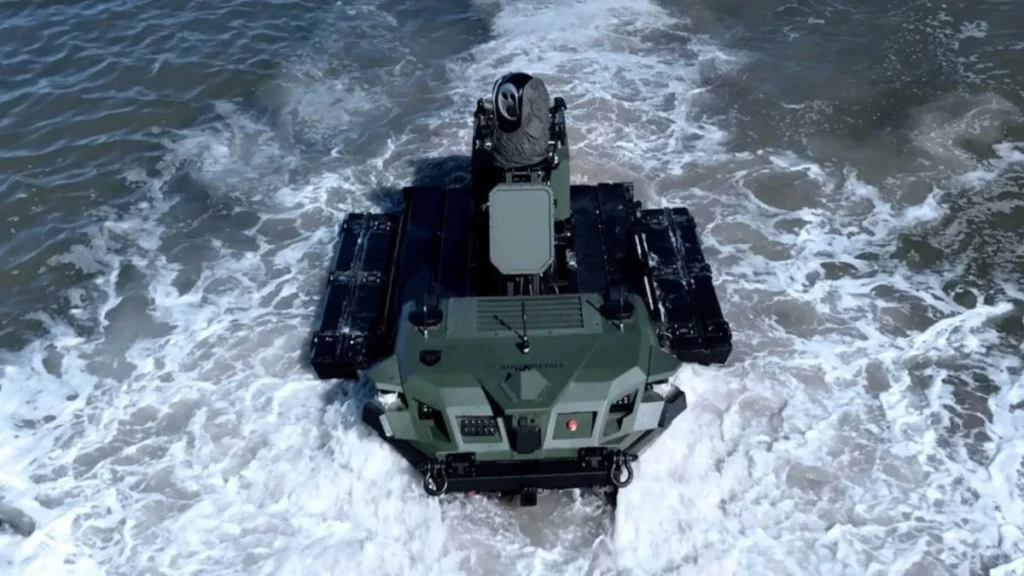
A defining feature of this contract is the inclusion of five amphibious kits, which will grant the Mission Master SP A-UGVs unparalleled operational flexibility across aquatic and coastal environments. This amphibious capability is particularly pertinent to the U.S. Marine Corps, whose strategic doctrine increasingly emphasizes littoral warfare, distributed maritime operations, and Expeditionary Advanced Base Operations (EABO). In such scenarios, the ability to transition effortlessly between land and water—moving personnel, equipment, and vital supplies between ships, contested beaches, and inland positions—is not merely an advantage but a fundamental necessity.
The integration of amphibious capabilities into the Mission Master SP directly addresses one of the most persistent and hazardous challenges of expeditionary missions: logistics in contested littoral zones. By enabling autonomous resupply operations across diverse domains, these A-UGVs can perform critical logistical tasks without exposing Marines to every dangerous facet of a resupply mission. This not only enhances force protection but also significantly improves mobility and extends the operational reach of both crewed and uncrewed units, offering a resilient solution for maintaining logistical lifelines in complex, distributed battlefield environments.
Strategic Imperative: The US Marine Corps’ Vision for Autonomy
The acquisition of the Mission Master SP vehicles is a direct reflection of the U.S. Marine Corps’ profound strategic shift encapsulated in its Force Design 2030 initiative. This transformative blueprint aims to reorient the Corps from its traditional emphasis on land-based operations to a lighter, more agile, and technologically advanced force capable of operating effectively within the Indo-Pacific region’s vast maritime and littoral expanse. Central to Force Design 2030 is the concept of distributed operations, where small, highly mobile units operate across a wide geographic area, often with limited logistical support and under constant threat.
In this context, autonomous logistics becomes not just a capability enhancer but an operational imperative. Traditional supply chains are vulnerable to interdiction in contested environments, posing significant risks to personnel and mission success. A-UGVs like the Mission Master SP offer a compelling solution by providing resilient, stealthy, and risk-mitigating options for delivering essential supplies, ammunition, and medical aid. They reduce the reliance on vulnerable manned convoys, lower the logistical footprint, and free up Marines from routine, dangerous resupply tasks, allowing them to focus on core combat missions.
The Marine Corps Warfighting Laboratory, which will be utilizing these vehicles, serves as the primary conduit for experimenting with and developing new warfighting concepts and capabilities. Its efforts with the Mission Master SP will focus on understanding how unmanned vehicles can best integrate into existing and future operational schemes, particularly in supporting EABO, where Marines operate from temporary, dispersed bases across islands and coastal areas. This involves rigorous testing of vehicle performance, human-machine teaming protocols, and the overall impact on combat effectiveness and survivability.
A Long-Standing Partnership and Future Trajectory
The contract underscores a robust and evolving partnership between Rheinmetall and the U.S. Marine Corps. Matt Warnick, CEO of American Rheinmetall, emphasized the significance of this collaboration: “This award represents a significant milestone in our long-standing partnership with the United States Marine Corps. For more than four years, we have worked side-by-side with Marines to mature, refine, and advance autonomous ground capabilities. The Mission Master SP captures the full breadth of those lessons learned and showcases Rheinmetall’s commitment to delivering cutting-edge, reliable, and mission-ready autonomous systems.”
Pietro Mazzei, President and CEO of Rheinmetall Canada, further highlighted the collaborative spirit within the Rheinmetall group, stating, “This collaboration between Rheinmetall colleagues enables the U.S. Marine Corps to deploy the Mission Master SP in the most advanced configuration to date. The addition of an amphibious capability marks a significant milestone in ensuring that our system meets the evolving demands of littoral and expeditionary operations.” This internal synergy between American Rheinmetall, leading the program, and Rheinmetall Canada, serving as the original equipment manufacturer (OEM), exemplifies a unified approach to delivering advanced defense solutions.
Beyond the immediate delivery of vehicles and kits, the contract encompasses a comprehensive support package. Rheinmetall will provide extensive supporting equipment, program management, specialized training for Marine personnel, ongoing capability development support, and essential engineering services. This holistic approach ensures that the Marine Corps is not just receiving hardware but a fully integrated solution supported by expert guidance and continuous innovation. The vehicles will undergo further experimentation as the Marine Corps continues to explore the optimal deployment and integration of autonomous systems within its distributed forces concept.
Broader Context: The Global Rise of Military Robotics
The U.S. Marine Corps’ investment in the Mission Master SP is indicative of a broader global trend towards the integration of autonomous systems into military operations. Nations worldwide are increasingly recognizing the strategic advantages offered by robotics and artificial intelligence in enhancing force protection, extending operational reach, and improving logistical efficiency. The global market for military unmanned ground vehicles (UGVs) is projected to experience substantial growth in the coming years, driven by advancements in AI, sensor technology, and battery life, alongside evolving geopolitical landscapes that demand more flexible and resilient military capabilities.
Major defense powers are allocating significant resources to research and develop robotic combat vehicles (RCVs), autonomous logistics platforms, and unmanned systems for reconnaissance and security. The U.S. Army, for instance, has several programs dedicated to exploring RCVs for manned-unmanned teaming operations, aiming to reduce human exposure to direct combat and enhance lethality. The Marine Corps’ focus on autonomous logistics with the Mission Master SP aligns perfectly with this overarching strategic imperative to leverage technology to gain a decisive edge in future conflicts.
Ethical considerations surrounding autonomous weapon systems remain a critical aspect of this development. However, the Mission Master SP, primarily a logistics and support platform, falls within the domain of semi-autonomous systems designed to reduce risk to human operators rather than replace them in lethal decision-making. Its role in resupply and reconnaissance emphasizes the force-multiplier and force-protection aspects of robotic technology.
Implications for Future Warfare and Logistics
The successful integration and deployment of the Mission Master SP A-UGVs could herald a transformative shift in Marine Corps operations. For logistics, it offers the potential to create truly resilient supply chains in contested environments, reducing the "tyranny of distance" and the vulnerability of manned convoys. This means fewer Marines exposed to ambushes, IEDs, and other threats inherent in logistics operations, ultimately saving lives and preserving combat power.
From an operational standpoint, these autonomous systems can enhance expeditionary mobility by scouting routes, carrying heavy loads across difficult terrain, and providing persistent surveillance, thereby extending the operational reach and endurance of Marine units. The ability to integrate different mission payloads also means the Mission Master SP can adapt to various roles, from carrying medical supplies to deploying sensors for enhanced situational awareness, making it a versatile asset in a commander’s toolkit.
Looking ahead, this program also supports Rheinmetall’s longer-term strategic ambition to expand its autonomous vehicle manufacturing footprint within the United States. The company intends to establish a dedicated autonomous systems hub focused on production, integration, and future vehicle development. This localized investment would not only strengthen the domestic defense industrial base but also foster further innovation and collaboration with U.S. military branches.
In essence, the contract for the Mission Master SP provides the U.S. Marine Corps with a crucial platform for extensive experimentation. These trials will be instrumental in shaping how the service deploys autonomous ground systems during future coastal and battlefield operations, paving the way for a more agile, resilient, and technologically advanced force capable of meeting the complex challenges of 21st-century warfare. The Mission Master SP is not just a vehicle; it is a testament to a future where autonomy plays an increasingly critical role in safeguarding personnel and ensuring mission success.