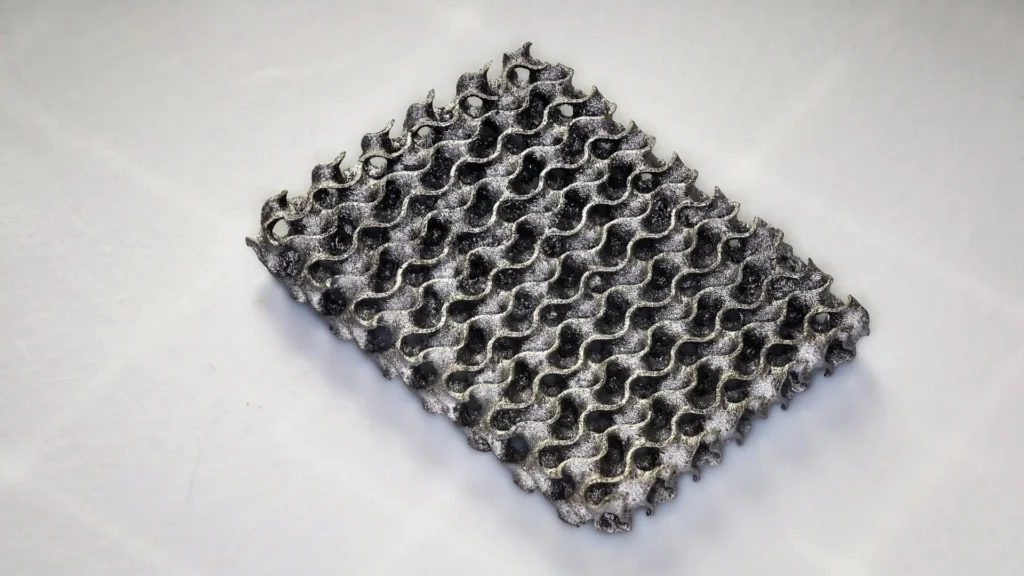
A groundbreaking advancement in additive manufacturing has emerged from the École Polytechnique Fédérale de Lausanne (EPFL), promising to overcome significant limitations in the production of high-quality metal and ceramic components. Researchers at EPFL’s School of Engineering, led by Daryl Yee, have developed a novel method that allows for the creation of dense, strong, and precisely shaped metal and ceramic objects using a readily accessible 3D printing process. This innovative technique, detailed in the latest issue of Advanced Materials, diverges from traditional photopolymerization methods by decoupling the printing of the structural framework from the introduction of the final material.
Historically, vat photopolymerization, a prevalent 3D printing technology, has relied on the selective solidification of light-sensitive liquid resins. While this method excels at producing intricate geometries, its utility has been constrained by the inherent properties of photopolymers, which often yield materials lacking the robustness required for demanding applications. Previous attempts to imbue these printed polymer structures with metallic or ceramic properties have often resulted in porous materials with significantly reduced strength and substantial shrinkage, leading to undesirable warping and dimensional inaccuracies. These challenges have hindered the widespread adoption of 3D printing for high-performance metal and ceramic parts.
The research team at EPFL, recognizing these persistent drawbacks, embarked on a mission to develop a more effective solution. Their approach, as outlined in their publication, fundamentally rethinks the material deposition and transformation stages of 3D printing. Instead of attempting to print a resin already pre-loaded with metal compounds, which often leads to uneven distribution and compromised structural integrity, Yee and his colleagues first construct a scaffold using a simple, water-based gel known as a hydrogel. This hydrogel acts as a precise blueprint, accurately capturing the desired three-dimensional architecture.
Following the initial printing of the hydrogel framework, the "blank" structure undergoes a transformative process. It is immersed in solutions containing metal salts. Through a carefully controlled chemical conversion, these salts are transformed into incredibly fine, metal-containing nanoparticles. These nanoparticles are not merely deposited on the surface but are encouraged to spread throughout the entire volume of the hydrogel matrix. This iterative “growth cycle” is repeated multiple times. Each cycle enhances the density and metal content of the composite structure, progressively building towards the final desired material composition. This meticulous, multi-step infusion and conversion process is key to achieving the high metal loading that underpins the strength and integrity of the resulting components.
"Our work not only enables the fabrication of high-quality metals and ceramics with an accessible, low-cost 3D printing process; it also highlights a new paradigm in additive manufacturing where material selection occurs after 3D printing, rather than before," Daryl Yee, head of the Laboratory for the Chemistry of Materials and Manufacturing at EPFL, commented on the significance of their findings. This paradigm shift, he explained, offers unprecedented flexibility and control over the final material properties.
A New Paradigm in Additive Manufacturing
The innovative methodology employed by Yee and his team offers a distinct advantage over existing techniques. By printing a stable, non-reactive hydrogel template first, the researchers can ensure exceptional dimensional accuracy from the outset. The subsequent infiltration with metal salts and their controlled conversion allows for a uniform distribution of the desired material throughout the printed structure. This contrasts sharply with methods that attempt to print pre-mixed resins, where the filler particles can settle or clump, leading to inconsistencies.
After a typical series of 5 to 10 of these "growth cycles," the hydrogel scaffolding, having served its purpose in defining the precise shape, is carefully removed. This is achieved through a controlled heating process, which evaporates the water and any residual organic components, leaving behind a dense, solid object composed entirely of the metal or ceramic material. The final product is a robust component that meticulously replicates the intricate geometry of the initial hydrogel print.
A particularly compelling aspect of this new approach is its inherent versatility. Because the metal salts are introduced after the printing of the hydrogel template, a single printed hydrogel structure can be used to produce a wide array of different materials. By simply changing the type of metal salt solution used during the immersion process, researchers can fabricate objects from various metals, ceramics, or even complex composite materials, all from the same initial printed form. This flexibility significantly broadens the potential applications and reduces the need for specialized printing equipment for each different material.
Targeting Advanced 3D Architectures
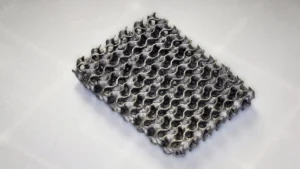
To showcase the capabilities of their revolutionary technique, the EPFL team focused on fabricating intricate mathematical lattice structures known as gyroids. These complex, triply periodic minimal surfaces are renowned for their high surface area to volume ratio and their exceptional mechanical properties. The researchers successfully produced gyroids out of iron, silver, and copper, demonstrating the technique’s ability to create robust yet complex geometries.
The strength of these newly fabricated materials was rigorously tested using a universal testing machine, a standard device for evaluating the mechanical performance of materials. The gyroids were subjected to increasing amounts of pressure until they failed. The results were striking.
"Our materials could withstand 20 times more pressure compared to those produced with previous methods, while exhibiting only 20% shrinkage versus 60-90%," stated Yiming Ji, a PhD student and the first author of the study. This dramatic improvement in both strength and dimensional stability addresses the core challenges that have historically plagued metal and ceramic 3D printing. The minimal shrinkage is a critical factor for manufacturing precision parts, where even slight deformations can render a component unusable.
The implications of this breakthrough are far-reaching, particularly for the fabrication of advanced 3D architectures. Such architectures are increasingly in demand for applications requiring a simultaneous combination of strength, lightweight properties, and intricate complexity. Examples include:
- Sensors: Highly porous or precisely patterned metallic structures can enhance sensor sensitivity and response times.
- Biomedical Devices: Implants and prosthetics that require both biocompatibility and mechanical integrity, where complex internal structures can promote bone ingrowth.
- Energy Conversion and Storage Devices: Components for batteries, fuel cells, and catalysts, where large surface areas and controlled porosity are crucial for efficiency. For instance, metal catalysts are fundamental to numerous electrochemical reactions that enable the conversion of chemical energy into electricity. The ability to create high-surface-area metal structures with advanced cooling properties is also vital for next-generation energy technologies.
The EPFL team’s work opens doors to the design and manufacture of components that were previously unattainable with existing 3D printing technologies. The ability to precisely control the internal structure at a nanoscale level, combined with the high mechanical performance, suggests a future where custom-designed materials with tailored properties can be manufactured on demand.
Future Directions and Industrial Adoption
While the current findings represent a significant leap forward, the researchers are already focused on further refining their process to facilitate broader industrial adoption. A primary goal is to further increase the density of the fabricated materials, pushing the boundaries of what is achievable in terms of material performance.
Another key area of development is speed. The iterative nature of the infusion and growth cycles, while essential for achieving high material density, currently makes the process more time-consuming compared to some other 3D printing techniques. To address this, the team is actively exploring ways to optimize these steps.
"We are already working on bringing the total processing time down by using a robot to automate these steps," Daryl Yee confirmed. Automation of the repetitive infusion and washing stages is expected to significantly streamline the manufacturing workflow, making the technology more competitive with existing industrial processes. This strategic focus on efficiency and scalability is crucial for transitioning this laboratory innovation into a commercially viable manufacturing solution.
The potential impact on industries that rely on advanced materials, such as aerospace, automotive, and electronics, cannot be overstated. The ability to rapidly prototype and produce complex metal and ceramic parts with superior performance characteristics could lead to lighter, stronger, and more efficient products. Furthermore, the decentralized manufacturing capabilities offered by 3D printing, combined with this new material fabrication method, could revolutionize supply chains and enable on-demand production of critical components.
The research was supported by the Swiss National Science Foundation and the European Research Council, underscoring the significant interest and investment in advancing additive manufacturing capabilities. As the EPFL team continues to push the boundaries of what is possible in 3D printing, their hydrogel-based approach is poised to redefine the landscape of metal and ceramic component manufacturing, paving the way for a new era of innovation and technological advancement.