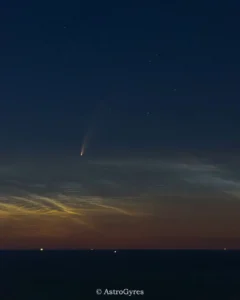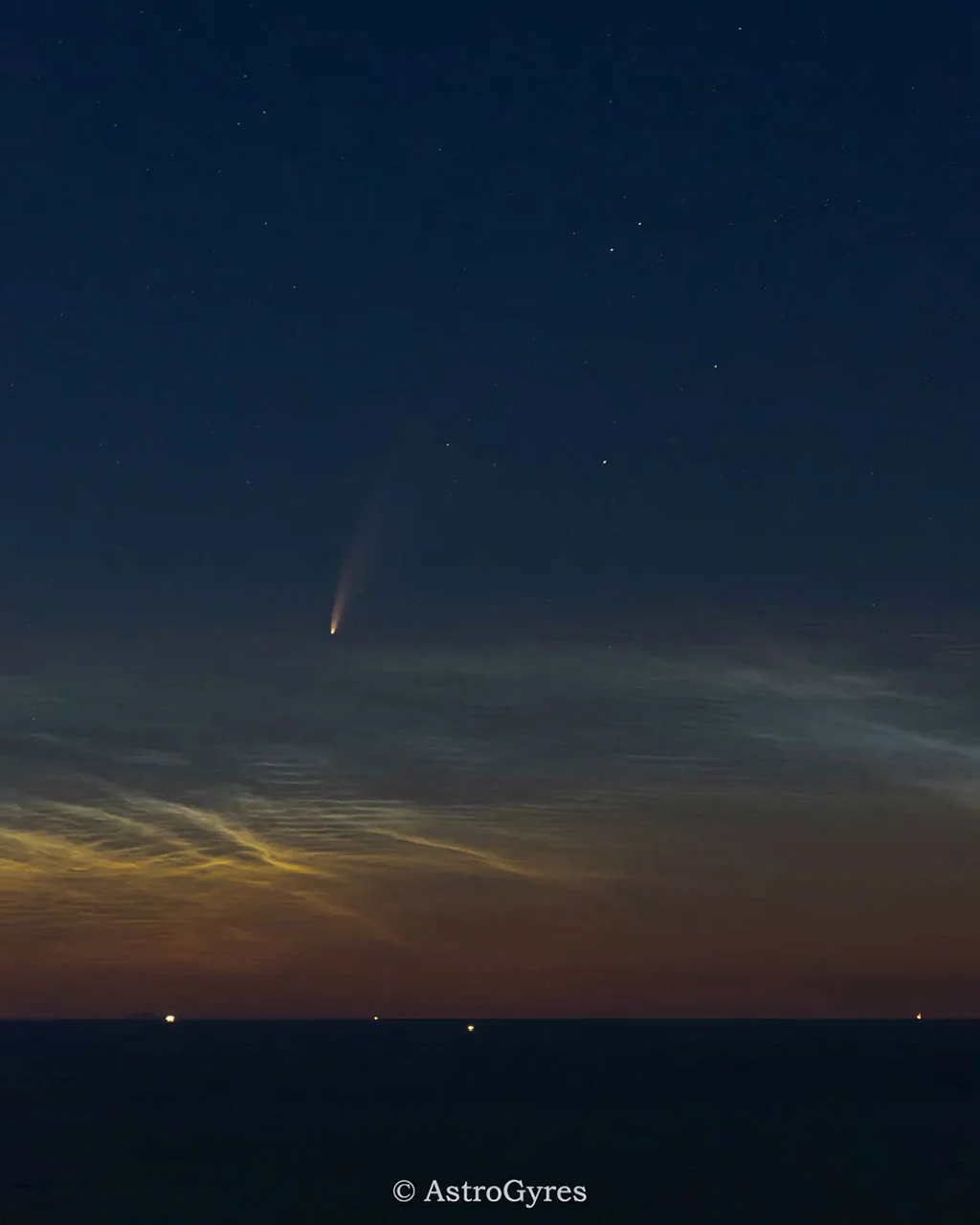
The celestial spectacle of Comet C/2020 F3 (NEOWISE) gracing the pre-dawn skies over the Adriatic Sea, captured in a breathtaking time-lapse video, offers a profound glimpse into the transient beauty of our solar system. This extraordinary astronomical event, which unfolded in the early hours of July 8, 2020, provided a rare opportunity for skygazers across the Northern Hemisphere to witness a comet visible to the unaided eye – a phenomenon seldom seen in the current century. The featured video, meticulously compiled from over 240 individual images taken over a 30-minute period by photographer Paolo Girotti from Italy, immortalizes the comet’s majestic ascent above the shimmering waters of the Adriatic, set against a backdrop of distant stars and ethereal noctilucent clouds.
A Celestial Visitor Emerges
Comet C/2020 F3 (NEOWISE) was discovered on March 27, 2020, by the Near-Earth Object Wide-field Infrared Survey Explorer (NEOWISE) mission. Initially appearing as a faint smudge in the infrared spectrum, it gradually brightened as it approached the Sun. Its trajectory brought it closer to Earth than any comet had in over two decades, culminating in its closest approach to the Sun on July 3, 2020, at a distance of approximately 27 million miles (43 million kilometers). This proximity to the Sun caused the comet’s ice to sublimate, releasing gas and dust that formed its characteristic coma and tail.
The "Great Comet of 2020," as it was affectionately dubbed, was a remarkable sight due to its brightness and visibility to the naked eye. For over a month, it remained a prominent celestial object, delighting amateur astronomers and the general public alike. Its visibility was particularly impressive in the Northern Hemisphere, where it could be observed in the evening sky after sunset and, as captured in Girotti’s stunning footage, in the pre-dawn hours.
The Making of an Iconic Image
Paolo Girotti’s photograph captures Comet NEOWISE at a pivotal moment of its visibility. The image showcases the comet emerging from behind the horizon, its luminous tail stretching upwards. The foreground is illuminated by the soft glow of noctilucent clouds, wispy, high-altitude clouds that appear to shimmer with an otherworldly light. These clouds, formed from ice crystals at altitudes of around 50 miles (80 kilometers), are typically visible during the summer months in mid-latitude regions and are a testament to the dynamic atmospheric processes occurring above our planet.
The time-lapse video adds another dimension to the experience, illustrating the subtle yet continuous movement of the comet as it ascends. The compilation of hundreds of images taken over 30 minutes provides a sense of the celestial dance, with the comet appearing to gracefully rise above the Adriatic Sea. This technique, often referred to as "stacking," not only enhances the visual impact but also helps to reduce noise and bring out finer details in the comet’s structure.
Scientific Insights from Comet NEOWISE
Comet NEOWISE’s nucleus, estimated to be approximately five kilometers (about three miles) in diameter, is a remnant from the formation of the solar system, roughly 4.6 billion years ago. As it journeyed through the inner solar system, the intense solar radiation caused its volatile materials to vaporize, creating the spectacular visual display. Scientists were able to study two distinct tails: a dust tail, composed of small particles ejected from the nucleus, which curves gently away from the Sun due to solar radiation pressure, and an ion tail, made of charged particles swept away by the solar wind, which points directly away from the Sun.
The unexpectedly sustained brightness of Comet NEOWISE provided astronomers with a valuable opportunity to gather data on cometary composition and behavior. Studying these icy bodies offers crucial insights into the early conditions of our solar system, as they are essentially pristine remnants from the protoplanetary disk.
Broader Context and Significance
The visibility of Comet NEOWISE was a significant event for public engagement with astronomy. In a time often dominated by screens and digital interactions, the comet offered a tangible, awe-inspiring connection to the vastness of the universe. Its passage served as a reminder of the dynamic and ever-changing nature of our cosmic neighborhood.
Furthermore, the comet’s appearance spurred a surge of interest in astrophotography. Enthusiasts worldwide, from seasoned professionals to budding photographers, turned their lenses towards the sky, sharing their images and experiences online. This collective effort not only documented the comet’s journey but also fostered a global community of stargazers.
The "Great Comet" appellation is not bestowed lightly. It typically refers to comets that become exceptionally bright and visible to the naked eye for an extended period, often appearing spectacular in the night sky. Comet NEOWISE certainly lived up to this designation, joining the ranks of historically significant comets like Hale-Bopp (1997) and Hyakutake (1996).
Supporting Data and Astronomical Context
- Comet Designation: C/2020 F3 (NEOWISE)
- Discovery Date: March 27, 2020
- Discovery Instrument: NEOWISE (Near-Earth Object Wide-field Infrared Survey Explorer)
- Nucleus Diameter: Approximately 5 kilometers (3 miles)
- Closest Approach to the Sun (Perihelion): July 3, 2020, at ~27 million miles (43 million km)
- Closest Approach to Earth: July 23, 2020, at ~64 million miles (103 million km)
- Orbital Period: Estimated to be around 6,765 years, indicating a long-period comet.
The visual phenomenon of noctilucent clouds, which frame Comet NEOWISE in Girotti’s capture, occurs in the mesosphere, the third layer of Earth’s atmosphere. They are the highest clouds in our atmosphere and are only visible during twilight when the Sun is below the horizon but still illuminates these high-altitude ice crystals. Their presence adds a layer of atmospheric beauty to the celestial event, highlighting the interconnectedness of phenomena both in space and within our own planet’s atmosphere.
Official Recognition and Continued Exploration
NASA’s Astronomy Picture of the Day (APOD) program, which has been showcasing stunning astronomical images since 1995, frequently features remarkable celestial events. The inclusion of Paolo Girotti’s video on APOD underscores the significance and aesthetic appeal of Comet NEOWISE’s appearance. The program, a collaborative effort between NASA, the American Astronomical Society (AAS), and Michigan Technological University, aims to educate and inspire the public about the wonders of the universe.
The APOD website, which has recently transitioned its main presence from apod.nasa.gov to science.nasa.gov/apod, continues to serve as a vital resource for astronomical imagery and explanations. The consistent presentation of such events by APOD reinforces the ongoing scientific endeavor to understand our universe and share its marvels with a global audience.
Future Implications and Legacy
The study of comets like NEOWISE contributes to our understanding of planetary formation, the delivery of water and organic molecules to early Earth, and the potential for future asteroidal or cometary impacts. While Comet NEOWISE has now receded into the outer solar system, its legacy persists through the countless images and videos captured by astronomers and enthusiasts. These records serve not only as a testament to a spectacular celestial event but also as valuable data for ongoing scientific research.
The fact that Comet NEOWISE was visible to the naked eye for an extended period is a testament to its inherent brightness and its orbital path that brought it into a favorable viewing position for Earth-bound observers. Such comets are rare, and their appearances often mark significant moments in the collective astronomical consciousness. The enduring impact of Comet NEOWISE lies in its ability to spark wonder, inspire curiosity, and remind us of the immense, beautiful, and dynamic universe we inhabit. The video from the Adriatic Sea, with its captivating blend of cometary brilliance and atmospheric artistry, stands as a poignant reminder of these fleeting cosmic encounters.