Motion Index Drives (MID) has introduced advanced high-speed cam-driven indexing solutions, including the RTX350 rotary index table and high-speed precision link conveyors, specifically engineered to enhance throughput and accuracy within the burgeoning electric vehicle (EV) battery manufacturing sector. These cutting-edge systems are designed to provide unparalleled positioning precision and significantly reduce index times, thereby facilitating faster, more reliable, and highly automated assembly processes critical for the next generation of electric vehicles. This strategic development by Motion Index Drives positions the company at the forefront of providing essential automation infrastructure to meet the escalating global demand for EV batteries, addressing critical needs for efficiency, quality, and scalability in a rapidly evolving industrial landscape.
The Crucial Role of Advanced Automation in EV Battery Production
The global transition towards electric vehicles represents one of the most significant industrial shifts of the 21st century. At the heart of this revolution lies the EV battery, a complex and highly engineered component whose manufacturing process demands extraordinary levels of precision, speed, and repeatability. Unlike traditional internal combustion engine components, EV batteries, particularly lithium-ion variants, involve the assembly of numerous delicate cells into modules, and then into large packs, each step requiring meticulous handling and exact placement. Any deviation in the assembly process can compromise battery performance, safety, and longevity, making automated assembly not just an advantage, but an absolute necessity.
The demand for EV batteries is surging exponentially. According to recent market analyses, the global EV battery market size, valued at approximately $49.0 billion in 2022, is projected to reach an astounding $559.8 billion by 2032, exhibiting a compound annual growth rate (CAGR) of 27.6% from 2023 to 2032. This explosive growth necessitates a parallel advancement in manufacturing capabilities, pushing original equipment manufacturers (OEMs) and their suppliers to invest heavily in state-of-the-art automation. Factories, often referred to as "Gigafactories," are scaling up production to unprecedented levels, requiring automation solutions that can not only handle high volumes but also maintain stringent quality control standards. This is where specialized equipment like those offered by Motion Index Drives becomes indispensable.
Motion Index Drives’ Core Offerings: Precision and Speed Defined
Motion Index Drives’ latest contributions to EV battery manufacturing automation focus on two primary product categories: high-speed cam-driven indexing solutions, epitomized by the RTX350 rotary index table, and high-speed precision link conveyors. Both systems are foundational to efficient automated assembly lines.
-
Cam-Driven Indexing Technology: At the core of MID’s solutions is their proprietary cam-driven indexing technology. Cam mechanisms are renowned in industrial automation for their inherent precision, rigidity, and smooth motion profiles. Unlike servo-driven systems that can exhibit slight positional variations due to feedback loop latency or backlash, well-engineered cam systems provide deterministic, repeatable motion with exceptional accuracy, often down to microns. This precision is critical when assembling battery cells, where electrode alignment, separator placement, and subsequent welding operations require micron-level tolerances to prevent short circuits or degradation in performance. The robust mechanical linkage of cam drives also ensures durability and consistent performance over millions of cycles, reducing maintenance downtime and increasing overall equipment effectiveness (OEE).
-
The RTX350 Rotary Index Table: The RTX350 rotary index table is a prime example of MID’s commitment to high-performance automation. Rotary index tables are workhorses in assembly operations, designed to move parts or fixtures to various workstations in a precisely controlled, intermittent motion. The "350" in its designation likely refers to a specific size or load capacity, indicating its suitability for handling significant components or multiple fixtures simultaneously. In EV battery manufacturing, such tables are vital for processes like:

- Cell Loading and Unloading: Accurately positioning battery cells for subsequent processes like stacking or welding.
- Module Assembly: Indexing battery modules through stations for busbar attachment, thermal management component integration, or wiring.
- Quality Inspection: Presenting modules or packs to vision systems or testing equipment at precise intervals.
The high-speed capability of the RTX350 means faster cycle times per station, directly translating to higher overall production throughput. Its exceptional positioning precision ensures that each operation is performed exactly where and when it should be, minimizing errors and scrap rates—a significant cost saving in high-value battery production.
-
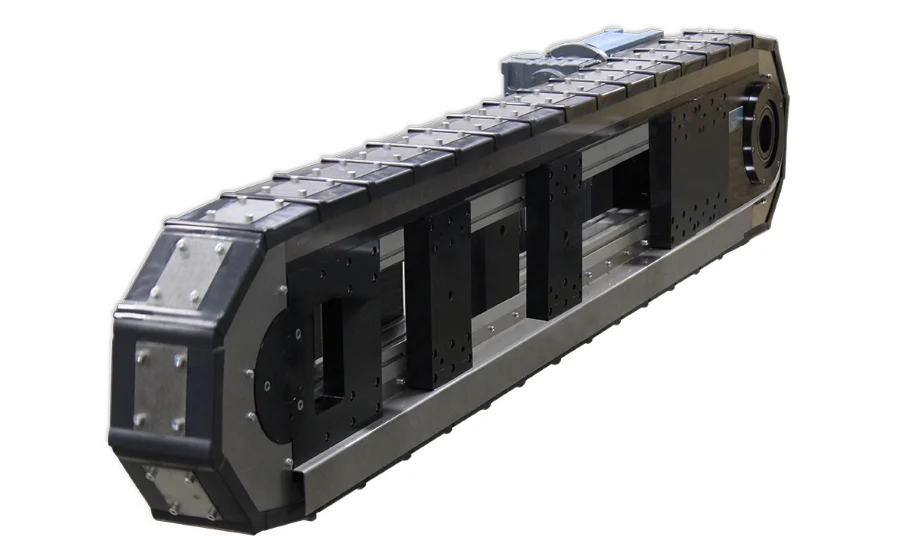
High-Speed Precision Link Conveyors: Complementing the rotary index tables are Motion Index Drives’ high-speed precision link conveyors. These systems are specifically designed for continuous, high-speed, and synchronous movement of products or work-in-progress through an assembly line. Unlike standard belt or roller conveyors, precision link conveyors utilize a series of mechanically linked segments, often driven by a precision chain or cam system, to ensure absolute positional accuracy at each stop or processing point along the line. This synchronized movement is crucial for:
- Sequential Assembly: Moving battery cells, modules, or even entire battery packs through a series of automated workstations, such as adhesive application, ultrasonic welding, laser welding, or vision inspection.
- Process Integration: Seamlessly integrating different automated machines and robotic work cells, ensuring that components arrive at each station in the correct orientation and at the exact time needed for synchronized operations.
- Heavy-Duty Material Handling: While the example image shows a heavy-duty pallet conveyor, the "precision link" aspect implies a focus on accurate indexing and smooth transport, even for substantial loads like partially assembled battery packs.
The "high-speed" attribute ensures that the overall line velocity can match the demanding production targets of Gigafactories, while "precision" guarantees that the quality and integrity of the delicate battery components are maintained throughout the assembly journey.
The Intricacies of EV Battery Assembly and Automation Needs
Manufacturing an EV battery pack is a multi-stage, intricate process that requires a symphony of automation technologies. It typically begins with individual cell production, followed by cell-to-module assembly, and finally module-to-pack integration.
-
Cell Assembly: Individual battery cells (cylindrical, pouch, or prismatic) are the fundamental building blocks. Their assembly involves precise electrode stacking, separator insertion, electrolyte filling, and sealing. While cell manufacturing often involves highly specialized equipment, the subsequent handling and grouping of these cells for module creation requires extremely gentle yet precise automation. Misalignment or damage at this stage can lead to reduced capacity, thermal runaway risks, or even catastrophic failure.
-
Module Assembly: This stage involves arranging multiple cells into a module, connecting them electrically, integrating busbars, and incorporating thermal management components (cooling plates, sensors). Precision indexing and conveying systems are paramount here. For instance, cells must be precisely spaced and presented for laser welding of busbars, an operation that demands exact alignment to ensure robust electrical connections without damaging the cell casing. The RTX350 rotary index table could be used to present a fixture holding multiple cells to a robotic welding station, while precision link conveyors move completed modules to the next stage.
-
Pack Assembly: Finally, multiple modules are integrated into a complete battery pack, along with a Battery Management System (BMS), thermal management system, and structural components. This stage involves handling heavier sub-assemblies and requires robust, yet still precise, material handling. Large precision link conveyors are ideal for moving these heavy packs through stations for wiring harness installation, BMS integration, lid sealing, and final testing. The high-speed aspect becomes critical as pack production volumes scale.
The specific demands include:
- Thermal Management: The integration of cooling systems is vital to prevent overheating. Automation must precisely place and secure cooling plates and tubes.
- Electrical Connections: Spot welding, laser welding, and crimping of busbars and wiring harnesses require highly accurate positioning and repeatable force application.
- Weight and Size: Battery packs can be very large and heavy, necessitating robust conveyor and indexing systems that maintain precision under load.
- Safety: Lithium-ion batteries pose inherent safety risks (fire, explosion) if mishandled or improperly assembled. Automation minimizes human interaction with potentially hazardous materials and ensures consistent, safe assembly practices.
Market Trends and the Strategic Importance of Motion Index Drives’ Innovation
The introduction of specialized solutions by Motion Index Drives aligns perfectly with several overarching trends in industrial automation and the EV sector:

- Industry 4.0 and Smart Manufacturing: These systems contribute to the vision of smart factories by enabling highly automated, interconnected, and data-driven production lines. The precision and repeatability of cam-driven systems allow for more predictable processes, which can be monitored and optimized using real-time data analytics, reducing waste and improving efficiency.
- Localization of Battery Production: With geopolitical shifts and supply chain vulnerabilities highlighted in recent years, many countries are pushing for localized EV battery production (e.g., in North America and Europe). This necessitates the rapid establishment of new manufacturing facilities, all of which will require advanced automation to be globally competitive. Companies like Motion Index Drives are critical enablers for this localization effort.
- Demand for Higher Energy Density and Faster Charging: As EV technology evolves, there’s a constant push for batteries with greater energy density (longer range) and faster charging capabilities. This often means more complex cell chemistries and tighter manufacturing tolerances, further elevating the need for ultra-precise assembly automation.
- Cost Reduction Imperatives: While EV battery costs have fallen dramatically over the past decade, they still represent a significant portion of an EV’s total cost. Highly efficient automation helps reduce manufacturing costs by minimizing labor, improving yield rates, and reducing energy consumption per unit, thereby making EVs more affordable and accelerating their adoption.
Broader Impact and Implications
The implications of robust, high-precision automation systems for EV battery manufacturing extend far beyond the factory floor:
- For EV Manufacturers: Access to reliable, high-speed assembly equipment allows EV makers to scale production faster, meet ambitious delivery targets, and maintain a competitive edge. It also helps in ensuring the quality and safety of their vehicles, which is paramount for brand reputation and consumer trust. Reduced production costs can be passed on to consumers, making EVs more accessible.
- For the Automation Industry: Innovations from companies like Motion Index Drives set new benchmarks for performance and reliability in specialized applications. This drives further research and development within the automation sector, fostering a cycle of continuous improvement and technological advancement. It also highlights the growing niche for highly specialized automation components tailored to specific industrial needs, moving beyond generic solutions.
- For the Global Economy and Sustainability: By enabling more efficient and cost-effective EV battery production, these automation solutions directly contribute to the acceleration of EV adoption worldwide. This, in turn, supports global sustainability goals by reducing reliance on fossil fuels, lowering carbon emissions, and combating climate change. The growth of the EV sector also creates new jobs in manufacturing, engineering, and related services, stimulating economic growth in regions investing in this technology.
A History of Precision: The Evolution of Industrial Automation
The capabilities demonstrated by Motion Index Drives are the culmination of decades of evolution in industrial automation. From the early days of mechanical assembly lines in the early 20th century, which relied heavily on manual labor and simple mechanical aids, manufacturing has steadily moved towards greater automation. The mid-20th century saw the introduction of programmable logic controllers (PLCs) and early robotics, bringing flexibility and rudimentary intelligence to production.
The late 20th and early 21st centuries witnessed the rise of advanced robotics, computer numerical control (CNC) machines, and sophisticated vision systems. However, the unique demands of high-volume, high-precision manufacturing, especially for delicate components like semiconductors or, more recently, EV batteries, necessitated even greater levels of accuracy and speed. This drove the refinement of mechanical indexing systems, which, despite their mechanical nature, offer unparalleled repeatability and robustness when correctly engineered. Cam-driven systems, in particular, have seen continuous development, incorporating advanced materials, precision machining, and sophisticated motion profiles to meet the stringent requirements of modern high-tech industries. Motion Index Drives’ current offerings represent the cutting edge of this lineage, tailored specifically for the challenges of EV battery assembly.
While no direct statements from Motion Index Drives regarding this specific announcement were immediately provided in the original context, the company’s continuous focus on delivering high-performance, cam-driven indexing solutions underscores a clear strategic alignment with the needs of high-growth industries like EV manufacturing. Industry analysts frequently emphasize that the bottleneck in EV adoption is increasingly shifting from consumer demand to manufacturing capacity and efficiency. Therefore, suppliers of critical automation technology, such as Motion Index Drives, are vital partners in enabling the future of sustainable transportation. The introduction of the RTX350 and advanced precision link conveyors signifies a proactive approach to addressing these industry-wide challenges, ensuring that EV battery production can keep pace with the accelerating global demand.
The robust design and precision engineering inherent in these systems also speak to the long-term reliability required in continuous production environments. Downtime in a Gigafactory can cost millions of dollars per day, making the durability and low maintenance of cam-driven systems a significant advantage over more complex or less robust alternatives. Furthermore, the ability to customize these indexing solutions to specific battery cell formats (pouch, prismatic, cylindrical) and assembly sequences provides EV manufacturers with the flexibility needed to adapt to evolving battery technologies and production scales.
In conclusion, Motion Index Drives’ delivery of the RTX350 rotary index table and high-speed precision link conveyors marks a significant advancement in automated assembly systems for electric vehicle battery manufacturing. By leveraging the inherent strengths of cam-driven technology—namely, exceptional positioning precision, reduced index times, and robust operation—the company is directly contributing to the scalability, efficiency, and quality control imperative for meeting the burgeoning global demand for EVs. As the automotive industry continues its transformative journey towards electrification, the role of specialized automation partners providing foundational assembly solutions will only grow in importance, solidifying Motion Index Drives’ position as a key enabler of the electric future.