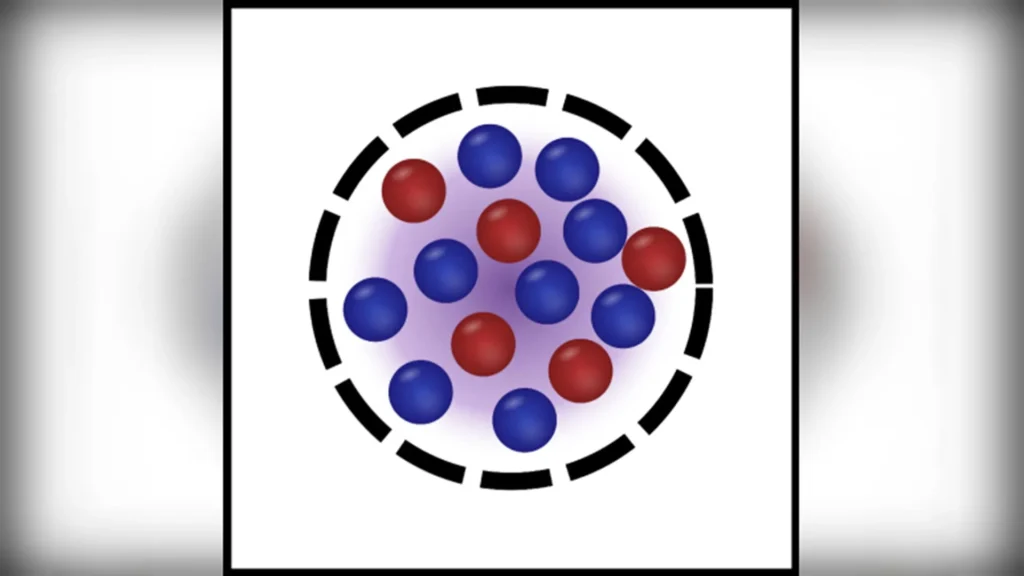
A team of theoretical physicists at Monash University has predicted the existence of a new, stable form of quantum matter that defies long-standing expectations regarding the behavior of ultracold particles. Led by PhD candidate Sam Foster, alongside Associate Professor Jesper Levinsen and Professor Meera Parish from the Monash School of Physics and Astronomy, the research details how two fundamentally distinct categories of subatomic particles—bosons and fermions—can coalesce into self-bound "quantum droplets." This discovery, published in the prestigious journal Physical Review Letters, provides a sophisticated theoretical framework that could fundamentally alter the landscape of quantum chemistry and the development of next-generation quantum technologies.
For decades, the scientific community operated under the assumption that mixtures of bosons and fermions would be inherently unstable under conditions of strong interaction, likely resulting in either a total collapse of the system or a phase separation where the two types of matter refuse to occupy the same space. However, the Monash team’s calculations, performed in collaboration with researchers at Heidelberg University, suggest that a precise balance of quantum forces allows these particles to form a liquid-like state that maintains its own structural integrity without the need for external confinement.
The Fundamental Divide: Bosons vs. Fermions
To understand the magnitude of this prediction, one must first consider the two distinct "families" of particles that make up the universe. In the realm of quantum mechanics, all particles are classified based on their spin, which dictates how they organize themselves in groups.
Bosons, named after the Indian physicist Satyendra Nath Bose, are often described as "social" particles. They have integer spin and are capable of occupying the exact same quantum state simultaneously. This unique characteristic is what allows for the creation of Bose-Einstein Condensates (BECs), a state of matter where thousands of atoms act as a single "super-atom" at temperatures near absolute zero. Photons and gluons are common examples of bosons.
Fermions, named after Enrico Fermi, follow the Pauli Exclusion Principle. These particles, which include electrons, protons, and neutrons, have half-integer spin and are "antisocial" by nature; no two fermions can occupy the same quantum state at the same time. This principle is what prevents matter from collapsing into itself and explains the structure of the periodic table.
Traditionally, these two groups are studied in isolation or in systems where one dominates the other. The Monash study focuses on the "resonant" interaction between them—a state where the attractive force between a boson and a fermion is tuned to be exceptionally strong. The researchers discovered that the repulsive pressure generated by the fermions (due to the Pauli Exclusion Principle) can perfectly counteract the attractive force pulling the particles together, resulting in a stable, self-contained droplet.
A Chronology of Quantum State Discoveries
The prediction of Bose-Fermi quantum droplets represents the latest milestone in a century-long timeline of quantum discovery.
In 1924, Albert Einstein and Satyendra Nath Bose first predicted the Bose-Einstein Condensate, though it took until 1995 for technology to catch up, allowing Eric Cornell and Carl Wieman to produce the first BEC using rubidium atoms. This achievement opened the floodgates for ultracold atom research.
By the early 2000s, researchers had successfully created degenerate Fermi gases, cooling fermions to the point where quantum effects dominate their behavior. Following this, the focus shifted to "Bose-Fermi mixtures," but these were primarily explored in the "weakly interacting" regime, where the particles barely influenced one another.
A major turning point occurred in 2016 and 2017, when experimental groups at the Institute of Photonic Sciences (ICFO) in Spain and the University of Stuttgart in Germany observed the first "purely bosonic" quantum droplets. These droplets were held together by quantum fluctuations—small, temporary changes in energy in a point in space—rather than external containers.
The Monash University study, published in late 2023 and early 2024, marks the next logical but highly complex step: the integration of fermions into these droplet structures. By moving beyond the "weakly interacting" models that limited previous theories, Foster and his colleagues have mapped out the "strongly interacting" or "resonant" regime, where the most transformative physics is thought to occur.
Supporting Data and the Physics of Stability
The stability of the predicted Bose-Fermi droplets relies on a delicate interplay of energy scales. In a standard liquid, like a drop of water, the liquid is held together by surface tension and intermolecular forces. In a quantum droplet, the "surface tension" is replaced by a balance of quantum mechanical pressures.
According to the research data, the "self-bound" nature of these droplets is achieved when the interaction between the bosons and fermions is tuned near a Feshbach resonance. A Feshbach resonance is a tool used by experimentalists to control the strength of interactions between atoms using an external magnetic field.
The Monash team used advanced mathematical modeling to show that as the attractive interaction increases, the fermions provide a "degeneracy pressure." Because fermions cannot occupy the same state, they effectively push back against the attraction of the bosons. The data suggests that this pressure is sufficient to stop the droplet from collapsing into a dense singularity, while the attractive force is strong enough to keep the particles from evaporating into a gas.
Furthermore, the team identified signs of a "liquid-to-gas" phase transition. Their calculations indicate that by varying the ratio of bosons to fermions or adjusting the interaction strength, the system can be made to shift between a dilute gas and a dense, self-bound liquid. This suggests that the phase diagram for Bose-Fermi mixtures is far more complex than previously mapped, containing multiple "quantum phases" that were hitherto unknown.
Official Responses and Scientific Significance
Lead author Sam Foster emphasized the transformative nature of the study, noting that the results provide a map for future laboratory exploration. "Quantum systems can behave in ways that seem impossible in our everyday world," Foster stated. "We’ve shown that these two very different types of particles can balance each other perfectly to create a stable droplet that effectively holds itself together."
Foster also highlighted the theoretical hurdles his team overcame. "Previous theories could only describe these systems when the particles interacted relatively weakly. Our new approach lets us explore what happens when those interactions become much stronger, which is where the most interesting physics emerges."
Associate Professor Jesper Levinsen and Professor Meera Parish, who co-authored the study, noted that the findings are not merely academic. The ability to create stable, self-bound quantum matter provides a "clean" environment for studying complex many-body physics. Because these droplets do not require the magnetic or optical traps usually used to hold ultracold atoms, they allow for the study of quantum matter in its most "natural" state, free from the distortions of external fields.
Collaborators from Heidelberg University added that the findings align with the capabilities of current experimental setups. This means that laboratories in Australia, Europe, and the United States may soon be able to verify these predictions using existing ultracold atom technologies, such as laser cooling and magnetic trapping.
Broader Impact and Emerging Technologies
The implications of the Monash University discovery extend far beyond the niche of atomic physics. The mastery of quantum droplets could lead to significant advancements in several high-tech sectors:
1. Quantum Computing and Simulation
One of the primary challenges in quantum computing is the stability of quantum states. Understanding how different types of particles organize themselves into stable "phases" provides a blueprint for designing more robust quantum bits (qubits). Furthermore, these droplets can serve as "quantum simulators," allowing scientists to model other complex systems, such as the dense matter found in neutron stars, which are also composed of mixtures of different types of particles under extreme pressure.
2. Ultra-Precise Sensors
Because quantum droplets are self-bound and highly sensitive to their environment, they could be utilized in the development of next-generation sensors. These sensors could measure gravitational anomalies, magnetic fields, or inertial changes with a level of precision that far exceeds current mechanical or electronic devices. This has potential applications in deep-space navigation, mineral exploration, and fundamental tests of general relativity.
3. Material Science
The study of "strong interactions" in quantum mixtures provides insights into how new materials might be engineered at the atomic level. By understanding the forces that stabilize Bose-Fermi droplets, researchers may be able to develop materials with "tailored" properties, such as high-temperature superconductivity or unique magnetic characteristics, which are essential for more efficient energy grids and advanced electronics.
Conclusion
The prediction of Bose-Fermi quantum droplets by Monash University researchers represents a significant shift in our understanding of the subatomic world. By proving that bosons and fermions can coexist in a stable, self-bound liquid state, the team has challenged the boundaries of quantum stability and opened a new frontier for experimental physics.
As laboratories around the world begin to test these theoretical models, the results may well provide the foundation for the next generation of quantum innovation. The transition from theoretical prediction to experimental reality will be the next major hurdle, but the Monash team’s work has provided the necessary roadmap for this journey into the heart of quantum matter. While the research remains grounded in the fundamental laws of physics, its eventual legacy may be found in the technologies that define the 21st century.